


NBS Bangla — 24 November 2026, 6:39 PM
BRAC-BIGD study urges livelihood, safety considerations in battery-rickshaw regulation
A new study by BRAC and the BRAC Institute of Governance and Development calls for policies on battery-powered rickshaws that address road safety and environmental risks while protecting…
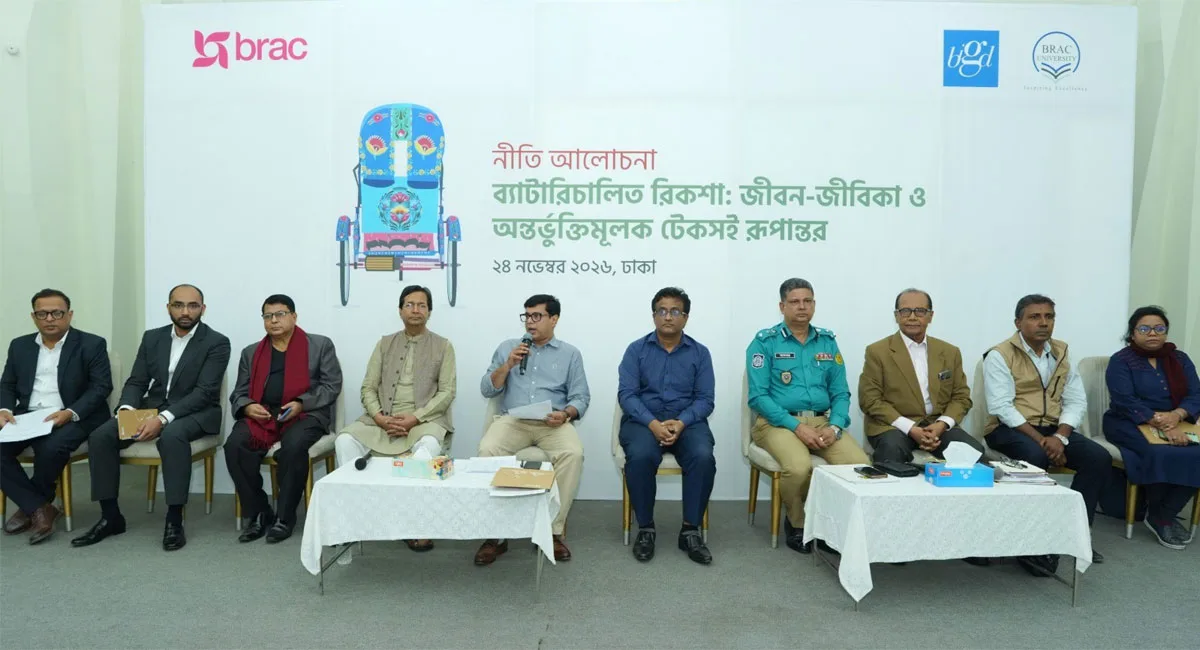
A new study by BRAC and the BRAC Institute of Governance and Development calls for policies on battery-powered rickshaws that address road safety and environmental risks while protecting the livelihoods of drivers, owners and garage operators who depend on the sector.
The findings were presented at a policy dialogue titled "Battery-run Rickshaws: Livelihoods and Inclusive Sustainable Transition," held Tuesday, Nov. 24, at the CIRDAP Auditorium in the capital. The study, "Understanding the Political Ecology of Battery Rickshaws in Bangladesh," was accompanied by a policy brief and panel discussions on next steps.
Md Abdus Salam, administrator of Dhaka South City Corporation, said urban problems such as traffic congestion, air pollution, waterlogging, mosquitoes and waste management are interconnected, and addressing one while ignoring others will not produce sustainable solutions. He said residents have the right to move freely and rickshaw drivers have the right to earn a living, but that providing adequate civic services becomes harder as more people migrate to Dhaka.
He called for an integrated plan that considers the city's capacity and involves all stakeholders.
Md Safiqul Islam Khan Milton, administrator of Dhaka North City Corporation, said authorities are not against auto-rickshaws or their drivers and that the right to earn a livelihood must be protected. Bringing the sector under a regulatory framework would establish accountability and allow better support, he said, adding that initiatives have begun to bring the unregulated sector into a formal legal framework even though not all challenges can be resolved overnight.
Asif Saleh, executive director of BRAC, said the voices of informal-sector workers rarely reach policymakers and that safety, road management and regulation must be addressed with drivers' realities in mind. He called on stakeholders to develop a three-to-four-year transition plan that allows gradual change while minimizing the impact on drivers and their families.
Saleh said informal workers, including rickshaw drivers and street hawkers, effectively pay an invisible tax every day — money that does not go to the state treasury but to various vested interest groups. Without legal recognition, he said, these workers face repeated fines, extortion and informal payments without recognition or protection. The study found that 96% of battery-run rickshaw drivers do not have a licence or permit, while two-thirds have experienced fines or harassment at some point, he said.
Citing BIGD research, Saleh said 78% of battery-run rickshaw drivers in Dhaka had migrated from other districts, with 84% citing a lack of employment opportunities in rural areas. People will keep moving to cities as long as rural areas lack adequate jobs and farmers do not receive fair prices for their produce, he said, warning that an abrupt ban couldpush hundreds of thousands of families into greater uncertainty.
Saleh said the country is going through a difficult economic period with limited opportunities for new employment, and battery-powered rickshaws serve as a last resort for many families. He said the response cannot fall to a single ministry and that the ministries responsible for road transport, local government, power, environment, labour and agriculture must work together through a whole-of-government approach.
Dr Imran Matin, executive director of BIGD, said rickshaw drivers depend on highly vulnerable livelihoods in which a single accident or instance of harassment could push them back into poverty. Pedestrians and battery-rickshaw drivers are both citizens, he said, and any transition must be designed to be fair and straightforward.
Nafiul Hasan, director of advocacy and regulatory affairs at BRAC, highlighted policy considerations and conditions on the ground and moderated a panel discussion in the event's second session. Panellists included Md. Shamsul Hoque, former director of the Accident Research Institute at the Bangladesh University of Engineering and Technology; Sajjad Sharif, executive editor of Prothom Alo; Dr Akter Mahmud, professor in the Department of Urban and Regional Planning at Jahangirnagar University; Ahmed Najmul Hussain, director of administration and road safety programme at BRAC; Md Asfikuzzaman Akter, joint commissioner of Dhaka Metropolitan Police; Mohammad Shafioul Alam, joint secretary in the Local Government Division; Faraaz Rahim, executive director of Rahimafrooz Batteries Limited; Shahin Akhter, journalist at New Age; and Khalequzzaman Lipon, convener of the Rickshaw, Battery-run Rickshaw, Easy Bike Sangram Parishad.
The event opened with welcome remarks from Shashwatee Biplob, director of BRAC's Gender Justice and Diversity and Legal Protection and Social Empowerment programmes. Mehnaz Rabbani, operations director of BIGD, presented the research findings. Senior officials from the two city corporations, representatives of the Local Government Division, development practitioners, researchers, engineers, civil society representatives, organizations representing battery-powered rickshaw drivers and relevant experts also attended.
The study surveyed 450 active battery-powered rickshaw drivers — 300 in Dhaka and 150 in Barishal — alongside an assessment of relevant stakeholders' experiences. Survey data were collected between June 11 and July 30, 2026.
According to a summary of the findings, 95.6% of surveyed drivers did not have a licence or permit. About 78.2% rented the rickshaws they operated, spending an average of 38.6% of their income on rental payments. If their earnings stopped, 62.9% would be unable to support their families for even a week. Additionally, 26.7% of drivers had experienced at least one road accident in the month before the survey.
The research highlighted the role of garages in the battery-powered rickshaw ecosystem. Drivers depend on garages for vehicle rentals, charging, battery replacement, repairs, financial assistance and support in situations involving accidents or fines. But the system is also associated with unregulated electricity consumption and the operation of garages on public land, while informal production and recycling of conventional lead-acid batteries pose risks to the environment and public health.
The study noted that the "Three-wheeled Low-speed Battery-powered Rickshaw (E-rickshaw) Operation Rules," formulated by the Local Government Division in 2026, represent an important step toward recognizing the sector and bringing it under an organized regulatory framework. Effective implementation will be the key challenge, it said, and the livelihoods of people associated with the sector must be taken into account alongside road safety, environmental risks and regulatory mechanisms.
Among the study's key recommendations are developing a realistic, phased roadmap for formalizing the sector that considers government institutions' implementation capacity and stakeholders' ability to comply. It also recommends immediately establishing minimum vehicle safety standards, designated operating zones and clear guidelines for road use. Costs for vehicle conversion or replacement, battery upgrades, charging, insurance and licensing should remain affordable for drivers and owners so they are not pushed out of their livelihoods and passenger fares do not rise significantly.
Existing garages and service networks should be integrated into the new system through support and incentives rather than excluded.
The study further emphasized promoting environmentally friendly charging systems and establishing effective mechanisms for collecting, safely disposing of and recycling used batteries. It concluded that no single regulatory measure would be sufficient, and that responsibilities and coordination among government institutions must be clearly defined, regulations enforced consistently and equitably, and stakeholders involved in decision-making and implementation.

Sub Editor, NBS Bangla
Related News
Bangladesh information chief calls right to information a fundamental human right
Chief Information Commissioner Nahreen Islam Khan said Wednesday that every citizen has the right to know abo…
Bangladesh youth urge swift rules under amended tobacco control law
DHAKA — More than 100 university students from across Bangladesh called Wednesday for the swift formulation o…

Bangladesh Information Commission Settles 28 Complaints in Five Days
Bangladesh's Information Commission settled 28 complaints in five days, including eight resolved at hearings …
Information Commission Resolves 20 of 25 Complaints in Four Days
The newly reconstituted Information Commission has resolved 20 of 25 complaints during hearings held over fou…
Education and employment opportunities declining for young people in Rohingya camps amid prolonged crisis
Livelihoods of young people in host communities also adversely affected