




Thunder in the Skies: Su-35 Flanker vs F-16 Fighting Falcon over Ukraine in 2026
NBS News Desk | প্রকাশিত: ০৭ জুন, ২০২৬, ০৬:৩৩ পিএম
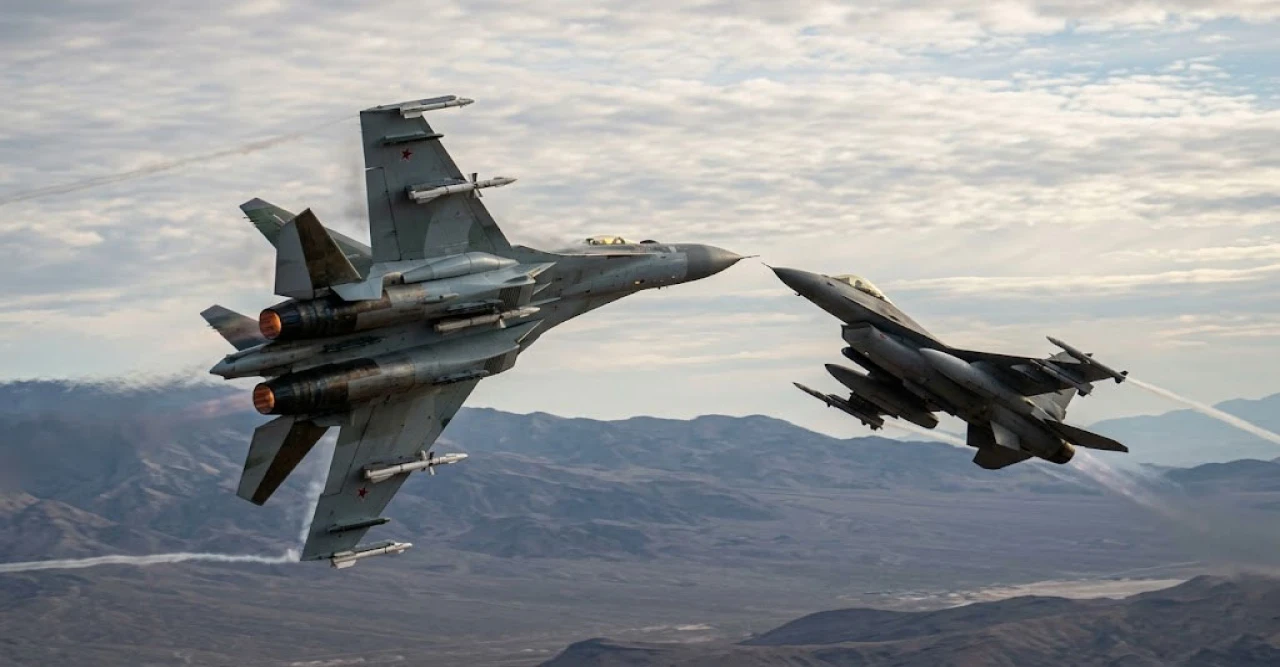
The air war in Eastern Europe has reached a critical, highly anticipated turning point. For the first time in modern military history, two legendary philosophies of fighter design are directly clashing in a high-stakes war of attrition. The Su-35 Flanker vs F-16 Fighting Falcon over Ukraine showdown is no longer a theoretical debate for aviation forums—it is a daily reality shaping the frontlines in 2026.
The Russian Heavyweight: Su-35 Flanker Advantages
The Russian Aerospace Forces (VKS) rely heavily on the Sukhoi Su-35S, a "Generation 4++" twin-engine heavyweight fighter designed specifically to hunt and destroy Western aircraft.
Unmatched Kinematics and Thrust Vectoring
The Su-35 is powered by two AL-41F1S engines equipped with thrust-vectoring nozzles. This allows the pilot to direct engine exhaust independently of the aircraft's direction of flight, enabling "super-maneuverability." In a close-range dogfight, the Flanker can perform physics-defying maneuvers that can easily break an enemy radar lock.
The Irbis-E Radar and BVR Lethality
For long-range engagements, the Su-35 relies on the N035 Irbis-E passive electronically scanned array (PESA) radar. This system pumps out massive amounts of power, allowing it to track standard aerial targets at ranges exceeding 200 miles.
-
High-Power Tracking: The Irbis-E detects traditional targets well before they enter visual range.
-
Hypersonic Arsenal: It seamlessly pairs with the R-37M and R-77M Beyond Visual Range (BVR) missiles.
-
Airspace Suppression: Operating from high altitudes, Russian pilots use these weapons to suppress Ukrainian airspace from deep within friendly territory.
The Western Challenger: F-16 Fighting Falcon Advantages
In contrast to Russia's heavyweight approach, the Ukrainian Air Force operates Western-supplied F-16 Mid-Life Update (MLU) variants. While smaller and lighter, the F-16 brings an entirely different brand of lethality to the theater.
The Power of Link 16 and Battlefield Networking
The single greatest advantage of the F-16 is not its airframe, but its connectivity. Utilizing the NATO-standard Link 16 data-sharing network, the F-16 acts as a digital node on the battlefield.
Instead of searching for targets blindly with its own radar, a Ukrainian F-16 can receive real-time targeting data securely from ground-based air defenses, friendly electronic warfare units, and Western airborne early warning platforms. This allows the pilot to hunt with their onboard radar turned completely off, minimizing their electronic signature to avoid detection.
Western Avionics and AMRAAM Integration
The F-16's cockpit ergonomics and advanced avionics suites dramatically reduce pilot workload compared to Soviet-era jets. Its primary weapon for the Su-35 Flanker vs F-16 Fighting Falcon over Ukraine conflict is the AIM-120 AMRAAM (Advanced Medium-Range Air-to-Air Missile). The AMRAAM features a highly reliable active radar homing seeker, giving Ukrainian pilots a true "fire-and-forget" capability that allows them to fire and immediately dive for cover.
Head-to-Head: Technical Specifications Breakdown
To see how these two platforms stack up on paper, look at the fundamental design choices separating a heavyweight twin-engine interceptor from a lightweight multirole fighter:
-
Engine Configuration:
-
Sukhoi Su-35S: Twin-engine layout equipped with 3D thrust-vectoring nozzles for extreme agility.
-
F-16 Fighting Falcon: Single-engine configuration optimizing a high thrust-to-weight ratio.
-
-
Maximum Speed:
-
Sukhoi Su-35S: Reaches Mach 2.25 at high altitude.
-
F-16 Fighting Falcon: Reaches Mach 2.0 at high altitude.
-
-
Combat Radius:
-
Sukhoi Su-35S: Approximately 1,000 miles relying strictly on internal fuel.
-
F-16 Fighting Falcon: Approximately 340 miles with a standard, heavy combat loadout.
-
-
Primary Radar Systems:
-
Sukhoi Su-35S: Irbis-E PESA radar characterized by ultra-high power output.
-
F-16 Fighting Falcon: AN/APG-66(V)2 or upgraded Active Electronically Scanned Array (AESA) variants.
-
-
Key Long-Range Weapons:
-
Sukhoi Su-35S: Hypersonic R-37M and active-radar R-77M missiles.
-
F-16 Fighting Falcon: AIM-120C/D Advanced Medium-Range Air-to-Air Missiles (AMRAAM).
-
The Real-World Verdict: What Decides the Winner?
Military analysts know that paper specifications rarely survive contact with reality. The true outcome of the Su-35 Flanker vs F-16 Fighting Falcon over Ukraine aerial campaign is decided by a complex web of tactics, training, and external support.
The Low-Altitude Tactical Reality
Because Russia maintains a dense network of high-altitude S-400 surface-to-air missile systems, Ukrainian F-16 pilots have been forced to adopt a low-altitude flight strategy. Flying just feet above the tree line masks the F-16 from long-range radar clutter, but it comes with a severe physics penalty. Firing a missile from a low altitude against a high-flying Su-35 means the missile must fight gravity and thick air, drastically reducing its effective range.
AWACS and Electronic Warfare: The Invisible Hand
The fighter that wins is almost always the one that sees the enemy first. When Western Airborne Warning and Control System (AWACS) aircraft operate near the theater, they act as the F-16's eyes, extending its vision far beyond its own nose. Conversely, Russia's heavy investment in land-based and airborne electronic warfare (EW) continuously attempts to jam Western GPS guidance and radar systems, creating an invisible, chaotic digital environment.
The Pilot Factor: While Russian aviators have thousands of hours of collective flight time in the Su-35, Ukrainian pilots have undergone highly compressed Western training programs. Success relies heavily on how quickly these pilots transition from old Soviet doctrine to automated, network-centric Western air combat tactics.
Conclusion
The intense air battles involving the Su-35 Flanker vs F-16 Fighting Falcon over Ukraine highlight two fundamentally opposing military doctrines. The Su-35 is a kinematically superior, heavy air-superiority brute that thrives on pure power, massive radar range, and sheer missile speed. The F-16 is a nimble, highly integrated team player whose lethality multiplies when connected to a wider digital network.
Ultimately, this showdown is not just a duel between two airframes. It is a harsh test of whether Western data-sharing systems and smart tactics can overcome a physically larger, heavily armed, and deeply entrenched adversary in a highly contested airspace.