



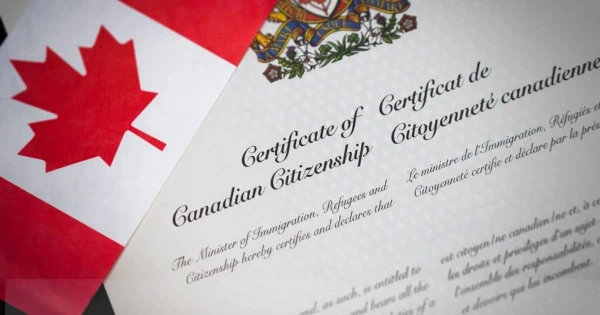
Canada's immigration department has sent letters to recent recipients of Canadian citizenship certificates, requesting the return of their documents for further review. The move has sparked confusion among applicants who had already received approval, some of whom had even obtained Canadian passports and Social Insurance Numbers. The letters, sent on June 13, inform recipients that their citizenship claims are now "under review" despite having been previously approved.
The directive applies to individuals who obtained citizenship through descent under Canada's expanded Citizenship Act. The letters cite subsection 26(1) of the Citizenship Regulations, which allows the Registrar of Canadian Citizenship to request surrender of a certificate when there is reason to believe the holder may not be entitled to it. This is not a revocation of citizenship but a re-examination of the application file.
The review process requires recipients to return their physical citizenship certificates while their files are reassessed. Recipients are allowed to submit additional documentary evidence to support their claims. If the department confirms the applicant's entitlement to citizenship, the certificate will be returned. The letters do not specify a timeline for the review, which experts say could take several months.

The department has identified two primary reasons for flagging these applications. First, some applicants submitted documents that did not originate from the appropriate source authority, such as civil registries or vital statistics offices. Second, when applicants could not obtain source documents, they failed to include a written explanation and proof of their efforts to secure the required records.
According to immigration experts, the core issue appears to be that applicants did not adequately prove an unbroken lineage from a Canadian citizen to themselves. Many applicants used printouts from genealogy websites like Ancestry or FamilySearch as their primary proof. While these platforms are useful research tools, they are not considered authoritative source documents by immigration officials.
Some applicants submitted certified records obtained from archives rather than vital statistics offices, raising questions about whether archives qualify as source authorities. Others faced genuine gaps in documentation, such as when no birth record exists for an ancestor born in the 1850s. However, these applicants failed to formally document the gap to immigration officials.
Individuals who have received a surrender letter can still submit further documentary evidence to support their application. The letter explicitly outlines the factors that raised an officer's suspicions, allowing applicants to address specific concerns. Applicants can strengthen their case by obtaining documents directly from source authorities and providing certified copies.
For each person in the line of descent, at least one authoritative record should prove the link to the next generation. Birth certificates are considered the strongest documents in this regard, while marriage certificates can bridge gaps when surnames change. Missing even one crucial document can stall or sink an application.
A certified copy is one that the issuing authority stamps or seals as a true copy of what it holds. Canada has no single national vital records office, so applicants typically order these from regional offices that vary by province and state. While obtaining certified copies is slower than downloading a scan, it significantly strengthens an application.
When records do not exist, applicants can request a "letter of no record" from the relevant vital statistics office. This formal statement confirms that the record does not exist in its files. Similarly, IRCC can issue a "no record letter" for its own records, confirming that the official authority cannot find the needed document.
Pairing a no-record letter with alternative evidence and a short written explanation can help document gaps in an application. Immigration officials are more likely to accept such documentation when it clearly demonstrates the applicant's efforts to obtain the required records. Professional help from an immigration lawyer familiar with the Bill C-3 framework can also be valuable in assembling a robust file.
The review process has highlighted the importance of proper documentation in citizenship applications. Applicants are being told to prove their claims more rigorously than they initially did. While the letters may cause concern, they do not necessarily mean that the recipients are not Canadian citizens, but rather that they need to provide stronger evidence.