



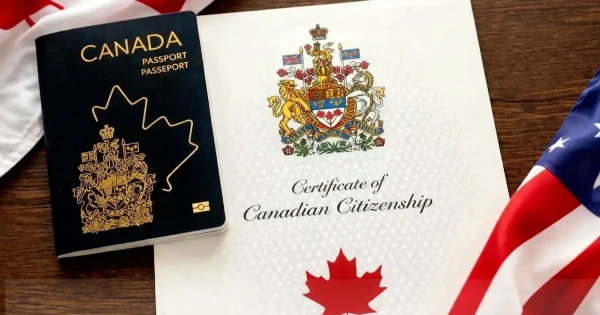
Hundreds of people who recently received Canadian citizenship certificates under a landmark new law are now being asked to return those documents, as federal immigration officials re-examine whether applicants submitted adequate proof of their family connections to Canada.
Immigration, Refugees and Citizenship Canada sent formal review notices on June 13, informing some recipients that their files suggest they "may not be entitled" to hold a citizenship certificate. The letters ordered recipients to surrender their paper documents while their cases are reassessed.
The development has caught many new citizens off guard, coming weeks or months after they had already been recognized as Canadian under the country's expanded citizenship rules.

The reviews involve people who obtained citizenship under Bill C-3, a law that took effect in December 2025. The legislation permanently removed the so-called "first-generation limit," which had since 2009 prevented Canadians born abroad from passing citizenship to their own foreign-born children and grandchildren.
The law retroactively granted citizenship to people who had been previously excluded, allowing descendants of Canadian citizens across multiple generations to claim recognition. Following its passage, the government filing fee for a citizenship certificate was set at CAD $75 per person, and IRCC received a surge of applications, with many cases requiring paper submissions due to the complexity of multigenerational family histories.
Despite the scale and enthusiasm of the response, the government is now scrutinizing a portion of those approved applications. Officials have clarified that the review process does not constitute a formal revocation of citizenship, but is instead a re-examination of whether specific applications contain sufficient documentation. Applicants are being given the opportunity to provide additional evidence before any final decision is made.
According to the review letters, applications were flagged for two primary reasons. In some cases, supporting documents were not obtained directly from official government record-holding authorities. In others, applicants failed to explain why official records could not be located or accessed.
A key concern appears to be whether applicants adequately demonstrated an unbroken chain of descent from a Canadian citizen using records deemed acceptable by IRCC. Some applicants reportedly relied on genealogy platforms and family history websites, while others submitted archival materials rather than records issued by provincial vital statistics offices or civil registries.
When official records are unavailable, IRCC guidance recommends that applicants provide a written explanation along with documentation — such as formal "no record" letters — showing that genuine efforts were made to obtain the records through proper channels.
Only paper citizenship certificates must be surrendered during the review period. Electronic certificates are not affected and do not need to be returned.
The notices have introduced serious disruption for individuals who had already begun making concrete life decisions based on their newly recognized citizenship status. One woman from the state of Maine had listed her home for sale and was preparing to relocate to Canada after receiving her certificate earlier this year. She described the notice as arriving without any prior warning, leaving her with little time to gather the additional documentation now being requested.
Processing times for citizenship certificate applications currently run between 12 and 18 months from the date IRCC confirms receipt of a complete application. For those now caught in a review, that timeline may effectively restart if additional documentation is required, adding further uncertainty to an already complex process.
Immigration lawyers have described the suspension of certificates that have already been issued as highly unusual, particularly given the apparent scale of those affected. The exact number of people who received review notices has not been publicly disclosed by the government.
Applicants who receive a review notice retain the right to submit additional supporting evidence. Those navigating the process are generally advised to obtain records directly from the agencies that originally created them, such as vital statistics offices or civil registries. Where records genuinely cannot be located, providing a documented paper trail of the search effort is considered essential.
Bill C-3 was introduced partly in response to a constitutional challenge in which an Ontario court found the original first-generation limit to be unconstitutional. The law was designed to correct longstanding injustices experienced by so-called "Lost Canadians" — people who lost or were denied citizenship due to outdated provisions in Canadian law.
The demand triggered by the legislation has been substantial. IRCC previously confirmed it received more than 12,000 proof-of-citizenship applications in the weeks immediately following the law's implementation.
Experts note that complex genealogical chains benefit significantly from professional oversight, and that a single missing document can restart the entire application clock — making thorough preparation critical before submitting any citizenship claim.
For many people abroad hoping to secure a Canadian passport through family heritage, the new law has created a genuine and meaningful pathway. However, the current reviews are a stark reminder that eligibility alone is not sufficient — documentation must be thorough, traceable, and obtained from recognized official sources.