


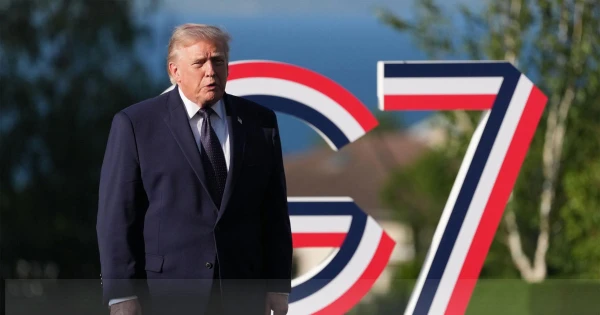
World leaders gathered at the G7 summit in France are employing a combination of strategic flattery and careful diplomacy to engage with President Donald Trump. The leaders are reportedly using personalized gestures, including a customized soccer jersey and a visit to the Palace of Versailles, to maintain positive relations with the U.S. president. These efforts reflect the delicate diplomatic balancing act required to manage Trump's unpredictable approach to international relations.
The summit, which is being held in France, has seen leaders adopting various strategies to ensure productive discussions with the American president. Some leaders are testing whether diplomatic alternatives to flattery can yield the desired results in negotiations. The approach to Trump at the summit is a mix of traditional diplomatic courtesies and calculated gestures designed to maintain engagement.
The U.S. president has been described as a "mercurial" figure in diplomatic circles, requiring unique handling by his international counterparts. The gifts and gestures are seen as part of a broader strategy to keep Trump engaged in discussions on key global issues. The leaders are navigating a complex diplomatic landscape where maintaining a positive relationship with the U.S. is crucial.
Trump’s UFC Birthday Bash Draws Public Backlash as New Poll Shows Voters Want Focus on Economy

France, as the host nation, has taken a lead role in orchestrating the diplomatic approach to Trump. The visit to the Palace of Versailles is among the planned activities, offering the president a taste of French grandeur. These efforts are part of a comprehensive plan to ensure the summit proceeds smoothly.
The G7 summit provides a platform for world leaders to address pressing global challenges, including trade, climate change, and geopolitical tensions. The leaders' approach to Trump reflects the importance of U.S. participation in these discussions. The balance between maintaining cordial relations and achieving substantive outcomes is a key theme of the summit.
Some leaders are exploring whether more direct approaches, rather than flattery, can be effective in dealing with Trump. These efforts are part of a broader re-evaluation of diplomatic strategies in the current geopolitical climate. The outcome of these approaches could shape future interactions between the U.S. and its allies.
The G7 summit is being held amid a complex international environment, with multiple challenges facing the global community. The leaders' diplomatic maneuvering around Trump is a notable aspect of the proceedings. The interaction between the U.S. president and his counterparts will be closely watched by observers.
The summit comes at a time of significant global uncertainty, with economic and security concerns top of the agenda. The leaders' ability to navigate these challenges effectively will depend on their diplomatic skills. The engagement with Trump is a key part of this effort.
The use of personalized gifts and gestures is a common diplomatic practice, but the approach to Trump has taken on additional significance. The leaders are carefully calibrating their interactions to maximize the chances of productive dialogue. The success of these efforts will be assessed in the coming days.
The G7 summit continues to be a critical forum for international cooperation, with the U.S. playing a central role. The leaders' strategies to engage with Trump reflect the broader challenges of managing relationships in today's geopolitical landscape. The summit's outcomes will have implications for global stability.