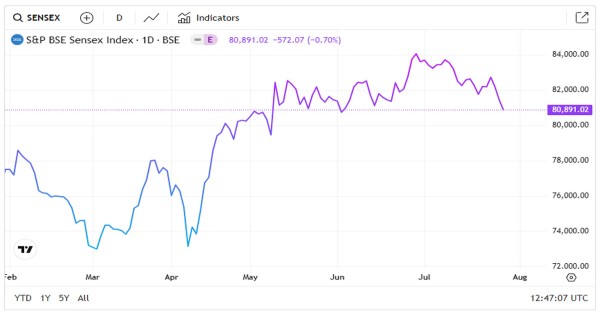
Indian stock markets closed lower on July 28, 2025, as fears of U.S. tariffs and weak corporate earnings weighed on investor confidence. The S&P BSE Sensex dropped 0.7% to 80,891, and the NSE Nifty 50 fell 0.6% to 24,680.
The decline marked the lowest levels for both indices since June 2025. Uncertainty over U.S.-India trade talks, with potential 26% tariffs looming, spooked investors. This followed reports of stalled negotiations, as noted by Reuters and Bloomberg.
Banking stocks faced heavy selling pressure. Kotak Mahindra Bank plunged 7.3% after reporting a 47.5% year-on-year drop in Q1 FY26 net profit to ₹3,282 crore. Higher provisions for bad loans hurt its performance, per The Hindu BusinessLine.
The technology sector also struggled. Tata Consultancy Services (TCS) fell 1.7% after announcing a 2% workforce reduction, impacting about 12,000 jobs. The Nifty IT index dropped 1.6%, reflecting weak demand, according to Times of India.
Auto sector stocks saw mixed results. Tata Motors gained 1.4%, supported by strong festive season demand, but others like Mahindra & Mahindra dipped slightly. The auto index fell 0.8%, impacted by global supply chain concerns, per Economic Times.
Foreign institutional investors (FIIs) sold equities worth ₹3,694 crore on July 24, adding to market pressure. This was the highest daily outflow since February, driven by trade uncertainties and global market weakness, as reported by Reuters.
Global cues also played a role. Japan’s Nikkei and South Korea’s Kospi closed lower, while Brent crude oil prices rose 0.9% to $70.16 per barrel, raising inflation fears for oil-importing India, according to The Hindu BusinessLine.
Other major Sensex losers included HDFC Bank, down 1.3%, and Axis Bank, which fell 5.2% after reporting a 3% profit drop. Weak asset quality in banking stocks dampened investor sentiment, per Times of India.
Despite the downturn, some stocks performed well. Shriram Finance rose 1.9%, and Cipla gained 2.6% after strong Q1 results. These gains offered limited support to the broader market, according to CNBCTV18.
The Nifty Bank index fell 1.3% to 56,084, reflecting weakness in private lenders. Analysts noted that banking stocks faced pressure from rising non-performing assets and cautious lending practices, as per Bloomberg Quint.
Market breadth was negative, with 1,134 stocks declining versus 1,928 advancing on the BSE. Small-cap and mid-cap indices also slipped, down 0.4% and 0.1%, respectively, signaling broad-based selling, per Economic Times.
Analysts expect market consolidation to continue. Dr. VK Vijayakumar from Geojit Investments noted that trade deal uncertainties and weak Q1 earnings could keep markets volatile in the near term, as cited by Times of India.
The Sensex has declined 3.25% over the past month, underperforming compared to its all-time high of 85,978 in September 2024. Year-on-year, it’s down 0.57%, per Trading Economics data.
Global trade tensions, particularly U.S. tariff threats, remain a key concern. Nomura highlighted that India faces exposure to a potential 6.5% reciprocal tariff, impacting sectors like IT and pharmaceuticals, as reported by Business Today.
Looking ahead, markets may stay cautious until clarity emerges on U.S.-India trade talks and upcoming Q1 earnings from companies like IndusInd Bank and Adani Green Energy, according to CNBCTV18.
Despite the challenges, some analysts remain optimistic. Vivek Subramanyam from TH Global Capital predicts a 9-10% market gain in the next six months if trade tensions ease, as noted by CNBC.