



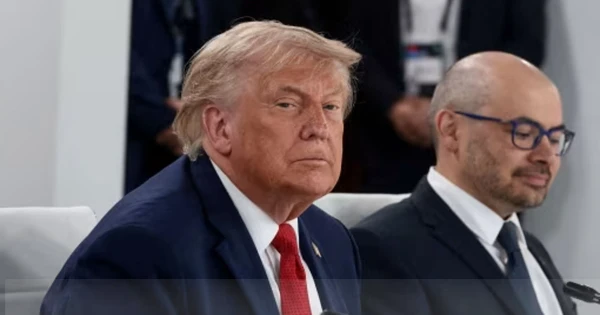
At the Group of Seven summit in Évian-les-Bains, France, President Donald Trump said negotiations with Anthropic over restoring access to the company’s latest artificial intelligence models are continuing and “going fine.” His remarks followed a working lunch that brought together G-7 leaders and top AI executives as nations discussed the global importance of advanced AI tools.
The talks between the United States and Anthropic began nearly a week earlier after the company restricted access to its most capable models for certain international users. President Trump and U.S. Commerce Secretary Howard Lutnick told reporters that discussions with Anthropic representatives, including the company’s co-founder Dario Amodei, remain active and constructive as both sides seek a resolution.
World leaders at the summit expressed concern about the prospect of limited access to leading U.S.-developed AI systems, which many governments and companies rely on for research, business, and public services. Delegations raised practical questions about continuity of service, regulatory alignment, and the potential economic impact if access to high-performing models becomes uneven across countries.

The presence of senior AI executives at the G-7 meeting reflected the technology’s rising geopolitical significance. Officials said they welcomed direct engagement with companies to better understand technical constraints, safety measures, and the steps needed to maintain international availability while addressing legitimate national security and export-control concerns.
President Trump framed the discussions as evidence of the strong momentum behind AI investment in the United States, saying the broader AI session at the summit had been productive. Administration officials emphasized that continued private-sector innovation, paired with clear government policies, is key to maintaining the U.S. lead in critical AI capabilities while managing risks.
Anthropic, founded by former AI researchers, has developed language and reasoning models that are widely used across industries. When access to its most advanced models was narrowed for some foreign users, customers and policymakers raised alarm about potential disruptions to services that depend on those capabilities. Governments noted the need for predictable access while considering rules that protect sensitive technology.
U.S. trade and technology policy officials are balancing competing priorities: enabling commercial access to powerful AI tools, enforcing export controls to protect national security, and coordinating standards with allies. The negotiations reported at Évian indicate ongoing efforts to reconcile those aims through direct dialogue with AI vendors rather than through abrupt restrictions.
European and other allied leaders urged clearer frameworks that would prevent sudden cutoffs while ensuring safety. They stressed the importance of cooperation on responsible deployment, certification processes, and shared guardrails that allow trusted international partners to access advanced models under agreed conditions.
Industry participants at the summit highlighted technical solutions that could support broader access without raising security risks. Options discussed included localized deployment, tailored API controls, certified partner programs, and enhanced transparency about model capabilities and safeguards. Such measures could allow governments and businesses to keep essential services running while reducing the chance of misuse.
Observers noted that the Anthropic-U.S. discussions are part of a larger pattern in which countries, companies, and multilateral bodies are negotiating how to manage AI’s rapid development. The G-7 gathering provided a venue for aligning approaches, sharing risk-assessment practices, and exploring trade and regulatory tools that could balance innovation with safety.
Officials left the meeting underscoring the value of continued, practical talks between governments and AI developers. The negotiations with Anthropic are expected to proceed in coming days, with participants aiming for agreements that preserve international access to advanced AI capabilities while satisfying legitimate security and compliance requirements.
As talks continue, businesses and public-sector users of advanced AI models will be watching for clarity on access terms, timelines for restored services, and any new conditions tied to international use. Governments involved in the G-7 discussions signaled a shared interest in predictable, rules-based access to critical AI technologies, coupled with mechanisms to address risks and ensure responsible deployment.