



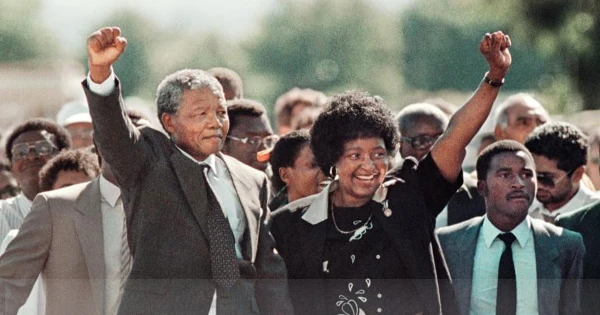
A major new exhibition at the African American Museum Dallas traces Nelson Mandela’s long struggle against apartheid and his later work to heal a divided nation. The exhibit presents Mandela’s life through photographs, artifacts and interactive displays that place visitors inside the historical, political and human realities behind his leadership.
“Mandela: The Official Exhibition” guides guests chronologically through Mandela’s early activism, his years in prison and his role in South Africa’s transition to democracy. The presentation emphasizes Mandela’s commitment to nonviolent protest and his belief in dignity and equality for all, while also conveying the harsh realities of the apartheid system that he fought against.
Exhibit organizers have curated a wide range of visual and material items to tell Mandela’s story. Photographs document key moments in his public life; personal items and archival objects connect visitors to the daily and political struggles he endured; and multimedia stations create immersive experiences that explain the historical context and legal frameworks of apartheid. Interactive features let visitors explore documents and timelines at their own pace, deepening understanding of how sustained civic action and legal pressure intersected with grassroots resistance.

Curators at the museum say the exhibit deliberately makes links between South Africa’s apartheid and the history of racial segregation in the United States. Displays and commentary illustrate how apartheid drew on systems of racial control already developed elsewhere, and they highlight both local and global patterns of oppression and resistance. Museum leadership frames Mandela’s story as part of an international struggle for civil rights and human dignity.
Educational components within the exhibition explore the legal and social structures that upheld apartheid, the domestic and international movements that challenged it, and the political negotiations that led to South Africa’s first multiracial elections in 1994. Panels explain how Mandela’s legal training, activism in the African National Congress, and willingness to engage in both protest and negotiation helped shape a path toward democratic transition.
One focal point of the exhibit is Mandela’s imprisonment, which lasted 27 years and became an international symbol of the anti-apartheid cause. The museum presents documentation of the prison sentences, photographs from those decades, and contextual material about how incarceration affected Mandela’s personal life and political strategy. Curators point to his decision after release to prioritize reconciliation, national unity and institutional reform, rather than personal retribution.
Museum leaders emphasize Mandela’s conscious commitment to reconciliation as a central lesson of the show. After his release, Mandela led efforts to build inclusive institutions, promote human rights, and foster social healing across South Africa’s deep racial divides. The exhibition highlights how that approach informed government policy, public rhetoric and civic initiatives during the early years of South Africa’s democratic era.
Sports diplomacy also receives attention as a surprising but powerful element of Mandela’s legacy. The exhibition documents his support for sporting events and how national teams and international competitions were used to create shared symbols of identity and belonging. Panels show how Mandela leveraged sports to foster cross-community dialogue and build a sense of national pride that transcended racial lines.
Museum staff and leaders say the exhibit aims to inspire visitors with lessons of moral courage, strategic patience and the long-term possibilities of social change. Through carefully arranged materials and storytelling, the display invites reflection on leadership that combines principled resistance with an emphasis on institutional renewal and social inclusion.
To accommodate increased interest, the African American Museum Dallas has extended public hours while the exhibit is on view. The museum is open Tuesday through Saturday from 10 a.m. to 7 p.m., and admission is free for all visitors. Organizers hope that the timing of the exhibition—arriving as major international sporting events draw visitors to North Texas—will broaden its audience and reinforce Mandela’s global message of unity.
The exhibition is scheduled to run through November 1, providing several months for students, families, educators and visitors to engage with the material. Alongside the main displays, the museum plans supplementary programs, including talks, guided tours and educational workshops intended to connect Mandela’s history to present-day conversations about justice, democracy and civic responsibility.
By presenting a full arc of Mandela’s life—from early protest to long imprisonment and a leadership that sought reconciliation—the African American Museum Dallas offers a compact, accessible resource for understanding a pivotal global figure. The exhibit foregrounds both the cost of sustained resistance and the potential for institutions and citizens to rebuild more inclusive societies after prolonged conflict.
Mandela: The Official Exhibition runs through Nov. 1 at the African American Museum Dallas. The museum’s expanded hours are Tuesday–Saturday, 10 a.m.–7 p.m., and admission is free.