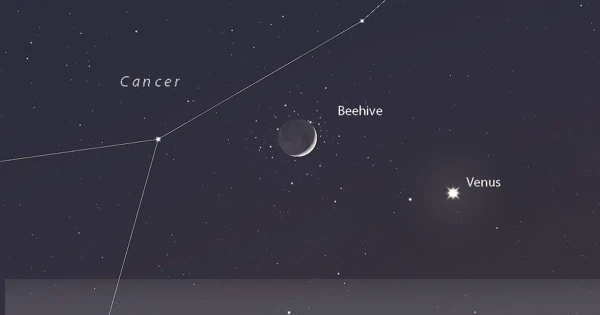
Skywatchers across North America will witness a remarkable celestial event on Wednesday, June 17, 2026, when the Moon passes directly in front of Venus, temporarily hiding the brilliant planet from view in broad daylight . This rare phenomenon, known as a lunar occultation, will be visible across the contiguous 48 states, much of Canada, and parts of northeastern South America .
What Makes This Event Special
The occultation occurs as a thin waxing crescent Moon, just 3.1 days old with only 11% illumination, slides before Venus . The event marks the first time such a daytime occultation has been visible from the United States since December 2015, making it a must-see opportunity for astronomy enthusiasts and casual observers alike . Venus, currently shining at magnitude -4.0, is the only planet bright enough to be visible during daylight hours under these conditions .
The Moon and Venus will sit approximately 38 degrees from the Sun, providing a safe viewing distance without the danger of solar glare . The planet will appear as a 74% waning gibbous disk, measuring 14.1 arcseconds across, though its brilliance comes from the thick cloud cover that reflects about 75% of sunlight, compared to the Moon's mere 12% reflectivity .

Viewing Times Across North America
The timing of the occultation varies significantly by location, with viewers needing to check specific schedules for their area .
On the East Coast, Venus will begin disappearing behind the Moon's dark leading edge around 3:49 p.m. EDT . For Chicago observers, the occultation starts at 2:24 p.m. local time, with the complete covering of the planet taking approximately 27 seconds . The planet will reappear about an hour later at 3:50 p.m. . West Coast viewers will see the event earlier, with Los Angeles experiencing the occultation beginning around 11:40 a.m. PDT .
The International Occultation Timing Association (IOTA) has published detailed timing information for various cities on their website, with times listed in Universal Time (UT) . Viewers should subtract 4 hours for Eastern Daylight Time, 5 for Central, 6 for Mountain, and 7 for Pacific to convert to local time .
How to Safely Observe the Occultation
Safety remains paramount when viewing this daytime event, as the Sun remains above the horizon during the occultation . Never point binoculars, telescopes, or any optical equipment toward the Sun, as this can cause permanent eye damage or blindness .
The safest viewing method involves finding a location where the Sun is physically blocked by a building, tree, or other structure . Standing in complete shade allows observers to search for the thin lunar crescent without risking accidental Sun exposure . Once the Moon is located, Venus will appear nearby as a bright white spark of light against the blue sky .
While Venus is technically visible to the naked eye with perfect vision and precise knowledge of its location, binoculars make the observation significantly easier . The crescent Moon serves as an excellent guidepost, and for an hour or two on either side of the occultation, both bodies will appear together in the same binocular field of view .
Photographing the Occultation
Astrophotographers seeking to capture the event's drama will need a small telescope magnifying at least 50 times to clearly show Venus's phase . The greatest magnification that sky conditions allow will enhance the scene's visual impact, showing the planet slowly disappearing behind the Moon's dark limb .
The reappearance of Venus from behind the Moon's bright limb creates a particularly dramatic moment, reminiscent of the iconic Earthrise photo captured by Apollo 8 astronaut Bill Anders in 1968 . This visual spectacle of one solar system body appearing to hover above another's limb offers a rare and unforgettable viewing experience.
Additional Evening Viewing Opportunities
Following the occultation, skywatchers can enjoy another celestial treat after sunset . The waxing crescent Moon will appear near Venus, Jupiter, and Mercury in the western sky, creating a beautiful planetary grouping . Additionally, the Moon will pass through the Beehive Cluster (M44) in the constellation Cancer, offering another impressive binocular target . Observers may also notice earthshine—sunlight reflected from Earth's oceans and clouds onto the Moon's dark side—which creates a striking three-dimensional appearance .
Looking Ahead
This occultation represents a relatively uncommon event, with the next visible Venus occultation from Los Angeles not occurring until October 2029 . For those unable to observe the daytime event, Griffith Observatory will record the phenomenon and make a replay available on their YouTube channel .
The June 17 occultation offers a rare chance to witness the dynamic nature of our solar system in broad daylight, demonstrating the Moon's swift motion across the sky as it passes in front of the brightest planet . With proper safety precautions and clear skies, this celestial performance promises to be a memorable experience for skywatchers across North America.