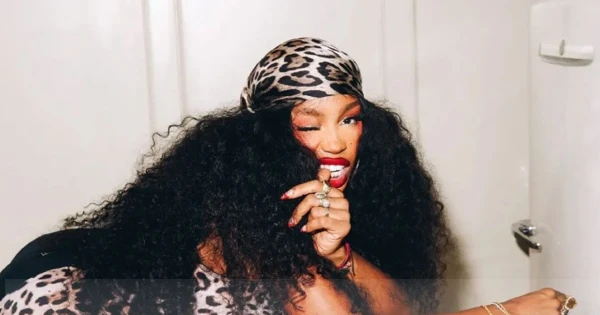
The Grammy-winning singer-songwriter SZA has launched an impassioned attack on artificial intelligence in the music industry, specifically targeting the generative AI platform Suno and producer Diplo, after discovering that hundreds of her songs, including unreleased material, have been used to train AI models.
The "Kill Bill" hitmaker took to her private Instagram account over the weekend to express her fury, claiming that a search of an AI music database revealed 238 of her songs had been incorporated into training datasets. She subsequently shared a screenshot of the findings on her main account, where she delivered a blunt message to musicians who support such practices.
"If your a musician and you support this degenerate sh*t? Your DISGUSTING and there's NOTHING YOU COULD EVER SAY TO ME TO MAKE THIS OKAY," SZA wrote. "I hope u have the life u deserve."

The controversy stems from the launch of an online search tool developed by The Atlantic's AI Watchdog, which allows artists to determine if their work appears in the massive datasets used to train music-generating AI systems. This database encompasses over 21 million songs, drawing from both international superstars and independent artists .
In a separate post from her private account, SZA leveled a specific allegation against producer Diplo, claiming he holds equity in Suno and is actively attempting to train the platform on the work of Black songwriters and producers. It remains unclear whether Diplo has a financial stake in Suno. However, he has previously invested in the AI research startup Aaru and has been a vocal advocate for the technology's integration into music production .
A Disproportionate Impact on Black Creativity
Central to SZA's argument is what she perceives as a disproportionate targeting of Black musical heritage by AI developers. She highlighted the striking disparity between the demographic representation of Black Americans and their outsized cultural influence.
"We make up 13% of the American population yet influence the world w our sound and perspective," she wrote on her private account. "I AINT HEARD A WHITE AI SONG YET... We have no protection in legislature medical or creative. The easiest to steal from. DO NOT GIVE AWAY YOUR VIBRANIUM!!! DO NOT TRAIN AI W YOUR GENIUS."
The singer's concerns echo previous statements she has made regarding the intersection of AI and racial justice. In a March interview with i-D Magazine, she pointed to what she sees as a troubling pattern within AI-generated music .
"It's happening disproportionately with Black music. Why am I hearing AI covers of Olivia Dean, when Olivia Dean just came the f**k out? She can't even collect the streams," SZA said. "I'm also really offended by the type of Black music that's coming out of AI. Weird, stereotypical struggle music" .
Industry Divide Over AI Adoption
SZA's outburst underscores a deepening divide within the music industry regarding the adoption of AI technology. While some artists and producers have embraced the tools, others have expressed vehement opposition.
Diplo, who has been a prominent advocate for AI integration, offered a starkly different perspective in an April interview. He declared that there is "no fighting AI" and stated that he no longer required human vocalists for his productions .
"The customer and accessibility is what's always going to be triumphant," Diplo said. "99% of people are going to wanna love the best product made the quickest, made the cheapest, that's what the American economy is" .
In a subsequent post on X, he told artists who resist the technology to "adapt or just like give up and become an uber driver" .
Producer Jack Antonoff has taken an equally forceful position on the opposing side, recently condemning those who make music with AI as "godless wh**es" and "bad actors." Meanwhile, industry heavyweights Will.i.am and Timbaland have reportedly invested in AI music companies, reflecting the complex and often contradictory responses to the technology .
Legal Battles and Industry Response
The conflict extends beyond social media rhetoric into active legal disputes. SZA's label, RCA Records, is owned by Sony Music, which is currently involved in litigation against both Suno and its competitor Udio . Warner Music Group and Universal Music Group have settled their own lawsuits against the platforms, a move that has prompted a separate lawsuit against the labels by the American Federation of Musicians .
In response to SZA's allegations, a Suno spokesperson declined to comment directly but pointed to a LinkedIn post from the company's chief product officer, Jack Brody. Brody stated that Suno's training metadata does not include artists' names and that the company's models are designed to prevent replication of material they were trained on. He also noted that Suno is working to improve impersonation detection .
"At Suno, preserving artistry and human creativity is just as important as product innovation itself," Brody wrote on LinkedIn. "Our philosophy has always been that AI should help people create new music, not replicate someone else's" .
Suno recently completed a $400 million investment round, with CEO Mikey Shulman stating that contributors included prominent figures from across the music industry, though the company has declined to identify them . The platform is currently testing a model backed by Warner Music Group.
A Call to Protect Creative Identity
SZA's protest represents a broader anxiety among musicians about the future of creative work in an age of generative AI. The singer has framed the issue as a battle not against fellow artists but against forces she believes devalue human expression.
"I'm not up against the pop girls, I'm not up against the R&B girls. I'm up against anti-intellectualism and doing things easy," she told i-D Magazine earlier this year. "The type of blend of information my human experience provides, AI can't even be prompted to f**k with" .
The debate shows no signs of resolution as the music industry grapples with how to regulate and incorporate rapidly evolving AI technologies. As SZA and other artists continue to push back, the coming months may prove critical in determining the legal and ethical boundaries of AI-generated music.