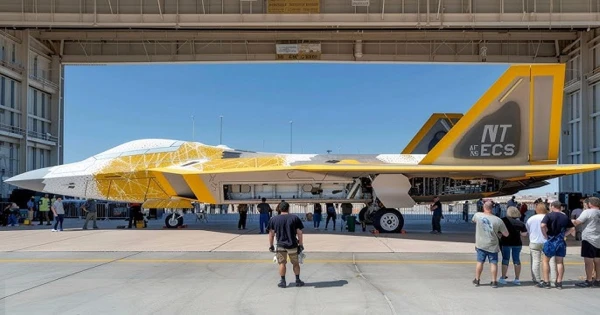
The U.S. Air Force’s planned modernization of the F-22 Raptor — often dubbed the “Super Raptor” or “Raptor 2.0” — is designed to preserve and extend America’s air-superiority edge as advanced combat aircraft from China and Russia enter widespread operational service. The upgrade program combines new sensors, digital systems, weapons integrations, and reduced logistics footprints to keep the F-22 relevant in an era of networked, contested airspace. At the same time, Beijing’s Chengdu J-20 and Moscow’s Sukhoi Su-57 continue to evolve in capability and numbers, reshaping the balance of power in the Asia-Pacific and beyond.
Modernization strategy and program goals
The Super Raptor initiative focuses on three core goals: sensor and avionics upgrades, expanded weapons carriage and integration, and improved survivability and sustainment. Rather than building a brand-new airframe, the program seeks to leverage the F-22’s proven stealthy platform while inserting modern digital architecture that supports rapid software updates, broader datalink connectivity, and advanced electronic warfare capabilities.
Key avionics improvements include open-systems computing, upgraded radar processing, and improved sensor fusion. These advances are intended to give F-22 pilots clearer situational awareness with less cognitive burden, enabling the aircraft to act as both a lethal shooter and a sensor node that feeds battlespace data to joint forces. Upgrading the aircraft’s mission computer and network interfaces also allows incorporation of new air-to-air and air-to-ground weapons that were not part of the Raptor’s original certification.

Weapons integration and payload changes
A central limitation of the original F-22 is its internal weapons bay capacity, which constrained the variety and quantity of munitions the aircraft can carry without compromising stealth. The Super Raptor program aims to expand the breadth of compatible weapons through software certification, new pylons for optional external carriage when stealth trade-offs are acceptable, and testing for next-generation air-to-air missiles and standoff munitions.
The modernization roadmap includes integration of longer-range air-to-air missiles, advanced short-range missiles with improved kinematics, and precision air-to-ground weapons to support suppression of enemy air defenses (SEAD) and deep strikes. Work is also under way to enable the F-22 to carry and control unmanned collaborative aircraft, a force-multiplier concept that would let Raptors use expendable or reusable drones to extend sensor reach or perform high-risk tasks.
Electronic warfare and survivability
As adversaries field more advanced integrated air defenses and electronic attack capabilities, the Super Raptor emphasizes enhanced electronic warfare (EW) systems, improved radar cross-section maintenance, and survivability upgrades. This includes advances in coatings and maintenance procedures to preserve low observable characteristics, as well as active EW suites that can detect, geolocate, and counter hostile emissions.
The F-22’s upgrades also focus on signature management and sensor resiliency, ensuring the jet remains difficult to detect while improving its ability to operate in contested electromagnetic environments. Enhanced data security and hardened communications will reduce the risk of electronic intrusion or spoofing — an increasingly important consideration as networked systems and artificial-intelligence-enabled sensors proliferate.
Command, control, and sensor fusion
A major theme of the Raptor upgrades is turning the jet into a distributed sensor and command node. Modern air combat increasingly values platforms that can gather, process, and disseminate information across services and allies. Upgraded datalinks, cloud-like mission systems, and improved sensor fusion are intended to let F-22s share high-fidelity tracks, engage collaboratively, and deconflict weapons employment in dynamic scenarios.
This shift moves the F-22 away from being purely an individual “ace” fighter to an orchestrator of joint effects. Through low-latency communications and standardized interfaces, Raptors could cue allied aircraft, direct long-range fires, and help integrate air operations with naval and ground-based systems.
Comparing platforms: F-22, J-20, and Su-57
The three fighters reflect different design philosophies and strategic priorities.
-
F-22 Raptor (Super Raptor): Prioritizes air superiority with advanced stealth, high cruise performance, and exceptional situational awareness. The upgrade path emphasizes digital modernization, weapons flexibility, and networked capabilities while retaining the proven aerodynamic and signature advantages of the existing airframe.
-
Chengdu J-20: China’s J-20 emphasizes stealth, long-range sensors, and payload flexibility suited to regional power projection. Recent production increases and incremental capability improvements — including domestically produced long-range missiles and advanced sensor suites — aim to create a multi-role platform capable of air superiority, fleet-area denial, and stand-off engagements.
-
Sukhoi Su-57: Russia’s Su-57 emphasizes supermaneuverability, integrated avionics, and a balance between stealth and kinetic performance. Evolving variants show improvements to engines, avionics, and weapons integration. The Su-57’s design allows for internal weapon carriage with an emphasis on air-to-air lethality and survivability against regional opponents.
Stealth and signature comparisons
Stealth is not a single attribute but a set of trade-offs across radar, infrared, acoustic, and visual signatures. The F-22’s stealth design, refined over decades and supported by rigorous sustainment regimes, yields a low observable profile optimized for high-threat penetrations. The Super Raptor upgrades seek to preserve that advantage while ensuring the aircraft can operate effectively in electronically contested environments.
The J-20’s stealth features are oriented toward front-sector reduction and long-endurance missions; some design elements prioritize range and payload. The Su-57 balances reduced radar signature with aerodynamic features that support agility and internal payload carriage. Each airframe will perform differently depending on the mission set and the sophistication of the opponent’s sensors.
Sensors, datalinks, and distributed sensing
Sensor capability increasingly defines aerial dominance. The F-22’s modernization prioritizes multi-spectral sensing and improved data processing, allowing Raptors to fuse radar, infrared search and track (IRST), electronic intelligence, and allied sensor inputs. Upgraded datalinks aim to ensure secure, high-volume data exchange with allied platforms and command nodes.
China has invested heavily in sensor suites for the J-20 and in a national sensor network that includes ground radars, airborne early-warning aircraft, and space-based systems. These investments reduce the advantage of any single stealth platform by improving detection layers across the battlespace.
Russia has focused on IRST, passive detection, and electronic warfare measures that can complicate adversary targeting. The Su-57’s sensor package is being iteratively improved, with emphasis on integration and mission computing.
Numbers, deployment, and industrial capacity
Quantity matters. The U.S. fielded F-22s in limited numbers before production halted more than a decade ago. Modernization gives existing airframes extended relevance, but the service still faces fleet-size constraints. Upgrades improve capability per aircraft, yet the total number of Raptors remains finite.
China’s J-20 production has accelerated, with increasing deliveries into service that expand the People’s Liberation Army Air Force’s (PLAAF) modern fighter inventory. Domestic production lines and a broad industrial base allow China to scale numbers rapidly, while ongoing incremental improvements increase capability over time.
Russia’s Su-57 production is smaller, constrained by budget, export strategy, and industrial bottlenecks. However, Russia emphasizes modernization of tactical units and export variants, seeking to deploy upgraded Su-57s where they can gain operational experience.
Operational concepts and doctrine
How these aircraft are employed will influence outcomes more than any single technical metric. The U.S. doctrine integrates stealth platforms with space, cyber, and long-range precision fires. The Super Raptor’s networked-sensor role reflects this joint approach, where Raptors help manage effects rather than operate singly.
China’s doctrine increasingly blends large numbers, integrated air defenses, and layered sensors to contest access and challenge adversary airpower in regional conflicts. J-20s are expected to perform patrols, contested-area strikes, and fleet-defense missions.
Russia uses the Su-57 in conjunction with legacy fighters and air-defense networks, prioritizing tactical flexibility, survivability in contested airspace, and export opportunities to build strategic ties.
Limitations and risks
No platform is invulnerable. The F-22’s sustainment and upgrade costs are significant, and the limited fleet size constrains continuous presence in multiple theaters. The J-20’s growing numbers may mask remaining gaps in avionics or engine performance. The Su-57 faces production and logistical challenges that limit rapid expansion.
Electronic warfare, space-based sensors, and long-range precision weapons can reduce the advantage of stealthy designs. Rapid software updates and interoperability will be decisive, meaning industrial base agility and secure supply chains are as important as raw performance.
Strategic implications
The Super Raptor upgrade underscores the U.S. commitment to maintaining a qualitative edge while acknowledging the need to adapt to new forms of warfare. Enhanced Raptors provide a more survivable, flexible, and networked force element that complements other U.S. systems.
For China and Russia, continued J-20 and Su-57 development signals investment in advanced airpower as a component of broader military modernization. These trends increase the complexity of aerial competition and push all parties toward integration of sensors, weapons, and allied networks.
Conclusion
Upgrades to the F-22 aim to sustain U.S. air superiority by merging proven stealth with modern digital architecture, expanded weapons options, and improved electronic warfare capabilities. Meanwhile, the J-20 and Su-57 remain active vectors of capability growth for China and Russia. Ultimately, the outcome of the 2026-era air superiority race will hinge on numbers, sustainment, doctrine, and the ability of each power to integrate aircraft into larger joint and allied networks rather than on any single platform’s specifications.