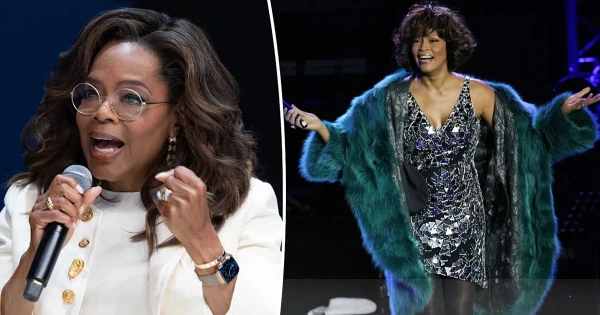
Nearly two decades after Whitney Houston's memorable appearance on "The Oprah Winfrey Show," new details have emerged challenging the media mogul's account of what really happened that day. The late singer's longtime bodyguard has come forward to correct the narrative, insisting that Houston was not under the influence when she took an unexpected tumble during the 2009 taping.
Ray Watson, who served as Houston's personal security detail for over ten years, recently addressed the incident in an interview with TMZ. His account directly contradicts Oprah Winfrey's recollection of the events, offering a different perspective on the moment that has sparked debate among fans and media observers alike.
According to Watson, Houston was making her way toward the front of the stage when the mishap occurred. The edge of the performance area was positioned in a dark spot, making it difficult for the singer to gauge where the stage ended. Watson explained that someone in the production crew had attempted to warn Houston to be cautious, but the singer stepped into the wrong area and lost her balance.

Rather than experiencing embarrassment or distress, Houston handled the situation with grace and humor. Watson emphasized that the singer simply laughed off the incident and continued with her appearance without any indication of impairment. The bodyguard's account paints a picture of a professional artist navigating an unfortunate but minor accident during a live television production.
The clarification comes after Winfrey made headlines at the Cannes Lions International Festival, where she recounted the 2009 episode during a public appearance. The media icon suggested that Houston had relapsed into substance use at the time and attributed the fall directly to drug impairment. Winfrey also revealed that she had to plead with her studio audience to keep the incident quiet, effectively withholding the footage from public view.
The estate of Whitney Houston has also weighed in on the controversy, pushing back against what they characterize as unfair assumptions about the singer's condition during that period. In an official statement previously provided to TMZ, Pat Houston, who manages the late singer's estate, confirmed that Houston did fall from the stage but attributed it to environmental factors rather than intoxication.
"Whitney absolutely fell off the stage, but it was during a sound check, and it was due to the darkness of the area and her unfamiliarity with the stage," Pat Houston stated. "She was absolutely not high."
The estate's statement acknowledged Houston's well-documented struggles with addiction while drawing a clear distinction between her personal battles and the assumptions made about specific moments in her career. Houston had been open about her substance abuse issues throughout her life, and she completed multiple rehabilitation programs before her tragic death in 2012 at age 48.
"Like many people, she faced personal battles, but it is inaccurate and unfair to attach that struggle to every performance or every chapter of her life," Pat Houston continued. "What the studio audience witnessed on stage was the result of discipline, talent, and commitment, not the assumptions others project."
Winfrey's recollection of the event appeared to suggest that Houston was visibly impaired during the performance portion of the show. The media mogul described Houston as being "not clean" and framed the fall as a consequence of substance use. However, Watson's account and the estate's statement challenge this version of events, emphasizing that Houston was simply navigating an unfamiliar stage in poor lighting conditions.
The 2009 interview was significant in Houston's career, as it came during her attempted comeback following years of personal and professional challenges. The singer was promoting her album "I Look to You," which marked her return to music after a seven-year hiatus. The appearance was intended to showcase Houston's resilience and renewed commitment to her craft.
At the time, fans and media outlets were eager to see Houston's performance, and her appearance on Winfrey's show generated substantial buzz. Houston had been working diligently to rebuild her image and demonstrate that she could still command the stage with the vocal power that had made her a global superstar.
Winfrey's admission that she requested audience members keep the incident confidential has raised questions about media ethics and the protection of celebrity images. The decision to conceal the footage while later sharing the story publicly has prompted debate among media observers about transparency and the selective presentation of information.
The differing accounts of what occurred that day highlight the complexities of documenting celebrity moments and the ways in which narratives can shift depending on who is telling the story. Houston's bodyguard and estate maintain that the fall was a simple accident, while Winfrey has described it as evidence of deeper issues.
Houston's fans have expressed frustration with what they perceive as ongoing attempts to define the singer's legacy through her struggles rather than her extraordinary talent. Throughout her career, Houston achieved record-breaking success, selling over 200 million records worldwide and earning numerous awards, including multiple Grammy Awards and American Music Awards.
The debate over the stage incident reflects broader conversations about how society discusses addiction and mental health, particularly when it comes to public figures. Critics argue that Winfrey's framing of the incident reinforces stereotypes about addiction and fails to acknowledge the complexity of Houston's life and career.
Watson's decision to speak out suggests a desire to protect Houston's legacy and ensure that her professional accomplishments are not overshadowed by speculation about her personal struggles. Having worked closely with Houston for more than a decade, Watson was in a position to observe the singer's condition on a daily basis and assess her state during public appearances.
The conflicting accounts may never be fully reconciled, as the only direct participants in the conversation cannot be consulted. However, the emerging details from Houston's inner circle provide an alternative perspective that challenges the assumptions made by Winfrey and others.
The incident serves as a reminder of the importance of accurate reporting and the need to verify accounts, particularly when they involve individuals who can no longer speak for themselves. As discussions about Houston's legacy continue, her contributions to music and entertainment remain undeniable, transcending any single moment in her career.
Ultimately, the fall on the Oprah Winfrey show represents just one small chapter in a life defined by remarkable achievement and ongoing personal challenges. Regardless of what occurred that day, Houston's impact on popular culture and her status as one of the greatest vocalists of all time remain secure. The renewed attention to this moment offers an opportunity to reflect on the responsibilities of those who shape narratives about public figures and the importance of preserving the dignity of those who cannot defend themselves.