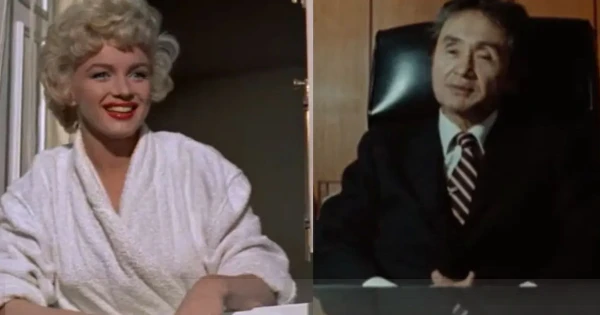
More than six decades after the world lost one of its most beloved icons, the forensic pathologist who performed Marilyn Monroe’s autopsy has publicly reaffirmed the medical conclusions that shaped one of Hollywood’s most enduring mysteries. Dr. Thomas Noguchi, now 99 years old, has spoken again about the night the screen legend died, shedding light on the rigorous scientific process that led to the official verdict of probable suicide .
The tragic discovery occurred on August 5, 1962, when the 36-year-old actress was found unresponsive in her Brentwood home. She was discovered lying face down on her bed, one hand clutching a telephone, with several empty prescription bottles scattered nearby . As a deputy medical examiner for Los Angeles County at the time, Dr. Noguchi was tasked with determining the cause of death for one of the most famous women in the world—an assignment he has since described as particularly challenging .
The Forensic Investigation

Dr. Noguchi, who would later become the county's chief medical examiner, approached the autopsy with a level of scientific rigor rarely seen at the time. Rather than relying solely on physical examination, he convened a panel of experts in suicide prevention and psychiatric evaluation to assist in the investigation . This interdisciplinary approach was groundbreaking and reflected Noguchi's commitment to science-based conclusions over speculation .
The autopsy findings were stark. According to Dr. Noguchi, the examination revealed elevated levels of barbiturates in the lining of Monroe's stomach, confirming that she had ingested a massive quantity of sedatives . The toxicology report later confirmed fatal amounts of both Nembutal and chloral hydrate in her system, enough to cause death in multiple individuals .
The Los Angeles Suicide Prevention Team provided additional context, documenting Monroe's history of chronic depression, erratic mood swings, and previous suicide attempts that required rescue interventions . These psychiatric findings, combined with the overwhelming physical evidence, led Dr. Noguchi to classify the death as a "probable suicide" .
The Conspiracy Theories
Despite the clarity of the official findings, Monroe's death has remained fertile ground for conspiracy theories. Speculation has swirled for decades, fueled by rumors of affairs with President John F. Kennedy and his brother, Attorney General Robert F. Kennedy, as well as alleged connections to organized crime . The actress's high-profile friendships, her political associations, and the general mystique surrounding Hollywood's golden age have all contributed to an alternative narrative that refuses to fade.
Dr. Noguchi has consistently pushed back against these speculative claims. In recent statements, he emphasized the importance of distinguishing between evidence-based conclusions and rumors that proliferate around famous cases . He has pointed out that high-profile investigations naturally attract exaggerated stories, but his responsibility was always to the scientific truth rather than sensationalism .
Even Dr. Noguchi himself has acknowledged certain unexplained aspects of the case. He later stated that a bruise found on Monroe's left hip "has never been fully explained" and described it as a "sign of violence" . When asked if this suggested murder, he reportedly answered, "Could be" . However, the coroner's official findings have never been overturned, and all medical evidence continues to support the original conclusion.
The Coroner to the Stars
Dr. Noguchi's career was extraordinary not only for his work on Monroe but for his role in investigating dozens of celebrity deaths that came to define an era. He performed autopsies on Robert F. Kennedy following the senator's 1968 assassination, as well as on actress Natalie Wood, singer Janis Joplin, and comedian John Belushi, among others . His meticulous approach to forensic science earned him both acclaim and criticism, as he often spoke publicly about his findings—sometimes to the chagrin of powerful figures .
His legacy has been explored in the documentary "Coroner to the Stars," directed by Ben Hethcoat and Keita Ideno, which traces the 99-year-old's groundbreaking career and examines how his autopsies shaped modern forensic medicine and American culture . Known for pioneering techniques like the psychological autopsy and criminal profiling, Noguchi transformed the role of the coroner from a shadowy bureaucratic function to a vital component of criminal investigation .
The Case Reopened
In 1982, the Los Angeles County District Attorney's Office reopened the investigation into Monroe's death in response to persistent public speculation . John Miner, a former prosecutor who had observed the original autopsy, testified that he had heard secret tapes Monroe made shortly before her death in which she discussed future plans, leading him to believe suicide was unlikely .
Miner's theory proposed an alternative scenario: that Monroe was rendered unconscious with chloral hydrate, and that a lethal dose of barbiturates was then administered by enema—an explanation that would account for the absence of pills in her stomach . However, the 1982 review concluded that the "cumulative evidence" did not support "any theory of criminal conduct" related to her death . The findings noted factual discrepancies and unanswered questions but ultimately affirmed the original ruling.
The Unanswered Questions
Part of what makes Monroe's death so compelling is the contrast between the brutality of the scientific findings and the tragedy of her life. The actress, born Norma Jeane Mortenson, had risen from a difficult childhood to become an international star . Her films "Gentlemen Prefer Blondes" and "Some Like It Hot" defined an era of Hollywood, but Monroe reportedly struggled with typecasting and longed to be taken seriously as an actress . Her final interview, conducted shortly before her death, showed her pleading with the public not to remember her as a joke .
Dr. Noguchi's enduring message has been one of scientific integrity. The forensic evidence, he insists, points overwhelmingly toward suicide. But his willingness to call for further investigation into certain inconsistencies suggests a man more concerned with truth than with protecting his legacy. In a 2021 interview, he said that his most important job was always to tell the truth, so that "no person is victimized by rumors" .
The Final Verdict
As the 99-year-old Noguchi continues to consult as Professor Emeritus of Forensic Pathology at USC's Keck School of Medicine, his testimony stands as a rare direct connection to the moment a Hollywood icon died . Dr. Noguchi's original report, completed in August 1962, has been scrutinized by generations of researchers and remains the foundation of our understanding of Monroe's death .
The coroner's office under Dr. Noguchi's later leadership ultimately determined that "suicide was the only reasonable explanation" for Monroe's death, though he personally added the word "probable" to the official report—a concession to the limitations of medical certainty . For those who knew the actress, however, the death remains a cautionary tale about the pressures of fame and the isolation that can accompany it .
To this day, mourners still visit Monroe's grave at Westwood Village Memorial Park Cemetery. The conspiracy theorists and fans who believe she was murdered continue to raise questions, while historians and medical professionals point to the weight of the evidence . The truth may never be known with absolute certainty, but the scientific record remains clear: Hollywood's brightest star died from a massive dose of barbiturates, alone in her bedroom on a summer night in 1962.