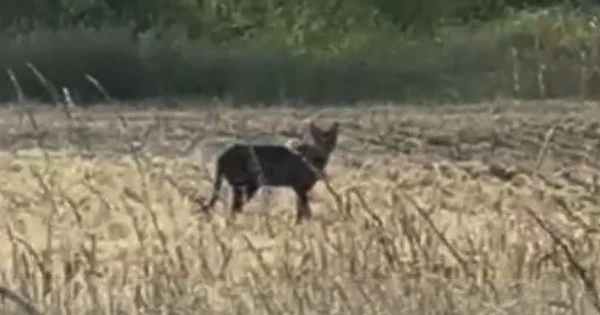
Residents of a quiet Norfolk village are on edge after a large, exotic-looking cat resembling a small leopard was spotted prowling through farmland near Bramerton, approximately five miles southeast of Norwich. The unusual sighting has prompted wildlife experts to speculate about the creature's origins and raised questions about the growing trend of keeping wild animals as domestic pets.
The spotted feline was first observed Tuesday evening by a local man walking his dog with his girlfriend. Initially mistaking the animal for an oversized fox, the couple quickly realized they were witnessing something far more extraordinary when they captured the creature on camera. The animal appeared significantly larger than a typical domestic cat, with distinct markings that immediately drew comparisons to a leopard.
Tom Baker, who made the discovery, described the encounter as deeply surprising. He noted that he maintained a safe distance from the animal and quickly redirected his walk to avoid any potential confrontation. Fortunately, his dog was on a leash at the time, allowing for a controlled and safe retreat from the area.
A Royal Confession: Princess Diana’s Candid Letters on Prozac and Friendship Head to Auction

Following the sighting, Baker reported the incident to the RSPCA, the United Kingdom's leading animal welfare organization. Officials confirmed they had not received any reports of missing exotic cats matching the description in the local area. However, authorities have urged residents to remain vigilant and report any further sightings.
Wildlife specialists who have examined photographs of the creature suggest it may be a Savannah cat, a hybrid breed created by crossing a domestic cat with a serval, a medium-sized wild cat native to Africa. Some experts also propose the possibility that the animal could be a serval itself, which would require its owner to possess a dangerous wild animals license under UK law.
Rick Minter, a prominent researcher who has extensively studied unofficial big cat populations across the British countryside, offered his assessment of the Norfolk sighting. He dismissed theories that the animal could be a leopard, instead identifying it as likely being a Savannah cat with a particularly wild genetic strain. Minter noted that these animals are increasingly popular as designer pets, despite the significant challenges associated with their care and containment.
Minter explained that the wilder varieties of Savannah cats can be difficult to manage in domestic settings, leading to occasional escapes or intentional releases. If such animals were to establish themselves in the wild, they could potentially survive by preying on rabbits, pigeons, and other small animals commonly found throughout the British landscape.
The expert also referenced recent observations in neighboring Suffolk, where farmers have reported the presence of wild black leopards and mountain lions. According to Minter, these larger predators have been helping to control deer populations, reducing crop damage caused by overabundant herds. He characterized these big cats as secretive ambush predators that appear to be adapting successfully to rural British environments.
Gary Ridley, an amateur investigator who has spent 15 years documenting big cat sightings, offered a slightly different perspective. While Ridley agreed the Norfolk animal was unlikely to be a leopard, he suggested it could potentially be an African wild cat or jungle cat. He acknowledged the possibility that the creature may have been bred with other exotic breeds to create distinctive hybrid animals, potentially as someone's pet or an escapee from a private collection.
The RSPCA has expressed ongoing concerns about the trade and keeping of wild animals as domestic pets. Senior scientific officer Evie Button emphasized that many exotic species, including servals, have complex needs that are extremely difficult to meet in a household environment. The organization maintains that wild animals should only be kept in captivity when their welfare can be properly assured, a standard that is frequently challenging to achieve.
Kevin Murphy, who operates Norfolk Wildlife Rescue, expressed concern about the potential dangers posed by a roaming serval or Savannah cat. While these animals are smaller than lions or tigers, they remain formidable predators with temperamental dispositions and powerful hunting instincts. Murphy advised that any owner should thoroughly inspect their enclosures to prevent further escapes.
Local residents have taken to social media platforms to share their own sightings and concerns, creating a network of community awareness around the mysterious feline. Norfolk Constabulary confirmed they had not received any formal reports regarding the animal, leaving the matter primarily in the hands of wildlife experts and animal welfare organizations.
The incident has reignited broader discussions about the ethics of keeping exotic animals as pets and the potential consequences when such creatures escape into the wider environment. As the search for the elusive spotted cat continues, authorities and wildlife experts remain watchful for any further developments in this unfolding rural mystery.