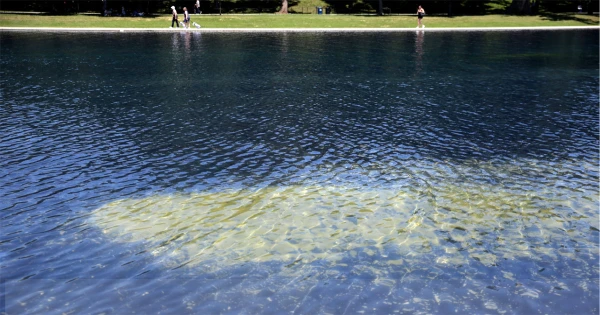
The iconic Lincoln Memorial Reflecting Pool in Washington, D.C., has become the center of a contentious dispute involving allegations of intentional sabotage, a $14.2 million renovation project, and an unexpected algae bloom. A senior National Park Service (NPS) official has now confirmed in a court filing that a liner along the pool’s bottom was deliberately cut with a sharp object, but questions persist regarding the extent of the damage and the overall integrity of the newly refurbished landmark.
The controversy reignited this week when Frank Lands, the deputy director for operations for the NPS, filed a declaration in federal court. The document, submitted on Wednesday, alleges that on June 9, following the completion of the pool’s extensive renovation, U.S. Park Police responded to a report of intentional damage. According to Lands, the damage involved a section of the foam sealant that appeared to have been cut using a "sharp knife or razor." The filing also noted that surface material was delaminating and that approximately 70 decorative fence post tops had been tossed into the water.
Lands stated that the NPS intends to begin draining the reflecting pool after the Fourth of July holiday to conduct a full assessment and implement necessary repairs to the damaged lining. However, the administration has not yet released photographic or video evidence to corroborate claims of a 350-foot gash that was previously referenced by former President Donald Trump. The lack of transparency has prompted calls from advocacy groups and members of the press for the Department of the Interior to release documentation that would substantiate the sabotage narrative.
World Cup 'Has Been Sold Out,' Claims German Legend Philipp Lahm in Scathing Attack on FIFA

The recent damage allegations come against the backdrop of a high-profile renovation project championed by Trump. The endeavor, which cost taxpayers $14.2 million, was pitched as a patriotic initiative to turn the pool "American flag blue" in time for the nation's 250th anniversary celebrations. However, the project has faced significant setbacks since its completion. Just days after the ribbon was cut, a severe algae bloom turned the waters a murky green, forcing NPS crews to deploy skimmers and introduce hydrogen peroxide to treat the water quality. Additionally, large flakes of the blue coating were observed peeling from the basin, floating on the surface, and washing ashore.
This weekend, Trump blamed unidentified vandals for the pool’s deterioration, claiming without providing details that "multiple individuals" had been arrested by park police. While the U.S. Park Police did arrest a three-time Olympic canoeist, David Hearn, on Friday, his case appears to be more complex than initially suggested. Hearn, who denies any malicious intent, told local media that he noticed a detached piece of the blue liner while walking by. He claims he simply reached into the water to feel the material, only to be arrested shortly after on a misdemeanor charge of destruction of government property. He has pleaded not guilty to the charge.
The arrest has sparked intense scrutiny from the public and media outlets, particularly regarding the lack of visual evidence supporting the administration’s claims. According to internal government documents obtained by The New York Times, while NPS workers did discover two cuts in sections of foam located between the pool’s expansion joints, the cuts were not directly linked to the peeling blue coating or the widespread algae bloom. The report noted that the exact cause and timing of the cuts remain unclear, suggesting that the narrative of a single widespread act of sabotage may be oversimplified.
Meanwhile, U.S. Park Police released a statement on Wednesday seeking the public’s assistance in identifying an individual connected to a "Destruction of Government Property" investigation. The agency provided a video showing a person reaching into the pool and appearing to pull something out, but they have not confirmed whether this specific incident is related to the cuts identified by NPS officials. This ongoing investigation highlights the challenges authorities face in verifying the cause of the damage while managing public perception of the controversial project.
The ongoing dispute regarding the reflecting pool raises broader questions about the preservation of national monuments and the stewardship of federal funds. As the NPS prepares to drain the pool, experts are divided on whether the issues stem primarily from human interference, construction deficiencies, or environmental factors. The liner, designed to improve water circulation and reduce maintenance costs, was intended to modernize the 1920s-era landmark, but the peeling coating and structural concerns have brought negative attention to the project.
The NPS plans to proceed with repairs following the Independence Day holiday, which will close the site for further inspections. Officials have assured the public that the site will be restored to its intended state, though no definitive timeline for reopening has been provided. The agency has yet to announce whether the suspected vandalism will lead to changes in security protocols or the re-evaluation of contractors involved in the renovation. As the legal proceedings continue, the story of the reflecting pool remains a focal point for discussions on accountability and transparency in government-funded projects.