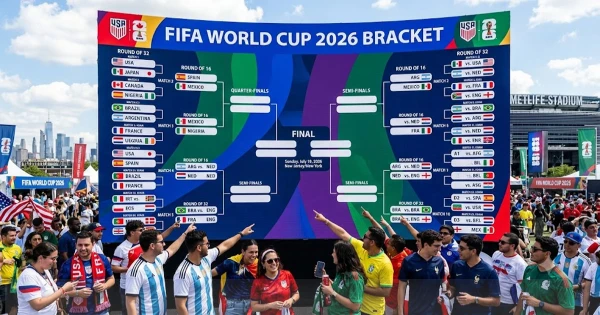
The FIFA World Cup 2026 bracket is the map that turns a massive, expanded tournament into a straight path to the title, and it is already shaping the drama for fans following every round of 32 matchup. With 48 teams in the field and a knockout stage built around single-elimination stakes, the bracket is where group-stage momentum turns into winner-take-all pressure.
Why the bracket matters
The World Cup bracket is more than a schedule. It shows how teams are paired after the group stage, which side of the draw they land on, and how each win opens one more door toward the final. For fans, that means the bracket helps answer the biggest question in tournament soccer: who can realistically reach the trophy match, and who faces a difficult route from the start.
In 2026, the bracket matters even more because the field is bigger than in previous men’s World Cups, which changes how the knockout rounds are organized. That extra size makes the early knockout stage more crowded, more varied, and easier to follow if you understand the structure first.

How the knockout stage works
The knockout phase is single elimination. A team wins and moves on, or loses and goes home. That simple setup is why the bracket draws so much attention: every match carries immediate consequences, and there is no room to recover from a bad day.
The 2026 tournament begins its knockout action with a Round of 32, not a Round of 16, because the expanded format produces a larger first knockout field. From there, the survivors advance through the Round of 16, quarterfinals, semifinals, and the final. In practical terms, the bracket is a layered map of do-or-die matches that gradually reduces the field until one champion remains.
Reading a World Cup bracket
For casual fans, the bracket can look crowded at first, but the logic is straightforward. Each side of the draw is built to show possible paths after the group stage, and every match position tells you which winner will face the next winner.
Here is the basic way to read it:
-
Start with the Round of 32 matchups.
-
Follow the winner’s path to the next round.
-
Look across the bracket to see which other teams sit in the same half.
-
Track the route all the way to the final.
That approach helps fans see more than just one game at a time. It also shows whether a team’s path looks balanced or unusually difficult, which is why bracket analysis becomes a major part of World Cup coverage.
What makes 2026 different
The 2026 FIFA World Cup is the first men’s World Cup with a 48-team field, and that changes the bracket’s structure at the knockout stage. Instead of beginning directly with 16 teams, the tournament now starts its elimination phase with 32 teams, creating more early knockout matches and more possible paths to the title.
That expansion affects more than just the number of games. It increases the variety of matchups, creates more opportunities for surprise runs, and makes bracket tracking more important for fans trying to understand how the tournament unfolds. It also means that the bracket can shift quickly once underdogs advance or favorites are eliminated, which is part of the appeal of the format.
Why bracket upsets happen
World Cup brackets are famous for upsets because knockout soccer is unforgiving. A stronger team can dominate possession and still lose on one mistake, one set piece, or one bad bounce. That unpredictability is part of what makes the bracket so compelling to follow from round to round.
The expanded 2026 format may amplify that effect. More teams in the knockout phase create more chances for surprise results, and that can reshape the bracket in ways no one predicted after the group stage. For readers trying to understand the bracket, the key idea is simple: seeding and reputation matter, but they do not guarantee survival in a single-elimination tournament.
What fans should watch
Fans following the FIFA World Cup 2026 bracket should pay attention to three things. First, track which teams land in the same half of the draw, because that determines the path to the final. Second, look at how teams perform in high-pressure knockout matches, since form in the group stage does not always carry over. Third, watch for travel and venue changes, because the 2026 tournament spans the United States, Mexico, and Canada, which adds a logistical layer to the competition.
A smart way to follow the bracket is to think in tiers. Some teams may look favored on paper, but the most dangerous bracket paths often belong to teams that combine defensive discipline, efficiency, and the ability to survive tight games. That is why bracket discussions usually blend math, matchups, and momentum rather than relying on reputation alone.
Common misconceptions
One common misconception is that the bracket is fixed once the tournament begins. In reality, it only becomes fully meaningful after the group stage results determine the exact knockout pairings. Until then, fans are often following projected brackets rather than final ones.
Another misconception is that the team with the “easier” route is guaranteed success. World Cup history does not support that idea, because the bracket rewards execution, not projection. A favorable path can help, but it still demands four or five strong knockout performances to win the tournament.
How to follow it well
If you want to follow the FIFA World Cup 2026 bracket like a seasoned fan, keep your focus on the structure instead of the noise. Watch how the bracket changes after each knockout round, and pay attention to which teams are still alive in each half of the draw. That gives you a clearer sense of likely finalists than simply watching isolated match results.
It also helps to remember that the bracket is a living story. Early surprises can rewrite the entire path to the final, which is why the most useful bracket coverage is the kind that explains consequences, not just scores. For readers, that is where the real value lies: the bracket is not only a list of games, but a framework for understanding the tournament itself.
The FIFA World Cup 2026 bracket gives the tournament its shape, turning a large international field into a clear sequence of knockout decisions. Once the Round of 32 begins, every match affects the road ahead, and every upset can redraw the story of the championship race.
For fans, the smartest approach is to follow the bracket round by round, understand the path each team faces, and remember that single-elimination soccer often rewards resilience as much as talent. In a World Cup built for drama, the bracket is the simplest way to see how that drama unfolds.