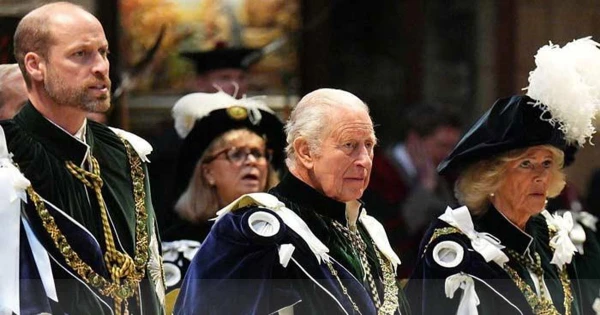
The Prince of Wales put aside his recent focus on social initiatives to step into a centuries-old tradition on Wednesday, joining his father, King Charles III, for the annual Service of the Order of the Thistle at St Giles' Cathedral in Edinburgh. The appearance marked a notable moment of royal unity, coming just one day after William concluded a major event for his homelessness project.
Dressed in the Order’s ceremonial dark green velvet robes, adorned with a gold collar and the insignia of Scotland’s highest order of chivalry, William took his place among the senior members of the royal family. Known in Scotland as the Duke of Rothesay, he held the order of service as he processed through the historic cathedral alongside the King, Queen Camilla, the Duke of Edinburgh, and the Princess Royal.
King Charles, who serves as the Sovereign of the Order, led the service celebrating The Most Ancient and Most Noble Order of the Thistle. The monarch, dressed in the Order's distinctive robes and feathered hat, presided over a spectacular display of royal pageantry that remains one of the highlights of Royal Week in Scotland.

The Order of the Thistle is the nation’s highest honour, recognizing 16 Knights and Ladies who have made outstanding contributions to Scottish national life. Appointments to this exclusive group are made personally by the King, acknowledging individuals who have demonstrated exceptional public service and achievement across a wide range of fields.
The annual service at St Giles' is not only a religious ceremony but also a reflection of how Scotland’s oldest traditions have evolved to remain relevant. In a landmark decision in 1987, Queen Elizabeth II admitted women to the Order on the same basis as men. This change ensured that the honour kept pace with modern societal values while maintaining its historical gravitas and prestige.
For William, the engagement provided a brief return to ceremonial duties following the high-profile conclusion of his Homewards initiative. That project, which aims to demonstrate that homelessness can be ended, has been a central focus of his recent public work and drew significant attention earlier in the week. His presence in Edinburgh underscores his commitment to both contemporary causes and the longstanding traditions of the monarchy.
The gathering of senior royals in Edinburgh served as a visible display of unity and continuity. With the King continuing his cancer treatment and the Princess of Wales also undergoing preventative chemotherapy, public appearances by working members of the family carry added significance. This service highlighted the monarchy’s ability to balance modern challenges with the stability of ancient ritual.
The Order of the Thistle remains a powerful symbol of Scottish heritage, and the service is a key date in the royal calendar. It offers the public a rare glimpse into the pageantry that defines the upper echelons of British chivalry, while also reminding observers of the family’s deep-rooted connections to Scotland. As Royal Week continues, this event stands out as a testament to the enduring nature of these historic institutions.