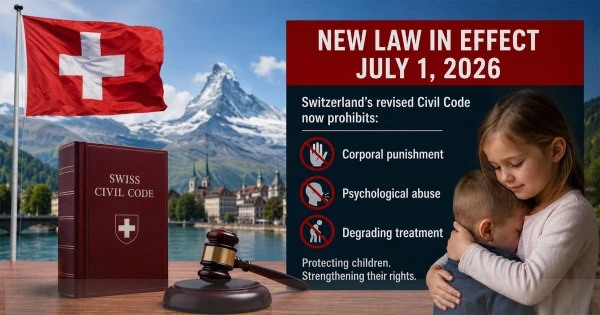
Switzerland's revised Civil Code officially took effect on July 1, 2026, formally outlawing corporal punishment, psychological abuse, and degrading treatment of children by their parents or guardians nationwide.
The updated law marks a significant milestone in Swiss family policy, closing a long-standing legal gap that left corporal punishment technically unaddressed despite decades of international pressure and shifting public attitudes.
A Landmark Shift in Swiss Family Law
Switzerland's Federal Council decided on February 25, 2026, that the explicit codification of the obligation to raise children without violence would take effect on July 1, 2026. The amendment had already cleared parliament the previous fall. LOC
Roche's Divarasib Shows Promising Results in Advancing Lung Cancer Treatment for KRAS G12C Patients

The Swiss Parliament adopted the amendment to the Swiss Civil Code on September 26, 2025, stating that parents must raise their children without using violence, particularly without corporal punishment or other forms of degrading treatment. Lawmakers debated the measure for years before final approval. LOC
The amendment passed the National Council with 134 votes in favor, 56 against, and two abstentions, aiming to outlaw corporal punishment and other forms of degrading treatment of children. That vote sent the bill to the Senate for further review before its eventual approval. Newstrack English
The legislation stemmed from a motion introduced by a Swiss lawmaker that received support from both chambers of parliament in 2021 and 2022, reflecting a gradual but sustained legislative push over multiple years. Child in the City
What the New Law Actually Requires
The revised article of the Civil Code states that parents are required to raise their children according to their abilities and means, with a duty to promote and protect their physical, intellectual, and other development. The language deliberately excludes any form of physical or degrading discipline. End Corporal Punishment
The new provision explicitly states that parents must bring up a child without the use of physical punishment and other forms of degrading violence, serving as a guiding principle that sends a clear signal that such treatment will not be tolerated. Officials describe it as an educational standard rather than a criminal trap for parents. Swissinfo
Importantly, the reform does not create new criminal penalties for individual parents. Penal law continues to criminalize perpetrators of serious violence, while the new civil provision grants children an added avenue to seek protection without centrally involving them in punishing their own parents. Ombuds-office-childrens-rights-switzerland
Swiss cantons, the country's regional governing bodies, must now ensure that parents and children have access to counseling services, either together or separately, whenever difficulties arise during child-rearing. This support-based approach is meant to complement the legal prohibition rather than replace it. LOC
Lawmakers who backed the bill framed it as a matter of setting expectations rather than punishing families. Supporters argued that parents can still exercise authority to discipline children without resorting to violence, distinguishing between firm boundary-setting and psychologically harmful threats or punishments. IamExpat
Decades in the Making
The path to this reform stretches back nearly half a century. Switzerland's Cruelty Act was enacted in 1978, and the country ratified the United Nations Convention on the Rights of the Child in 1997, committing to protect children from all forms of physical or psychological violence. End Corporal Punishment
Despite those commitments, Switzerland resisted explicit legal bans for years. The country remained one of the few in Europe, alongside a handful of others, without a clear commitment to prohibiting all corporal punishment of children, even as most neighboring nations moved to ban the practice. the BRIDGE
Switzerland's government had long argued that the country's Constitution, adopted in 1999, already provided sufficient protection through an article guaranteeing children the right to special protection of their integrity and development. Officials repeatedly maintained that existing violence and abuse laws covered children adequately. LOC
That position drew consistent criticism from international bodies. The U.N. Committee on the Rights of the Child and the U.N. Human Rights Council repeatedly called on Switzerland to enact explicit legal provisions prohibiting corporal punishment as an educational measure in all settings, including the home. LOC
Various legislative proposals to codify this obligation had been submitted to parliament over the years, including attempts in 1996, 2013, and 2015, but none were acted upon until the recent reform succeeded. A parliamentary motion in 2020 finally set the current process in motion. LOC
The Scale of the Problem
Data collected before the law's passage illustrates why advocates pushed so hard for reform. A 2019 University of Fribourg study found that 4.4 percent of Swiss parents admitted to regularly using physical force on their children, while 23.2 percent regularly used psychological forms of punishment. End Corporal Punishment
Researchers estimated that roughly 130,000 children living in Switzerland could be affected by regular physical violence from parents, based on a representative survey of over 1,500 people. Younger children were found to be more vulnerable than older ones. End Corporal Punishment
The long-term picture is even starker. Two-thirds of 17- and 18-year-olds in Switzerland reported having experienced some form of parental violence at some point during their youth, underscoring how widespread the issue remained despite decades of awareness campaigns. End Corporal Punishment
A separate 2025 study reinforced these findings. A February 2025 study from the University of Zurich found that 14 percent of parents in Switzerland resorted to corporal punishment when disciplining their children, a figure cited frequently during parliamentary debate over the bill. IamExpat
Advocates also point to the developmental consequences of physical discipline. Neurological research has found that corporal punishment negatively affects children's brain development because of the emotional stress it causes, and roughly one-quarter of children who experience violence go on to become perpetrators themselves. Ombuds-office-childrens-rights-switzerland
Switzerland Joins a Growing Global Movement
With this reform, Switzerland aligns itself with a broader international trend toward banning corporal punishment entirely. The law brings Switzerland into line with countries such as Germany, France, and Austria, which have already banned the practice. IamExpat
This move brings Switzerland closer to the roughly 67 countries, including neighbors like Germany and France, that had already banned all forms of corporal punishment by the time Switzerland's own legislation passed. By May 2025, smacking children had become an offense in around 70 countries and territories worldwide. Newstrack EnglishChild in the City
Sweden was the first country to ban smacking, doing so in 1979, and has since seen reduced rates of child abuse along with broader shifts in societal attitudes toward discipline. Swiss officials have pointed to that precedent as evidence that legal reform can shift cultural norms over time. IamExpat
Not everyone backed the change without reservation. A minority from the Swiss People's Party opposed the measure, arguing it was unnecessary and infringed on parental autonomy, even though most parents already reject violence as a disciplinary method. Newstrack English
Other critics raised concerns about how the law might be interpreted in practice. Some lawmakers argued that while they did not advocate harsh discipline, removing all threat of consequence could weaken parental authority, comparing the debate to broader questions about maintaining deterrents. IamExpat
What Comes Next
With the law now in force, attention shifts to implementation across Switzerland's 26 cantons, each responsible for ensuring families have access to counseling and support services when parenting challenges arise.
Child protection advocates and medical professionals have welcomed the change, noting that healthcare workers previously had limited legal grounding to intervene in cases involving mild but harmful disciplinary practices.
The coming months are expected to bring public awareness campaigns aimed at helping parents understand both the legal changes and the non-violent disciplinary alternatives the government hopes will replace physical punishment in Swiss households.
For now, Switzerland's July 1 reform stands as one of the most significant updates to its family law in nearly five decades, closing a gap that international bodies had flagged for years.