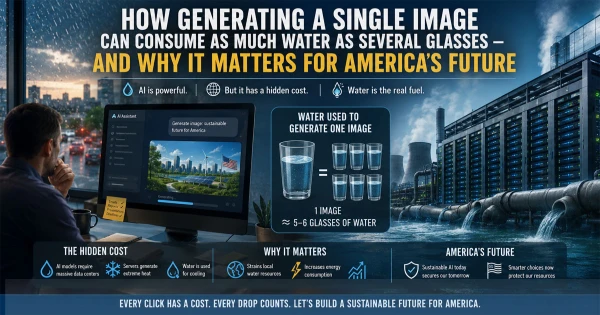
The morning rush is familiar to millions of Americans. After battling traffic and perhaps a sudden downpour, you settle at your desk, facing a mountain of tasks and a flood of emails demanding quick responses. Fatigue sets in fast. Many now turn to artificial intelligence tools like ChatGPT or Gemini to draft replies, summarize documents, or even create visuals for presentations. What feels like a simple digital shortcut carries an unseen environmental cost: significant water consumption far from the user's screen.
Data centers powering these AI systems require enormous amounts of electricity to process queries. That energy generates intense heat, which must be managed to prevent equipment failure. Cooling systems, often relying on water, step in to maintain optimal temperatures. While a person might sip one glass of water during a busy morning, the AI handling multiple requests can indirectly account for several more through its operational demands.
This connection between AI and water use stems from the fundamental physics of computing. Servers packed with powerful processors execute billions of calculations per second. The resulting heat buildup demands sophisticated cooling. Traditional air cooling has limits, especially as AI workloads surge. Many facilities now incorporate water-based systems, including evaporative cooling towers that dissipate heat into the air, consuming fresh water in the process.
Transform Modern Warfare: How Low-Cost Technology Empowers Weaker Forces on the Battlefield

Direct water use occurs on-site for cooling. Indirect use happens at power plants generating the electricity for data centers. Both add up quickly in an era of explosive AI adoption. A typical large data center can draw hundreds of thousands to millions of gallons daily, depending on size, location, and technology. Hyperscale facilities supporting major AI services amplify this demand.
Recent years have seen dramatic growth. U.S. data centers directly consumed around 17 billion gallons of water in 2023. Projections indicate this could rise sharply, potentially reaching tens of billions more annually within a few years as AI integration deepens across industries. Globally, estimates suggest hundreds of billions of liters currently, with potential to climb substantially higher by the end of the decade.
Consider everyday AI interactions. Drafting and refining an email might involve multiple prompts. Generating an image requires even more computational power. While exact figures vary by model, location, and efficiency, studies point to measurable water footprints per task. A single AI-generated image can equate to the water in one or more glasses, while complex video generation demands considerably more. Simple text queries use far less but accumulate rapidly at scale.
These numbers gain perspective when multiplied by billions of daily interactions worldwide. What seems negligible for one user becomes substantial across populations. Data centers in water-stressed regions, such as parts of the American Southwest, face particular scrutiny. Facilities there compete with agriculture, households, and ecosystems for limited supplies.
The infrastructure boom reflects AI's transformation of work, entertainment, and innovation. Companies deploy advanced chips that process information faster but run hotter. This drives demand for more robust cooling. Older air-only systems struggle under heavy loads. Liquid cooling technologies, including direct-to-chip methods, offer improvements but still often involve water mixtures.
Experts highlight that water consumption is not uniform. Factors like climate, time of day, and facility design play major roles. Cooler, humid locations allow more efficient air or hybrid cooling. Hot, dry areas rely more heavily on water evaporation. Many operators locate new centers strategically or invest in recycling and advanced systems to reduce freshwater withdrawal.
Broader environmental ties extend beyond cooling. Electricity production for data centers often involves water at thermal power plants. Coal, natural gas, and nuclear facilities use water for steam and cooling. Even renewable sources like hydropower have footprints. As AI energy demand grows, these indirect effects intensify.
Industry leaders report progress. Major technology companies publish sustainability data showing efforts to lower water usage intensity. Innovations include higher-temperature liquid cooling that reduces evaporation needs and closed-loop systems that recycle water more effectively. Some facilities achieve near-zero water consumption for cooling in suitable climates through dry coolers.
Despite advances, overall demand continues rising with AI proliferation. Training large models and serving constant inference requests across cloud platforms fuel expansion. Hyperscale centers, often spanning vast footprints, represent the fastest-growing segment. Their water needs can match those of small cities.
For American communities, implications are tangible. In drought-prone states, data center projects spark debates over water rights and infrastructure strain. Municipalities weigh economic benefits — jobs, tax revenue, technological leadership — against resource pressures. Some areas impose stricter permitting or require efficiency commitments.
Public awareness grows as stories highlight the issue. Everyday users increasingly recognize that digital actions have physical consequences. A casual image generation or extended chat session contributes to collective demand. This realization prompts reflection on usage patterns without diminishing AI's value in productivity, creativity, and problem-solving.
Balancing innovation with sustainability requires multifaceted approaches. Technological improvements in chip efficiency and cooling are essential. Siting decisions favoring water-abundant regions help. Policy frameworks encouraging transparency and best practices support responsible growth. Power grid modernization toward cleaner sources addresses both carbon and water aspects.
Individuals play a supporting role. Mindful application of AI — reserving it for meaningful tasks rather than frivolous ones — can curb unnecessary load. Organizations optimize workflows to minimize redundant queries. Developers focus on leaner models that deliver results with fewer resources. These steps compound when adopted widely.
Looking ahead, AI's trajectory points toward deeper integration in healthcare, education, transportation, and climate modeling. Its potential to tackle grand challenges, including water management itself through better prediction and optimization, is significant. Yet realizing this promise sustainably demands addressing its own resource intensity now.
The conversation around AI water use underscores a larger truth about modern technology. Digital convenience rests on physical foundations of energy, materials, and water. As society embraces AI, understanding and mitigating these foundations becomes critical for long-term resilience.
America stands at a pivotal juncture. With leadership in AI development, the nation can model responsible deployment. Investments in research, infrastructure, and efficiency can ensure technological progress aligns with environmental stewardship. Water scarcity concerns affect many regions already, making proactive management vital.
Ultimately, the goal is not to limit innovation but to guide it thoughtfully. Every AI interaction carries a small but real footprint. Collectively, these footprints shape the landscape for future generations. By prioritizing efficiency, transparency, and smart policy, the United States can harness AI's benefits while safeguarding precious water resources essential to life, economy, and environment.