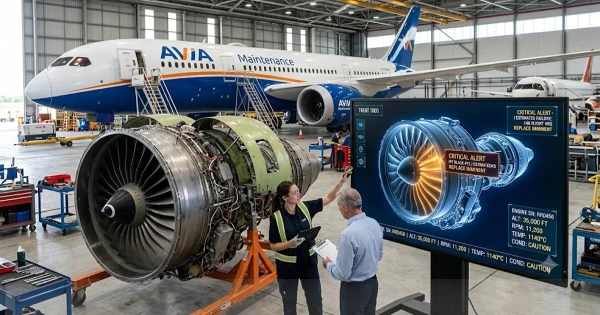
In the high-stakes world of commercial aviation, where a single mechanical failure can have catastrophic consequences, the industry has long relied on rigid maintenance schedules and reactive repairs. But a quiet revolution is underway, one that replaces guesswork with precision and hindsight with foresight. Imagine a world where an aircraft’s engine doesn’t just tell you it’s broken; it tells you it’s about to break, down to the specific component and the exact remaining flight hours. This is not science fiction. This is the era of the digital twin in aviation maintenance, a technological leap that is fundamentally reshaping how we keep the world’s fleet airborne, safe, and efficient.
The core of this transformation lies in the convergence of big data, artificial intelligence, and aerospace engineering. By creating a high-fidelity virtual replica of a physical aircraft, its engines, and its myriad systems, the industry is moving from a model of "fix it when it fails" to a proactive paradigm of predictive maintenance. This shift is not just about reducing costs; it is about redefining the very essence of aviation safety.
The Anatomy of a Digital Twin: More Than Just a Simulation
To understand the impact, it’s essential to distinguish between a standard 3D model and a true digital twin. A 3D CAD drawing is static; it is a snapshot of an aircraft's design. A digital twin, on the other hand, is a living, breathing digital entity.

It is a dynamic software model that mirrors the exact state of its physical counterpart in real-time. This is achieved through a network of thousands of sensors embedded throughout the aircraft. These sensors generate a constant stream of data related to:
-
Performance metrics: Engine temperature, vibration signatures, and oil pressure.
-
Environmental factors: Turbulence, humidity, and outside air temperature.
-
Operational data: Flight cycles, takeoff thrust, and landing impact.
This continuous influx of data is fed into the digital twin, allowing engineers to simulate stress, fatigue, and wear with extraordinary precision. The result is a virtual workspace where mechanics and engineers can "see" inside an engine or airframe without ever turning a wrench.
From Scheduled to Strategic: The Rise of Predictive Maintenance
For decades, the aviation industry has been governed by a "hard-time" maintenance schedule. An aircraft undergoes a specific inspection or part replacement after a set number of flight hours or cycles, regardless of its actual condition. While this is inherently safe, it is often inefficient and costly.
This is where predictive maintenance in aviation becomes a game-changer. Instead of replacing a part because the manual says it’s time, maintenance teams can now replace it because the data indicates it's necessary. This transition offers several critical advantages:
-
Reduced Unscheduled Downtime: Mechanical breakdowns are responsible for a significant percentage of flight delays. By predicting failures before they occur, airlines can schedule repairs during overnight layovers, minimizing disruption to passengers.
-
Optimized Inventory Management: Instead of stocking vast quantities of expensive spare parts "just in case," airlines can shift to a "just in time" model, ordering parts as they are projected to be needed, based on real-world usage data.
-
Extended Component Life: A digital twin can simulate the effects of different operating conditions. This allows pilots to adjust their flying techniques to reduce wear or allows engineers to adjust maintenance intervals, maximizing the service life of expensive components like landing gear or fan blades.
AI-Driven Aviation Safety: The Second Pair of Eyes
The sheer volume of data generated by a fleet of aircraft is overwhelming for human analysts alone. This is where the integration of artificial intelligence (AI) and machine learning (ML) becomes indispensable.
AI algorithms are the engine that powers the analysis of this big data. They process the information from the digital twin to identify patterns and anomalies that would otherwise go unnoticed.
-
Anomaly Detection: The AI learns the "normal" vibration pattern of a specific engine bearing. If it detects a subtle change in frequency, it flags this as an anomaly for human review. This early warning can provide weeks or even months of lead time.
-
Root Cause Analysis: When an issue is detected, AI can rapidly backtrack through millions of data points to determine the cause. This reduces the time spent troubleshooting and accelerates the repair process, getting aircraft back into service faster.
-
Predictive Algorithms: Machine learning models are constantly being refined with new data. As they ingest more information on failure modes, their predictive accuracy increases, leading to a self-improving safety system.
MRO Software Trends: The Digital Backbone of Modern Aviation
The digital twin is not an isolated piece of technology; it is the centerpiece of a broader ecosystem of advanced Maintenance, Repair, and Overhaul (MRO) software. As we move through 2026 and beyond, several key aerospace MRO software trends are shaping this ecosystem.
1. The Integrated Data Fabric
The old model involved disparate software systems that didn't "talk" to each other. The modern trend is toward an integrated data fabric where the digital twin, supply chain software, crew scheduling, and engineering databases are all interconnected. If a predictive alert is triggered, the software automatically checks for the availability of the replacement part in the nearest warehouse and identifies a mechanic with the right certification.
2. Cloud and Edge Computing
The immense computing power required to run complex simulations is moving to the cloud. Meanwhile, edge computing—processing data closer to the source (i.e., on the aircraft itself)—reduces latency. This allows for real-time analysis, enabling decision-making even while the aircraft is in flight.
3. Augmented Reality (AR) Integration
Technicians on the tarmac are beginning to use AR glasses. When working on a faulty component, they can use the digital twin to project an overlay onto the physical part, guiding them through complex repairs and showing them exactly where to look, bridging the gap between the digital and physical worlds.
Aircraft Component Lifecycle Management: A Holistic View
Effective maintenance goes beyond fixing individual parts; it requires a comprehensive understanding of the entire aircraft component lifecycle management. The digital twin provides a "digital thread" that traces every component from manufacturing to retirement.
-
Material History: The digital record includes not just the maintenance history but also the manufacturing pedigree of a component—its metallurgical composition, heat treatment, and factory test results.
-
Usage Tracking: The twin tracks how a component is actually used, not just how long it has been installed. A landing gear component used predominantly for short-haul, high-cycle flights will experience different stresses than one used for long-haul flights.
-
Lifecycle Prediction: This holistic data allows for a true lifecycle assessment. Airlines can make data-driven decisions about when it is more economical to repair a part versus retire it.
Overcoming Implementation Hurdles
Despite the clear benefits, the transition to a fully integrated digital twin ecosystem is not without its challenges.
-
Data Standardization: One of the biggest hurdles is the lack of a universal standard for data formats. Parts from different manufacturers generate data in different ways. For the industry to fully realize the potential of AI, this data needs to be harmonized.
-
Cybersecurity: With connectivity comes vulnerability. A digital twin connected to the internet could theoretically be a target for malicious actors. The industry must invest in robust cybersecurity measures to protect sensitive data.
-
Cultural Shift: Perhaps the most challenging aspect is the human element. Maintenance engineers and technicians must trust the software. This requires upskilling, training, and a fundamental shift in the culture from one of physical inspection to one of data interpretation.
The Future: A Self-Healing Aviation Ecosystem
Looking ahead, the integration of AI-driven aviation safety and digital twin technology will only deepen. We are moving toward a system that can be described as "self-aware."
This future ecosystem will be built on a few key principles:
-
Prescriptive Maintenance: Beyond simply predicting failures, AI will eventually prescribe the optimal fix. It will calculate the cost-benefit analysis of different repair strategies and suggest the one that maximizes value and uptime.
-
Fleet-Wide Learning: Today, if a Boeing 737 in Singapore experiences a rare engine anomaly, the data is siloed. In the future, the digital twins of all similar aircraft in the fleet will be connected. If one twin learns a failure pattern, that knowledge is instantly shared with the others, effectively making the entire global fleet smarter.
-
Dynamic Maintenance Scheduling: Maintenance schedules will become completely dynamic. Instead of being tied to a calendar, they will be dictated by the health of the aircraft. This will allow for unprecedented efficiency in dispatch and fleet planning.
Conclusion: The New Gold Standard for Aviation
The digital twin is more than just a software application; it represents a philosophical shift in how the aviation industry approaches safety and efficiency. By creating a perpetual, evolving digital mirror of our physical assets, we are empowering our engineers with a level of foresight that was previously unimaginable.
This transition from reactive to predictive maintenance is already demonstrating its value, reducing costs, minimizing delays, and—most importantly—enhancing the safety of air travel. While the challenges of standardization and cybersecurity remain, the trajectory is clear. The digital twin is not a passing trend; it is the new baseline, the fundamental standard upon which the future of aerospace MRO software and aircraft component lifecycle management will be built.
As we look toward a future where aviation is expected to be cleaner, quieter, and more efficient, the digital twin will be the indispensable tool that makes it possible. It ensures that for the passengers looking out the window at the clouds, the most complex machine in the sky is also the most understood.