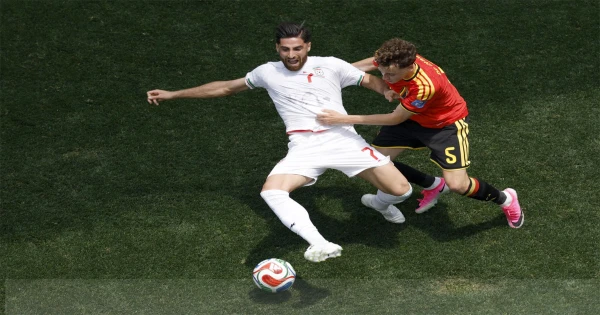
Iran produced a resolute defensive performance to hold Belgium to a 0-0 draw on Monday in Los Angeles, leaving both teams level on two points in Group G after two matches. The result followed Iran’s 2-2 comeback draw with New Zealand in its opening match and leaves the four-team group tightly poised ahead of the final group fixtures.
Iran entered the tournament under an unusual shadow: high-profile geopolitical tensions and diplomatic friction ahead of the World Cup had drawn attention away from the team’s on-field prospects. On paper Iran is no underdog — ranked 22nd in the FIFA world rankings, above several well-known nations — but off-field circumstances added extra scrutiny and expectation. On the field, Iran responded with disciplined defending and an inspired goalkeeping display to keep a star-studded Belgian attack at bay.
Goalkeeper Alireza Beiranvand was central to Iran’s best moments, producing a string of saves, including several that drew widespread praise for their timing and athleticism. By the final whistle Beiranvand had recorded seven saves, several of which prevented gilt-edged chances from becoming goals. One stop in the 60th minute, when he leapt across his goal to divert a close-range effort with a fully extended left hand, was widely hailed as one of the tournament’s standout saves so far.

Belgium created sustained pressure across the match, finishing with 23 shots, but were repeatedly stymied by Iran’s compact defensive organization and the reflexes of their goalkeeper. The Belgian midfield, creative and mobile throughout, moved the ball well into dangerous areas; Kevin De Bruyne helped craft the most promising sequences. In the moment that produced Iran’s most dramatic save, De Bruyne threaded a diagonal pass into the penalty area that found Maxime De Cuyper in a favorable position close to goal, but Beiranvand’s intervention kept the scoreline level.
The contest was also shaped by a turning point in the 66th minute, when Belgium were reduced to 10 men after defender Nathan Ngoy received a red card. The dismissal forced Belgium to reorganize and defend with one fewer outfield player for the remainder of the match. Iran responded by taking more initiative in attack and came close to capitalizing on numerical advantage on multiple occasions; however, finishing proved elusive and several promising moves ended without a decisive shot on target.
Belgium’s goalkeeper, Thibaut Courtois, also produced key saves to preserve the draw. Earlier in the match Iran appeared to have scored from a clever free kick, but the goal was ruled out for offside after a review, denying Iran an opportunity to claim the lead. Across both halves the game featured a tactically disciplined Iranian side committed to neutralizing space, blocking attempts, and limiting clear scoring chances.
Tactically, Iran set up in a low block that prioritized defensive angles and quick, organized transitions. Defenders and midfielders worked in concert to close lanes into the penalty area and funnel Belgian attackers into less threatening wide positions. When Belgium penetrated central areas, Iran’s goalkeeper and central defenders balanced risk and timing to snuff out chances at close range.
For Belgium, the match exposed both strengths and vulnerabilities. The team generated opportunities through ball circulation and individual creativity, but finishing and conversion were lacking. The red card compounded a growing concern about maintaining control under pressure and closing out matches against teams that defend deep and well-organized.
Group G now remains wide open. Iran and Belgium each have two draws from two matches, giving both two points. New Zealand and Egypt sit behind them with one point apiece after New Zealand’s draw with Egypt earlier in the group stage. With one match remaining for each team in the group, the final round of fixtures will determine which sides advance to the knockout stage. Iran is currently top on goal difference, with Belgium second, New Zealand third, and Egypt fourth.
The draw marks a significant moment for Iran’s World Cup campaign, demonstrating the team’s resilience and capacity to manage pressure in a tournament setting. It also underscores the importance of clinical finishing for Belgium as they seek to convert possession and chances into the results needed to progress. Both teams will now prepare for their concluding group matches, where points and goal difference will decide who moves on to the knockout rounds.
With defenses proving decisive, Group G’s closing fixtures promise high stakes and tactical battles as teams vie for the remaining spots in the tournament’s next phase. Iran’s ability to replicate this defensive discipline under differing conditions and Belgium’s response in sharpening their attacking edge will be decisive in the coming days.