Japan announced itself as a leading force in Asian football with a dominant 4-0 victory over Tunisia in a World Cup group-stage match that also marked the 1,000th game in World Cup history. The result, following a draw with the Netherlands in Japan’s tournament opener, reinforced growing expectations that Japan could advance deep into the competition.
The match—played at Estadio Olímpico Universitario in Mexico City—carried extra significance before kickoff because it was the 1,000th FIFA World Cup match. Both teams and match officials wore specially designed jerseys to mark the milestone. The celebration on the field was ultimately overshadowed by Japan’s comprehensive performance, while Tunisia, eliminated after losing both group matches, endured a disappointing exit.
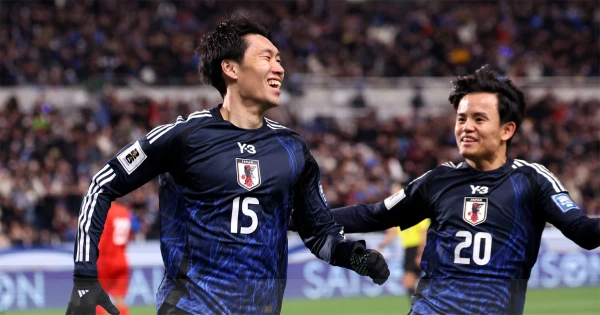
Japan seized control early. In the fourth minute, Daichi Kamada opened the scoring after a cross from Keito Nakamura, recording the fastest goal in Japan’s World Cup history. That early breakthrough set the tone for a confident, possession-oriented display. Japan doubled the lead in the 31st minute through Ayase Ueda, and although Tunisia’s goalkeeper kept the deficit from growing larger in the first half, Japan’s pressure never relented.

In the second half, Junya Ito added a third goal in the 69th minute, and Ueda completed his brace with a fourth in the 83rd minute—Japan’s first two-goal performance by a single player in a World Cup match. The 4-0 scoreline was notable on another level: Japan became the first Asian nation to score four goals in a single World Cup match across a combined total of 151 matches previously played by Asian teams at the tournament.
Beyond the scoreline, Japan’s style drew attention. The team delivered a tactically disciplined, fluid brand of football that combined high ball retention, quick transitions, and incisive attacking movement. That balance between structure and creativity reflected meticulous preparation under coach Hajime Moriyasu, who praised his players for sticking to a clearly defined game plan. “We knew what we wanted to do in this match,” Moriyasu said after the game. “We focused on playing attacking football rather than worrying about what the opponent might do.”
Japan’s performance is particularly notable given key absences ahead of the tournament. The squad was without several regular starters—including Kaoru Mitoma, Takumi Minamino and captain Wataru Endo—who were ruled out before the World Cup. The depth and adaptability shown in Mexico City underline Japan’s growing pool of international-quality players and signal a broader shift in the balance of Asian football.
Historically, South Korea often stood as Asia’s most visible global representative on the biggest stages. In recent years, however, Japan has steadily claimed that mantle. The national team’s modern approach blends technically proficient, attack-minded players who are increasingly experienced in top European leagues with a clear tactical identity developed by their coaching staff.
Japan’s path through the group now looks favorable. With three points from two matches, they enter their final group fixture against Sweden in a strong position to secure advancement to the knockout stage. Even a draw or a narrow defeat could be enough, depending on other results, but Japan’s current form suggests the team will pursue a win and maintain momentum into the knockout rounds.
Tunisia’s quick tournament exit will prompt reflection on squad depth and strategy after a campaign that did not yield any points. Facing two technically precise opponents in the Netherlands and Japan exposed defensive vulnerabilities and limited opportunities going forward. Tunisia now shifts focus toward rebuilding and assessing personnel ahead of future qualification campaigns and regional competitions.
Japan’s emphatic result also has implications beyond this single match. It will shape how opponents plan for the rest of the tournament and heighten attention on tactical matchups involving Asian teams. For Japanese football, the victory offers both a morale boost and a statement of intent: the nation is not merely competing at the global level but increasingly threatening to be among the tournament’s most dynamic sides.
As group play concludes, Japan will aim to carry the clarity and cohesion shown against Tunisia into tougher fixtures. The team’s ability to maintain defensive organization while producing varied attacking options will determine how far they can progress. For now, the 4-0 win stands as a powerful demonstration that Japan has emerged as a leading representative of Asian football on the World Cup stage.