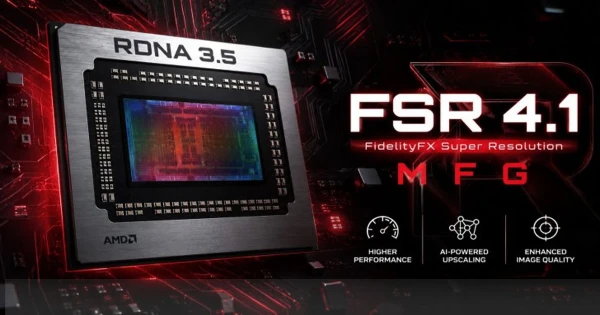
Valve accidentally released an early build of AMD's FSR 4.1 upscaling technology, and early testing suggests it works with RDNA 3.5 integrated graphics, offering a potential performance boost for handheld gaming devices.
An accidental leak from Valve has provided an early glimpse at AMD's upcoming FSR 4.1 upscaling technology, revealing its potential compatibility with a wider range of hardware than initially expected.
The leak originated from a Proton Experimental update, Valve's compatibility layer that allows Windows games to run on Linux-based systems like the Steam Deck. The update briefly included an FSR 4.1 file before it was swiftly removed. However, a Reddit user managed to download the file before it was taken down.

Testing Reveals Surprising Compatibility
The Reddit user successfully tested the leaked file on multiple graphics cards using OptiScaler, a community tool that enables upscaling technologies in games. The FSR 4.1.1 INT8 model worked as expected on the Radeon RX 7800 XT, an RDNA 3 GPU that AMD has confirmed will receive official support next month.
Unexpectedly, the technology also demonstrated functionality on an RDNA 2 GPU, the RX 6900 XT. Users reported visual artifacts on this older architecture, suggesting optimization work is still ongoing for legacy support.
The most promising development came from testing on the Radeon 890M, an integrated GPU based on the RDNA 3.5 architecture. This is particularly significant because AMD has not officially confirmed FSR 4 support for RDNA 3.5, and previous rumors suggested it might be excluded entirely. The leaked build reportedly worked without issues on this iGPU.
Implications for Handheld Gaming
The potential compatibility with RDNA 3.5 integrated graphics has major implications for the handheld gaming market. Many upcoming devices, including Valve's recently announced Steam Machine and the Xbox ROG Ally X, utilize AMD's Strix Point APUs, which feature RDNA 3.5 graphics.
FSR 4.1 represents a significant advancement in AMD's upscaling technology, incorporating machine learning models to improve image quality and performance. The technology functions similarly to Nvidia's DLSS, using AI to upscale lower-resolution images for improved frame rates without sacrificing visual fidelity.
AMD has remained silent regarding official FSR 4 support for RDNA 3.5. The company previously denied claims that the technology would be completely unavailable for this architecture, but has not provided a timeline for any official implementation.
Technical Implementation Challenges
The technical challenges of bringing FSR 4.1 to older architectures are significant. The technology was originally designed for RDNA 4 GPUs, which feature FP8 hardware acceleration. RDNA 3 and older architectures lack this capability, requiring engineers to adapt the machine learning models to work with INT8 integer calculations.
AMD has confirmed plans to release FSR 4.1 for RDNA 3 GPUs in July, with RDNA 2 support expected in 2027. The company has emphasized the complexity of the optimization process, which involves testing across hundreds of hardware configurations and thousands of games to ensure consistent quality.
Community Enables Early Access
The leaked FSR 4.1 build has enabled enthusiast users to access the technology ahead of its official release. The activation process using OptiScaler is relatively straightforward, requiring users to place the leaked file alongside the tool's existing files and enable a specific setting in the configuration file.
This community-driven approach has demonstrated the technology's broader compatibility, potentially influencing AMD's support decisions for previously unannounced hardware. The quality of the experience on unsupported hardware varies, with RDNA 3.5 showing particularly promising results compared to the artifacts reported on RDNA 2.
Looking Ahead
This accidental leak suggests AMD is actively developing FSR 4.1 support for a broader range of architectures than officially announced. The technology's successful operation on RDNA 3.5 integrated graphics opens possibilities for handheld gaming devices that rely on this architecture.
AMD's recent driver release added official FSR 4.1 support for RDNA 3 GPUs, expanding the technology to over 300 titles. While the company has not changed its official stance on RDNA 3.5 support, the leak demonstrates the underlying technical capability exists. For owners of the latest handheld gaming PCs, this may signal future performance improvements as AMD finalizes its compatibility roadmap.