
The Silent Revolution: How Enterprise AI Agents Are Reshaping Productivity in 2026
By the time most executives realized what was happening, their workflows had already changed forever.
Abdullah Sahel | প্রকাশিত: ১৮ জুন, ২০২৬, ০৩:২৩ পিএম
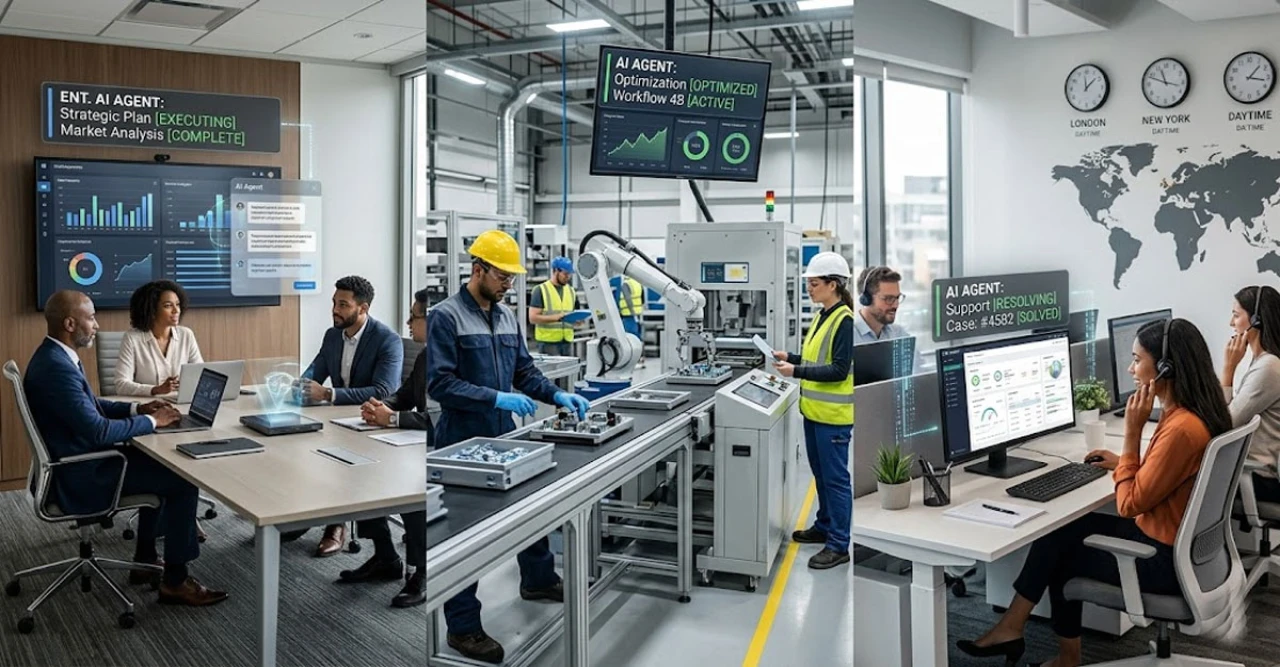
Across boardrooms, factory floors, and customer service centers worldwide, a new class of intelligent software is quietly dismantling decades-old assumptions about how work gets done. Enterprise AI agents — autonomous, goal-directed systems capable of reasoning, planning, and executing multi-step tasks with minimal human oversight — are no longer a distant promise buried in technology roadmaps. They are active participants in the modern workplace, and their impact on organizational productivity is both measurable and profound.
What Are Enterprise AI Agents, and Why Do They Matter Now?
Unlike traditional AI tools that respond to a single prompt and stop, enterprise AI agents operate with a degree of autonomy that sets them apart. They can break down complex objectives into subtasks, call upon external tools and data sources, make sequential decisions, and course-correct when something goes wrong — all without a human clicking "run" at every step.
Think of the difference between a calculator and an accountant. A calculator waits for you to punch in numbers. An accountant proactively gathers your financial data, flags anomalies, generates reports, and follows up on discrepancies. Enterprise AI agents behave much more like the latter.
This distinction matters enormously in 2026 because organizations are no longer deploying AI simply to speed up individual tasks. They are deploying AI to redesign entire workflows. The shift from AI-as-tool to AI-as-collaborator is the defining productivity story of this era.
The Core Capabilities Driving the Transformation
To understand the productivity gains enterprises are reporting, it helps to examine the specific capabilities that make modern AI agents uniquely powerful:
- Autonomous task orchestration: Agents can receive a high-level goal — "prepare a competitive analysis for our Q3 strategy meeting" — and independently gather data, synthesize findings, structure a document, and flag gaps for human review.
- Cross-system integration: Enterprise agents connect seamlessly to CRMs, ERPs, communication platforms, and proprietary databases, eliminating the manual data-transfer work that consumes hours of employee time each week.
- Continuous learning and adaptation: Unlike static software, well-designed AI agents improve their performance over time by learning from outcomes, user feedback, and updated data — making them more valuable the longer they are deployed.
- Scalability without proportional cost: A single AI agent framework can handle workflows that would previously have required entire teams, scaling capacity instantly during peak demand without the friction of hiring or training.
- Error detection and self-correction: Advanced agents don't just execute; they monitor their own outputs, verify results against defined criteria, and flag or fix inconsistencies before passing work downstream.
Where Enterprise AI Agents Are Delivering the Greatest Productivity Gains
Finance and Operations
Finance teams have been among the earliest and most enthusiastic adopters of agentic AI. Agents now handle end-to-end accounts payable workflows, automated variance analysis, real-time cash flow forecasting, and regulatory compliance checks. What once took a team of analysts several days can now be completed in hours — with greater consistency and a significantly lower error rate.
In operations, AI agents are coordinating supply chain logistics, monitoring inventory thresholds, automatically triggering purchase orders, and generating exception reports for human decision-makers to review. The productivity dividend here is not just speed — it is the liberation of skilled professionals from repetitive cognitive labor, freeing them to focus on judgment-intensive work.
Customer Experience and Support
Customer-facing AI agents have evolved well beyond scripted chatbots. Today's enterprise-grade support agents can access a customer's full interaction history, diagnose problems, execute backend transactions, escalate complex cases intelligently, and communicate in multiple languages — all in real time. Organizations deploying these systems are reporting measurable reductions in average handle time and sustained improvements in customer satisfaction scores.
Knowledge Work and Research
For knowledge workers — analysts, researchers, strategists, and product managers — AI agents are functioning as tireless research assistants. They can scan thousands of documents, extract relevant insights, cross-reference findings, draft summaries, and generate structured reports in a fraction of the time a human team would require. This is not replacing human judgment; it is dramatically amplifying the volume of informed decisions that human experts can make per unit of time.
Software Development
Development teams are experiencing one of the most dramatic productivity transformations of any sector. AI agents now assist with writing boilerplate code, reviewing pull requests, identifying security vulnerabilities, generating test cases, and maintaining documentation. Developers are reporting that agentic coding tools allow them to move from concept to deployable prototype significantly faster than before.
The Organizational Challenges Nobody Warned You About
Productivity gains of this magnitude do not arrive without friction. Organizations that have moved fastest with enterprise AI agents have also encountered a consistent set of challenges that deserve honest attention:
- Governance and accountability gaps: When an AI agent makes a consequential decision autonomously, questions of accountability become complex. Enterprises need clearly defined frameworks for determining when human oversight is mandatory and when autonomous execution is acceptable.
- Data quality as a bottleneck: AI agents are only as good as the data they work with. Organizations with fragmented, inconsistent, or poorly governed data infrastructure will find that deploying agents amplifies existing data problems rather than solving them.
- Workforce anxiety and change management: Employees whose roles are being reshaped by AI agents require clear communication, retraining pathways, and reassurance that the goal is augmentation — not replacement. Productivity transformations that ignore the human dimension tend to underperform.
- Security and compliance exposure: Agents that operate across multiple systems with elevated permissions represent a significant attack surface. Robust security protocols, access controls, and audit logging are non-negotiable prerequisites for responsible enterprise deployment.
How Forward-Thinking Organizations Are Getting It Right
The most successful enterprise AI agent deployments share several common attributes:
- They start with process clarity, not technology. Before deploying an agent, high-performing organizations map the existing workflow in granular detail — identifying bottlenecks, decision points, and exception cases. Agents inserted into poorly understood processes tend to automate chaos rather than create order.
- They prioritize human-in-the-loop design for high-stakes decisions. The most effective deployments distinguish clearly between tasks suitable for full automation and those that warrant human review before action is taken.
- They invest in data infrastructure first. Clean, well-governed, accessible data is the fuel that makes AI agents powerful. Enterprises that treat data quality as a prerequisite rather than an afterthought consistently achieve better outcomes.
- They measure what matters. Successful teams define productivity metrics before deployment — cycle time reduction, error rate, cost per transaction, employee hours recaptured — and track them rigorously. This enables continuous improvement and makes the business case concrete.
- They treat deployment as a journey, not an event. Enterprise AI agent capabilities evolve rapidly. Organizations that build internal expertise, iterate on deployments, and foster a culture of continuous learning extract far more value than those who treat AI as a set-and-forget implementation.
The Productivity Imperative Is Not Optional
What makes the enterprise AI agent revolution particularly significant is the competitive pressure it is creating across industries. Organizations that deploy these systems effectively are compressing timelines, reducing costs, and improving output quality simultaneously. Those that delay face a growing productivity gap that becomes harder to close with each passing quarter.
This is not a story about technology for technology's sake. It is a story about what becomes possible when intelligent systems handle the work that does not require human judgment — and what humans are freed to do with the cognitive bandwidth they reclaim.
The shift is already underway. The only real question is how intentionally and strategically organizations choose to participate in it.
Conclusion: A Permanent Shift in How Work Gets Done
Enterprise AI agents represent more than an incremental improvement in workplace efficiency. They represent a structural change in the relationship between human intelligence and organizational output. By automating not just tasks but entire reasoning workflows, these systems are compressing the distance between intention and execution in ways that were practically inconceivable just a few years ago.
The enterprises that will thrive in this environment are not necessarily those with the largest AI budgets — they are those with the clearest vision of what they want AI to accomplish, the organizational discipline to implement it responsibly, and the commitment to continuously refine their approach as the technology evolves.
For productivity, the era of enterprise AI agents is not a chapter that will eventually close. It is the new baseline from which all future progress will be measured.