
The Sky Is No Longer the Limit: How Sustainable Aviation Fuel Is Rewriting the Future of Flight
Mousumi Akter | প্রকাশিত: ১৮ জুন, ২০২৬, ০৩:২৩ পিএম
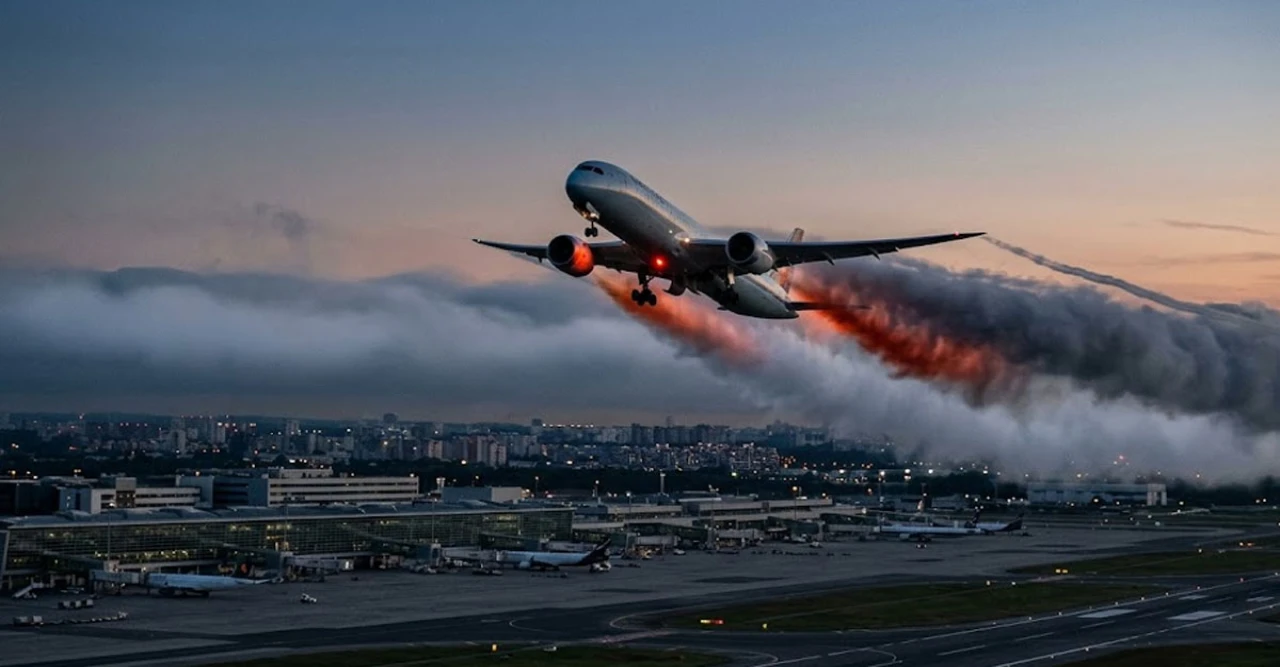
The aviation industry faces one of the most daunting decarbonization challenges of the 21st century — and a revolutionary green jet fuel is quietly becoming its most powerful answer.
Every time a commercial jet lifts off, it burns through thousands of gallons of kerosene-based fuel, releasing CO₂, nitrogen oxides, and contrail-forming particles into the upper atmosphere. Aviation currently accounts for roughly 2.5% of global CO₂ emissions — a figure that balloons to nearly 4–5% of effective climate forcing when non-CO₂ warming effects are factored in. With passenger numbers projected to double by 2040, the industry has been under mounting pressure to decarbonize, and fast.
Enter Sustainable Aviation Fuel — widely known as SAF — the drop-in alternative to conventional jet fuel that industry leaders, governments, and climate scientists increasingly describe as the single most viable near-term solution to aviation's carbon crisis.
What Exactly Is Sustainable Aviation Fuel?
At its core, SAF is a jet fuel produced from non-fossil feedstocks. It is chemically similar enough to conventional aviation fuel (Jet-A or Jet-A1) to be used in existing aircraft engines and fueling infrastructure without modification — hence the term "drop-in fuel." But the similarities largely end there.
SAF is manufactured from a diverse range of sustainable feedstocks, including:
- Agricultural and forestry residues — crop waste, wood chips, and sawdust
- Municipal solid waste — household and industrial refuse that would otherwise end up in landfills
- Cooking oils and animal fats — waste lipids from food processing industries
- Algae and energy crops — fast-growing biomass specifically cultivated for fuel production
- Green hydrogen and captured CO₂ — the basis for synthetic Power-to-Liquid (PtL) SAF, considered the most scalable long-term pathway
Across its full lifecycle — from feedstock cultivation or collection to combustion — SAF can reduce carbon emissions by up to 80% compared to conventional jet fuel. Some advanced production pathways, particularly those using direct air carbon capture, push that figure even higher.
The State of SAF in 2026: Momentum Meets Reality
The SAF industry has entered a phase of decisive acceleration. Global production capacity has grown dramatically over the past three years, driven by a convergence of policy mandates, airline commitments, and unprecedented capital investment in green aviation technology.
Key indicators of where the industry stands:
- The European Union's ReFuelEU Aviation regulation mandates a minimum 2% SAF blend at EU airports as of 2025, scaling to 6% by 2030 and 70% by 2050. Airlines that fail to uplift the required SAF volumes face per-tonne financial penalties.
- The United States Inflation Reduction Act (IRA) provides production tax credits of up to $1.75 per gallon for SAF that meets a 50% lifecycle greenhouse gas reduction threshold — a provision that has catalyzed dozens of new domestic refinery projects.
- The United Kingdom, Singapore, Japan, and India have each introduced national SAF blending mandates or roadmaps, creating a genuinely global regulatory push.
- The International Air Transport Association (IATA) has maintained its commitment to net-zero aviation by 2050, with SAF expected to contribute around 65% of the total emissions reduction required.
Despite this momentum, SAF still represents less than 1% of global jet fuel consumption. The production gap is real, and closing it is the defining challenge of the next decade.
The Net-Zero Aviation Technology Landscape
SAF does not exist in isolation. It forms one pillar of a broader net-zero aviation technology ecosystem that is evolving rapidly.
Hydrogen-Powered Aircraft
Green hydrogen — produced through electrolysis powered by renewable energy — is being actively developed as both a direct fuel source and a feedstock for synthetic SAF. Airbus has publicly committed to bringing a hydrogen-powered commercial aircraft to market by 2035. While hydrogen propulsion faces significant infrastructure and certification hurdles, its role in long-range aviation decarbonization is considered strategically essential.
Electric and Hybrid-Electric Aviation
For short-haul routes of under 500 kilometers, battery-electric and hybrid-electric aircraft are advancing from prototype to commercial viability. Startups such as Heart Aerospace and established players like Embraer are developing regional electric aircraft that could eliminate direct emissions on the routes that represent the majority of flight departures worldwide — even if not the majority of fuel burned.
Carbon Offsetting and Removal
High-quality carbon removal — including direct air capture, enhanced weathering, and biochar — is increasingly recognized as a necessary complement to efficiency gains and SAF adoption for hard-to-abate emissions. However, reliance on low-quality offsets has fallen sharply out of favor following independent scrutiny of offset integrity in the early 2020s.
Breaking Down the SAF Cost Challenge
One of the most persistent barriers to SAF adoption is cost. Conventional jet fuel trades at approximately $0.60–$0.90 per liter, while first-generation SAF currently costs two to five times more. Advanced Power-to-Liquid SAF can cost even more at current scale.
However, this cost gap is narrowing, for several structural reasons:
- Economies of scale — As production capacity grows and more refineries come online, per-unit production costs are falling in line with standard manufacturing learning curves.
- Policy support — Government subsidies, tax credits, and blending mandates are de-risking investment and effectively lowering the net cost for airlines.
- Carbon pricing — As carbon markets mature and the price of conventional fuel's carbon externalities is increasingly internalized, the cost differential between SAF and conventional fuel continues to shrink.
- Co-product revenues — Many SAF production processes yield valuable chemical co-products that help offset production costs.
Industry analysts broadly project that SAF could reach cost parity with fossil jet fuel in premium markets by the mid-2030s, with broader parity achievable by 2040 as renewable energy costs continue to fall.
What Airlines and Airports Are Doing Right Now
The transition to green aviation is already visible at the operational level.
- Delta Air Lines, United Airlines, and Lufthansa Group have each signed multi-year SAF offtake agreements worth hundreds of millions of dollars with producers including Neste, World Energy, and LanzaJet.
- Schiphol Airport in Amsterdam and Los Angeles International Airport have both invested in centralized SAF delivery infrastructure, enabling high-volume blending before aircraft fueling.
- Several major cargo carriers, including DHL and FedEx, have committed to fleet-wide SAF targets, recognizing that freight aviation faces identical decarbonization pressures.
- Corporate aviation programs — known as Book-and-Claim systems — allow business travelers and freight customers to purchase SAF certificates corresponding to their flight emissions, creating demand independent of where the physical fuel is uplifted.
The Road Ahead: Five Factors That Will Shape SAF's Trajectory
The future of sustainable aviation fuel will be determined by how quickly the industry resolves five interconnected challenges:
- Feedstock availability and sustainability certification — Scaling SAF production without competing with food systems or driving deforestation requires rigorous certification standards and diversified feedstock pipelines.
- Green hydrogen cost reduction — Power-to-Liquid SAF is the most scalable long-term pathway, but it depends on affordable renewable electricity and green hydrogen — both of which are still declining in cost but not yet cheap enough at the scale required.
- Regulatory harmonization — Inconsistent national mandates, differing lifecycle carbon accounting methodologies, and fragmented certification frameworks create compliance complexity for global carriers.
- Infrastructure investment — Production facilities, logistics networks, and airport storage capacity all require significant capital deployment over the next decade.
- Public and corporate demand — Traveler willingness to pay a SAF surcharge and corporate Scope 3 emissions commitments will play a meaningful role in accelerating supply-side investment.
Conclusion: A Fuel for a Cleaner Sky
The story of Sustainable Aviation Fuel is ultimately the story of an industry confronting its most uncomfortable truth — that the same freedom of movement it enables comes with a profound environmental cost — and choosing to engineer its way out of that contradiction rather than deny it.
SAF is not a silver bullet. It will not, on its own, solve aviation's climate impact overnight. The path to net-zero commercial aviation runs through a portfolio of solutions: efficiency improvements in aircraft design, operational optimization, electric propulsion for short routes, green hydrogen for longer ones, and credible carbon removal for residual emissions. But SAF is, by any serious analysis, the most immediately deployable, scalable, and infrastructure-compatible option available to the industry today.
What was a niche concept a decade ago has become a regulatory mandate, a multi-billion-dollar investment category, and the centerpiece of every credible net-zero aviation roadmap on the planet. The planes flying over your city in 2035 will very likely burn a meaningfully different fuel than the ones flying today — and that difference will matter, enormously, to the atmosphere above them.
The aviation industry's green transformation is no longer a question of if. The only question that remains is how fast.