
Inside NGAD: How America's Sixth-Generation Fighter Is Reshaping the Future of Air Combat
Abdullah Sahel | প্রকাশিত: ২৮ জুন, ২০২৬, ০৯:৪৮ পিএম
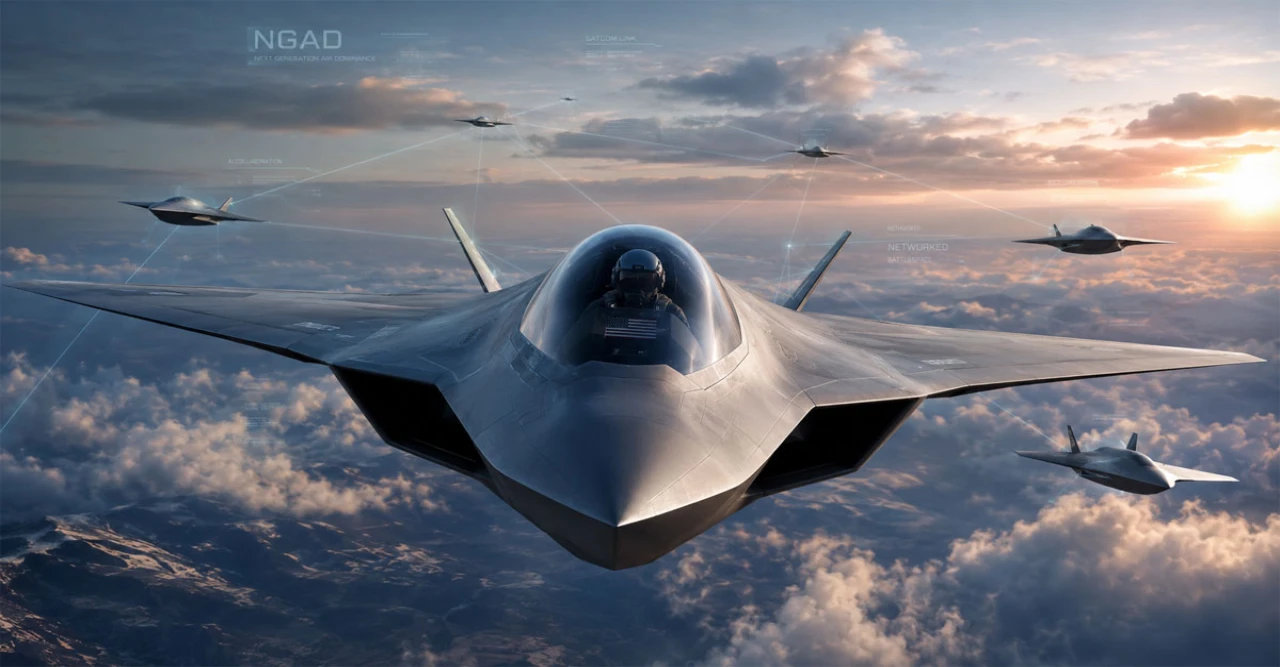
The next aircraft to defend American skies will not look, fly, or fight like anything currently in service. It will share its cockpit with artificial intelligence, coordinate a swarm of robotic wingmen, and trade some of the dogfighting instincts that defined fighter jets for a century in favor of long-range sensors and networked decision-making. That aircraft is the product of the Next Generation Air Dominance program, known throughout the defense world simply as NGAD.
For most Americans, NGAD has surfaced in headlines as a single number — a price tag, a contract award, a budget line — without much explanation of what the program actually is or why it matters. But NGAD is not just another fighter jet acquisition. It represents a fundamental rethink of how the United States plans to maintain air superiority in an era when stealth alone is no longer enough, when satellites and sensors can spot aircraft from farther away than ever, and when potential adversaries are fielding their own advanced jets. Understanding NGAD means understanding where American air power is headed for the next several decades.
What NGAD Actually Is
NGAD is not the name of an aircraft. It is the name of a Department of the Air Force initiative built around a "family of systems" concept rather than a single jet. At its center sits a crewed, sixth-generation stealth fighter — now formally designated the F-47 — designed to succeed the F-22 Raptor as the nation's primary air superiority platform. Surrounding that fighter is a constellation of supporting technologies: autonomous drones, advanced sensors, resilient communications, and new weapons designed to work together rather than in isolation.
This systems-based approach distinguishes NGAD from earlier fighter programs. The F-22 and F-35 were each conceived as standalone aircraft that happened to share data with other platforms. NGAD inverts that logic. The crewed fighter is the anchor of a broader network, but the network itself — not any single jet — is the actual military capability the Air Force is buying.
From Concept to Contract: A Decade in the Making
The roots of NGAD stretch back further than most people realize. The program traces its origins to a 2014 Defense Advanced Research Projects Agency study on air superiority needs for the coming decades, which prompted Air Force and Navy officials to begin planning the next generation of dominance in the skies. That analysis concluded that a single aircraft type would not be sufficient on its own and that future air superiority would instead require a coordinated family of systems built around a crewed fighter, supported by networked drones, sensors, and new weapons.
From there, the program moved through several phases:
- Early demonstration (2015–2019): Full-scale experimental aircraft, known as X-planes, were built and flown under a classified DARPA effort, with competing prototypes from major defense contractors taking shape during this period.
- Formal designation (2018): The effort, previously organized around an "Air Superiority 2030" flight plan, evolved into the formally named Next Generation Air Dominance program, encompassing propulsion, stealth, advanced weapons, digital design, and aircraft signature management.
- Competition and pause (2022–2024): By 2023, multiple major contractors had each developed their own NGAD demonstrator aircraft, and the Air Force issued a classified request for proposals to select a replacement for the F-22. Budget pressures, however, forced a temporary pause in the program the following year while officials reassessed cost and design choices.
- Contract award (2025): The Air Force ultimately moved forward with development, awarding an engineering and manufacturing development contract for the aircraft that would become the F-47.
That award ended a long stretch of uncertainty and, notably, went to a company that had not built a new fighter jet in decades — a detail that surprised much of the defense industry given the alternative contender's extensive history producing America's existing stealth aircraft.
Why the Air Force Says It Needs a Sixth-Generation Fighter
It's a fair question: the F-22 and F-35 are still considered among the most capable fighters in the world. So why replace them?
The answer comes down to a combination of geography, technology, and the changing nature of detection. Air Force planners have specifically pointed to the need for a fighter that can operate over the vast distances of the Indo-Pacific region, where current aircraft lack sufficient range and payload capacity to be fully effective. A fighter designed in the 1990s for shorter-range European contingencies does not necessarily translate well to a theater where the nearest friendly airfield might be hundreds of miles from a contested area.
There's also the matter of staying ahead of advancing sensor and missile technology. Stealth shaping that defeated radar systems a generation ago faces tougher challenges today, as detection methods improve and proliferate. A sixth-generation design has to assume that low observability alone won't guarantee survivability — it needs longer range, better situational awareness, and the ability to operate as part of a team rather than alone.
Military officials have also emphasized a less obvious rationale: it's not really about replacing one jet with a slightly better jet. Air Force leadership has described the value of crewed sixth-generation aircraft specifically in terms of their ability to operate effectively alongside tomorrow's air defense networks, electronic warfare systems, and adversary aircraft of similar sophistication — a cooperative function rather than a solo one.
Key Characteristics Defining Sixth-Generation Fighters
While many design specifics remain classified, defense analysts and military officials have outlined the general characteristics that separate sixth-generation aircraft like the F-47 from their fifth-generation predecessors:
- Manned-unmanned teaming. Rather than flying alone, the crewed fighter is expected to direct semi-autonomous drone wingmen, known as Collaborative Combat Aircraft, that can scout ahead, carry additional weapons, or absorb risk that would otherwise fall on a human pilot.
- Artificial intelligence as a decision aid. AI systems are intended to help pilots process sensor data faster than a human could alone, functioning as an evolution of the sensor fusion already found in fifth-generation cockpits.
- Adaptive-cycle propulsion. New engine designs aim to adjust their performance characteristics in flight, balancing fuel efficiency at cruise altitude with the power needed for high-speed maneuvers — extending range without sacrificing thrust.
- Digital engineering from the ground up. Designers are using model-based digital design tools throughout development, a departure from the more traditional engineering processes used for earlier aircraft, intended to reduce both cost and schedule risk.
- Extended range and persistence. Greater range is a recurring theme across nearly every public description of the program, driven largely by the operational demands of the Pacific theater.
- Resilient, non-traditional navigation and communication. Systems designed to function even when GPS signals are degraded or denied, along with secure methods of sharing large volumes of data between aircraft in real time.
The Family of Systems: More Than Just a Fighter Jet
It's worth dwelling on the "family of systems" framing, because it explains decisions that would otherwise seem puzzling — including the Air Force's willingness to pause the crewed fighter component while continuing to invest in everything around it.
The broader NGAD effort includes uncrewed collaborative combat aircraft operating in a manned-unmanned teaming arrangement alongside the crewed jet. Air Force plans call for procuring roughly 200 of the new crewed fighters alongside more than 1,000 of these uncrewed collaborative aircraft, with a planned ratio of about two drones for every crewed F-47 or F-35A in the fleet.
This matters for a simple reason: a smaller number of expensive, highly survivable crewed aircraft can extend its reach and effectiveness dramatically if it's paired with a much larger number of cheaper, expendable drones. The crewed fighter becomes a quarterback rather than a lone striker — directing sensors, weapons, and risk distribution across a networked formation. This approach also offers a hedge against attrition; losing an uncrewed wingman in combat carries a far lower cost, in both dollars and lives, than losing a crewed fighter.
Addressing the Cost Question
No discussion of NGAD is complete without acknowledging its price. Earlier cost estimates placed the per-unit price of the crewed fighter near $300 million, roughly three times the cost of an F-35 — a figure that triggered a genuine reckoning inside the Pentagon.
That cost concern led the Air Force to pause the program and commission a dedicated affordability study, which considered options including a smaller airframe, a reduced number of engines, shorter range, and shifting more capability onto uncrewed platforms. The study ultimately concluded that the program remained necessary but needed to be redesigned with affordability as a central requirement, and that redesign shaped the competition that followed.
This back-and-forth illustrates a broader truth about major defense acquisition programs: cost growth and schedule slippage are not unique to NGAD, but recurring features of developing aircraft at the technological frontier. Programs of this scale routinely face a tension between maximizing capability and controlling cost, and the public record of NGAD's pause-and-redesign cycle offers a useful, transparent example of how that tension gets resolved in practice.
How NGAD Fits Into the Bigger Picture of U.S. Air Power
It helps to place NGAD alongside the aircraft it will eventually join — and in some cases replace — in the Air Force's inventory:
- F-22 Raptor: The current air superiority fighter and the aircraft NGAD's crewed component is designed to succeed. Due to schedule realities common to advanced fighter development, the F-22 is expected to remain in service well into the next decade.
- F-35 Lightning II: A multirole stealth fighter that will continue serving alongside the new sixth-generation aircraft rather than being replaced by it; the two are designed to operate as complementary, not competing, platforms.
- B-21 Raider: A new stealth bomber developed separately but sharing some of the same design philosophy — digital engineering, advanced stealth, and a focus on long-range, contested-environment operations.
- Collaborative Combat Aircraft: The uncrewed drones designed to operate alongside both the F-47 and existing F-35 fleets, forming the connective tissue of the broader family-of-systems concept.
This is also a global story, not solely an American one. Other nations are pursuing their own sixth-generation efforts on different timelines and with different design philosophies, underscoring that air superiority remains a contested, evolving competition rather than a fixed American advantage.
Common Misconceptions About NGAD
A few persistent misunderstandings are worth clearing up:
- "NGAD is the name of the plane." It isn't. NGAD is the program; the aircraft itself carries its own designation, the F-47.
- "It will replace the F-35." It won't. The F-35 is a multirole fighter built for a different mix of missions and is expected to remain in production and service for many years alongside the new sixth-generation fighter.
- "Sixth-generation just means stealthier." Stealth matters, but the defining shift is the move toward networked, AI-assisted, manned-unmanned operations — a change in how aircraft fight, not just how well they hide.
- "The drones will replace human pilots." The collaborative combat aircraft are designed to extend and support a human-piloted fighter, not eliminate the pilot's role in air combat decision-making.
What This Means for the Years Ahead
NGAD represents a long-term bet on a particular vision of future air combat: fewer but more capable crewed aircraft, extended dramatically in reach and effectiveness by larger numbers of autonomous systems, all tied together by artificial intelligence and resilient networking. It is as much an organizational and conceptual shift as it is a hardware program.
For readers tracking defense policy, a few durable takeaways apply regardless of any single year's budget cycle or headline:
- Expect continued emphasis on uncrewed teaming, not just crewed aircraft performance, as the real measure of next-generation air power.
- Cost and schedule pressure will remain a permanent feature of advanced fighter development, not a one-time hurdle.
- The "family of systems" framework — rather than any single jet — is the lasting organizing principle behind how the Air Force is planning for future air dominance.
- Sixth-generation aircraft are being designed around persistence, range, and networked decision-making at least as much as raw stealth performance.
The sixth-generation fighter era is still taking shape, and many specifics will remain classified for years. But the underlying logic driving NGAD — distributed, AI-enabled, manned-unmanned air combat — is likely to define American air power doctrine well beyond the arrival of any single aircraft.