
Ghost Bat Rising: Inside the Drone Wingman Reshaping How America Fights in the Sky
Omor Farooq | প্রকাশিত: ২৯ জুন, ২০২৬, ০১:২৯ এএম
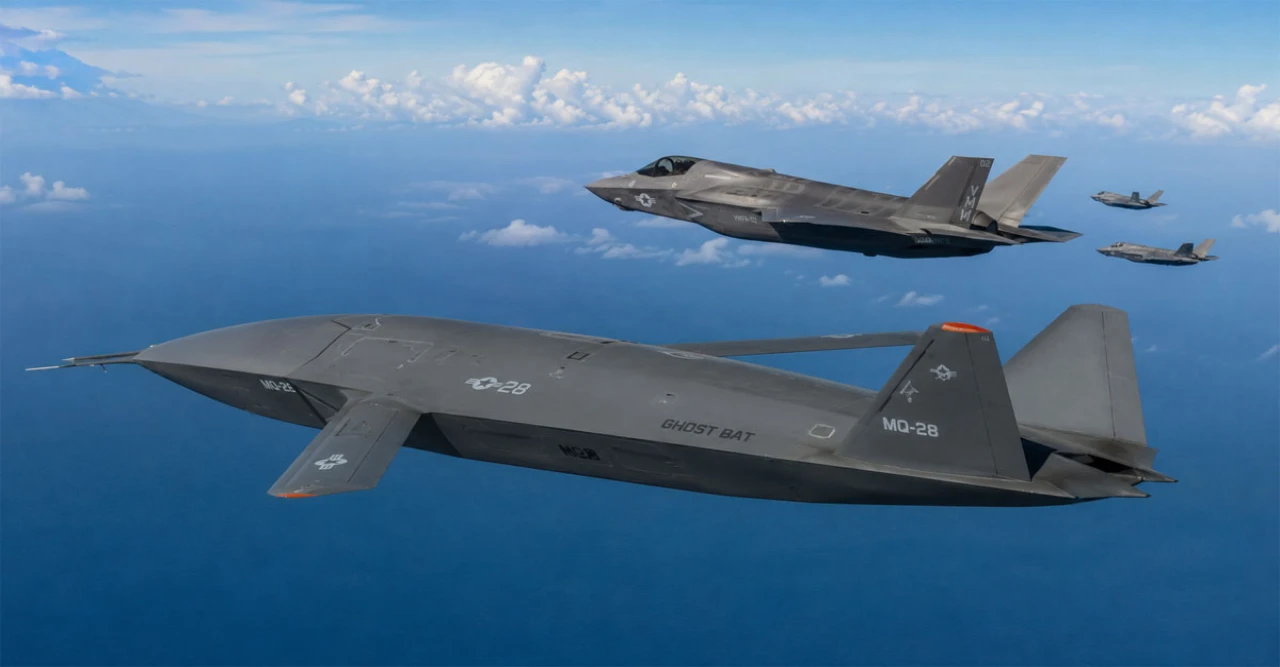
A sleek, finless aircraft taxis down a remote Pacific runway with no pilot aboard because it doesn't need one. Minutes later, it's airborne, flying in formation with crewed fighter jets as if it has done this for years. This is the MQ-28 Ghost Bat, and its recent appearance alongside U.S. Air Force and allied aircraft in a major Indo-Pacific exercise marks more than a single test flight. It signals a shift in how the United States and its allies intend to fight future air wars — fewer pilots in harm's way, more autonomous "teammates" in the sky. For anyone tracking where American airpower is headed, the Ghost Bat's debut offers a clear window into that future.
What the MQ-28 Ghost Bat Actually Is
The MQ-28 Ghost Bat is an uncrewed, jet-powered aircraft developed by Boeing's Australian subsidiary, originally built for the Royal Australian Air Force before drawing interest from the U.S. military and other allied nations. It belongs to a category known as Collaborative Combat Aircraft, or CCA — a term quickly becoming as familiar in defense circles as "drone" or "fighter jet."
Unlike the remotely piloted drones many Americans picture when they hear "UAV," the Ghost Bat isn't simply flown by a joystick operator watching a video feed. It's designed to operate with a high degree of autonomy, using artificial intelligence to fly independently for long stretches of a mission while a human supervises critical decisions from a distance.
Key characteristics include:
- Stealthy airframe with a fighter-sized fuselage, canted tail surfaces, and side-mounted intakes that reduce radar signature.
- Modular nose section swappable for infrared search and track sensors, electronic warfare gear, or reconnaissance equipment.
- Long range, capable of flying thousands of kilometers without refueling — critical for the vast distances of Pacific operations.
- Internal weapons capacity in later versions, allowing air-to-air missiles while keeping a low radar profile.
- AI-driven flight management that reduces routine human input while keeping a person "in the loop" for weapons decisions.
Why the Pacific Exercise Mattered
The Ghost Bat's participation in a large, multinational exercise in the Pacific — bringing together forces from the United States, Australia, Japan, Canada, and New Zealand — marked its first real test inside a complex, coalition-style training environment. Rather than flying in isolation, the aircraft operated alongside crewed fighters and surveillance planes, contributing to missions requiring detection and tracking of simulated threats across vast stretches of ocean and airspace.
This kind of exercise matters for reasons that extend well beyond any single event:
- It tests integration, not just flight performance. Building an aircraft that can fly is one challenge. Building one trusted to operate safely alongside crewed jets, radar planes, and ground controllers from multiple countries is far harder — and only large, realistic exercises can validate it.
- It demonstrates "human-machine teaming" in practice. Drones like the Ghost Bat are designed to be handed off between operators mid-mission — launched by one team, then tasked by a fighter or airborne early warning crew to perform reconnaissance, electronic warfare, or strike-support functions.
- It showcases distributed, austere operations. Modern planners favor spreading aircraft across many small, remote airfields rather than concentrating them at a few major bases vulnerable to attack. Operating an autonomous aircraft from a small island runway with minimal infrastructure demonstrates that capability.
The Strategic Logic Behind Collaborative Combat Aircraft
To understand why the U.S. military has invested heavily in this aircraft category, it helps to look at the underlying problem CCAs are meant to solve.
The Pilot and Cost Problem
Modern fighter jets are extraordinarily expensive, and training a single pilot takes years and millions of dollars. Meanwhile, potential adversaries have fielded growing numbers of advanced fighters and air defenses. Building more crewed fighters runs into budget limits and a simple fact: there aren't enough pilots to fly an unlimited number of jets.
Collaborative Combat Aircraft offer a different path: produce large numbers of relatively lower-cost, uncrewed aircraft that fly alongside fewer crewed jets, multiplying the sensors, weapons, and decoys in the sky without multiplying the pilots at risk.
Mass, Attrition, and Adaptability
Military planners often describe future high-end conflicts, particularly in the Pacific, as contests of "mass" — the side that can field more capable systems across a wide area and sustain losses without losing the fight holds an advantage. Because CCAs are uncrewed and built with attrition in mind, commanders can use them for higher-risk missions, such as scouting contested airspace, without risking a pilot's life.
That risk tolerance pairs with flexibility. Because aircraft like the Ghost Bat use modular, swappable payloads, the same airframe can be reconfigured for different missions — surveillance one day, electronic jamming the next, decoy duties after that — without needing an entirely different aircraft for each role. This lets air forces adapt faster than adversaries relying on single-purpose platforms.
How Collaborative Combat Aircraft Fit Into the Broader U.S. Air Force Plan
The Ghost Bat is one entrant in a wider U.S. Air Force effort to field CCAs at scale. The service has been developing its own designs through a phased program, often called "Increment 1" and "Increment 2," under which competing contractors build prototype aircraft that undergo rigorous flight testing before any production decision is made.
This phased approach reflects principles worth understanding regardless of which aircraft wins which contract:
- Competitive prototyping reduces risk. Rather than betting everything on one design, the Air Force funds multiple competing prototypes, letting the best-performing or most cost-effective design — or a mix — move into production.
- Iterative increments allow rapid learning. Early CCA variants are treated as a starting point, not a finished product. Lessons from initial testing inform substantially different, more advanced designs later.
- A "family of systems" is the goal. Rather than one drone design, the Air Force envisions a mix of aircraft with different strengths — range and endurance, speed, sensor or strike roles — operating together as a flexible, layered force.
Common Misconceptions About Drone Wingmen
As autonomous military aircraft move from concept to real-world testing, several misunderstandings tend to recur in public discussion. Clearing them up helps put programs like the Ghost Bat into proper context.
Misconception: These aircraft fly themselves with no human involvement. In practice, current programs keep a human responsible for critical decisions, particularly weapons use. Autonomy generally applies to routine tasks — navigation, formation-keeping, sensor management — rather than lethal-force decisions.
Misconception: Collaborative Combat Aircraft are meant to replace fighter pilots. These programs extend and protect crewed aircraft rather than eliminate them. The drones act as "loyal wingmen," taking direction from crewed fighters or command aircraft rather than operating as independent replacements for piloted jets.
What This Means for Long-Term U.S. Air Power
Looking past any individual exercise or aircraft milestone, a few durable trends are worth tracking for anyone following American defense policy and aerospace innovation in the years ahead:
- Expect continued, incremental testing rather than sudden full deployment. Military aircraft programs typically move through years of prototyping and limited evaluation before large-scale fielding. CCAs follow that same pattern.
- Allied interoperability will remain a priority. As more countries develop or buy similar autonomous aircraft, joint exercises will grow more common and more important for validating coordination.
- Costs and timelines will shape outcomes as much as technology. Even a highly capable autonomous aircraft only matters if it can be produced affordably and in sufficient numbers.
- Human oversight of autonomous weapons will remain a central policy question. As these aircraft take on more sophisticated roles, expect continued attention to how much autonomy is appropriate and what safeguards keep humans accountable for decisions involving force.
Frequently Asked Questions
Is the MQ-28 Ghost Bat an American aircraft? No. It was originally designed and built by Boeing's Australian subsidiary for the Royal Australian Air Force, though it has since drawn interest from the U.S. military and other allied air forces.
How is a Collaborative Combat Aircraft different from a typical military drone? Traditional drones are usually flown remotely by a dedicated operator for the duration of a mission. Collaborative Combat Aircraft are designed to operate with greater autonomy, often tasked intermittently by the crew of a manned aircraft rather than continuously piloted from the ground.
The Bottom Line
The Ghost Bat's appearance in a major Pacific exercise is a milestone worth remembering not because one aircraft flew successfully, but because of what it represents: the slow, deliberate transition of autonomous combat aircraft from experimental technology into a tested component of allied military strategy. For the U.S. Air Force and its partners, the work ahead involves years of further testing, competitive development between multiple designs, and careful policy decisions about how much autonomy to entrust to machines in contested skies. Readers tracking the future of American airpower should watch not just individual aircraft like the Ghost Bat, but the broader Collaborative Combat Aircraft concept it represents — a shift likely to define military aviation procurement, allied cooperation, and air combat doctrine for years to come.