



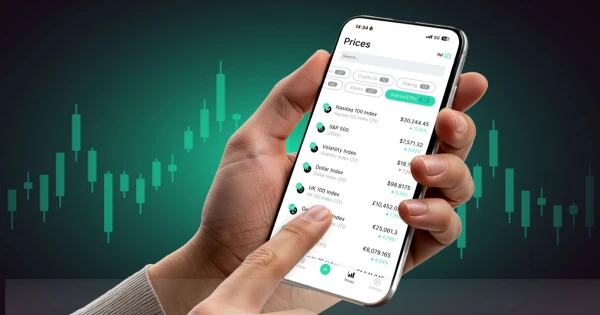
The number of Americans managing their investments through a smartphone application has reached a record high in 2026, with new data showing that 58 percent of the US population now uses a mobile investment platform — up sharply from 41 percent just four years ago.
The surge reflects a broader shift in personal finance habits, driven by years of low interest rates on traditional savings accounts, rising awareness of long-term wealth building, and the growing ease of entry offered by modern investment apps. Where investing once required a formal relationship with a licensed broker and a minimum deposit of thousands of dollars, today's platforms allow anyone to start building a portfolio with as little as one dollar.
"The barriers to entry have essentially been eliminated," said a New York-based certified financial planner who advises retail investors. "It used to be that investing was something wealthy people did. Now it is something everyone can and should be doing."

With dozens of competing platforms now available, however, selecting the right app has itself become a challenge. Each platform offers a different combination of fees, available assets, interface design, and educational tools — and the wrong choice can cost investors both money and opportunity.
This report evaluates the five most widely used investment applications in the United States, based on commission structures, minimum deposit requirements, available asset classes, customer satisfaction data, and independent analyst reviews compiled through June 2026.
1. Fidelity Investments — Best Overall
Fidelity Investments has held the top position in independent consumer rankings for the third consecutive year, and its dominance in 2026 appears firmly established. The platform charges no commissions on stock or ETF trades, imposes no minimum deposit requirement, and provides access to one of the most comprehensive libraries of financial education content available to retail investors anywhere in the United States.
The company's fractional shares feature — which allows users to purchase a portion of high-value stocks, including Berkshire Hathaway Class A shares, for as little as one dollar — has been particularly well received by new investors who might otherwise feel priced out of premium assets. Customer support is available 24 hours a day, seven days a week, both by phone and through the platform's in-app chat function.
Independent analysts note that Fidelity's research tools, which include detailed company financials, earnings projections, and third-party analyst ratings, are comparable to those offered by professional-grade platforms that charge significantly higher fees.
2. Robinhood — Best for Active Traders
Robinhood, which popularized commission-free trading when it launched in 2014, remains one of the most downloaded financial applications in the country. The platform has expanded considerably since its early days, adding retirement account options in 2023 and introducing 24-hour trading on select securities — including the most actively traded stocks and ETFs — in 2025.
The app's interface is widely regarded as the most intuitive of any major investment platform, a quality that continues to attract first-time investors despite the platform's historical reputation for catering to more active, risk-tolerant traders. Robinhood's access to cryptocurrency markets — including Bitcoin, Ethereum, and a selection of altcoins — also sets it apart from more conservative platforms such as Fidelity and Charles Schwab.
Critics have pointed to the platform's relatively limited research and analysis tools, as well as a history of technical outages during periods of high market volatility — a concern that prompted regulatory scrutiny in prior years. The company has invested significantly in infrastructure improvements since then, and outage incidents have declined markedly.
3. Acorns — Best for Passive Savers
Acorns operates on a fundamentally different model from the other platforms reviewed here. Rather than requiring users to actively select and purchase securities, the app invests automatically on the user's behalf — rounding up linked debit and credit card purchases to the nearest dollar and channeling the difference into a pre-selected diversified portfolio.
A $3.60 purchase at a coffee shop, for example, generates an automatic $0.40 investment. Over time, and across the hundreds of daily transactions that characterize modern American spending, those small amounts compound into meaningful savings. Consumer reports indicate that the average Acorns user accumulates approximately $1,200 within their first two years on the platform — without ever making a deliberate manual transfer.
The platform's $3 monthly fee is its primary drawback, particularly for users with very small balances for whom the charge may represent a disproportionate percentage of their portfolio. However, for users who struggle to save consistently, many financial advisors argue that the behavioral nudge Acorns provides more than justifies the cost.
4. Charles Schwab — Best for Long-Term Investors
Charles Schwab is widely regarded among financial professionals as the platform of choice for investors with a long-term horizon — particularly those building toward retirement. Its range of available investment products is the broadest of any platform reviewed in this report, encompassing stocks, bonds, ETFs, mutual funds, options, and futures contracts.
Customer service has been a consistent point of distinction for Schwab, which has ranked first or second in J.D. Power's annual brokerage satisfaction survey for three consecutive years. Support is available around the clock via phone, online chat, and in-person at more than 300 branch locations across the United States — a physical presence that no other app-based platform can match.
5. Betterment — Best Robo-Advisor
Betterment takes an approach that is fundamentally different from all other platforms reviewed here. Users do not select individual stocks or funds. Instead, the app's algorithm builds and manages a diversified portfolio automatically, based on the investor's stated financial goals, time horizon, and risk tolerance.
The platform's tax-loss harvesting feature — a strategy that minimizes tax liability by strategically selling underperforming assets — is included at no extra charge. It is a service that has historically been available only to clients of private wealth management firms with minimum investment thresholds of $250,000 or more. Betterment makes it accessible to anyone, at any balance level.
How to Choose the Right App for You
The most important factor in choosing an investment app is not which platform has the best features on paper — it is which platform you will actually use consistently. An app with sophisticated tools that feels confusing or discouraging will generate worse financial outcomes than a simpler app used regularly and confidently.
If you are investing for the first time:
Start with Fidelity or Acorns. Fidelity provides the most complete and transparent investing experience available at no cost. Acorns removes the decision-making process entirely, which many first-time investors find helpful while they are still learning.
If you want to trade stocks actively:
Robinhood offers the cleanest interface for frequent trading and is the only platform on this list with meaningful cryptocurrency exposure. More experienced active traders may prefer Charles Schwab, which offers advanced charting and analysis tools alongside its core brokerage services.
If your primary goal is retirement:
Both Charles Schwab and Betterment offer robust individual retirement account options with tools specifically designed for long-term planning. Betterment's automated approach is particularly well-suited to investors who prefer to set a goal and let the platform handle the details.
Frequently Asked Questions
Which investment app is safest for beginners in 2026?
Fidelity is consistently rated the safest and most transparent option for first-time investors. It is regulated by FINRA, SIPC-insured up to $500,000, charges no fees, and provides extensive educational resources at no cost.
Can I really start investing with just one dollar?
Yes. Platforms such as Robinhood and Fidelity offer fractional share investing, meaning you can purchase a portion of any stock for as little as $1. You do not need a large sum to begin building a portfolio.
Are investment apps regulated by the US government?
All five platforms reviewed here are registered with the Financial Industry Regulatory Authority (FINRA) and insured by the Securities Investor Protection Corporation (SIPC). Customer assets are protected up to $500,000 per account in the event of brokerage failure.
What returns can I realistically expect from these apps?
Historical data shows the US stock market has returned an average of 7 to 10 percent annually over the long term, after adjusting for inflation. Individual returns vary significantly based on investment choices, timing, and market conditions. These platforms are tools for building long-term wealth, not instruments for quick profits.
Which app has the lowest fees in 2026?
Fidelity, Robinhood, and Charles Schwab all charge zero commissions on stock and ETF trades with no monthly account fees. Of the five platforms reviewed, these three are the most cost-effective for most investors.