



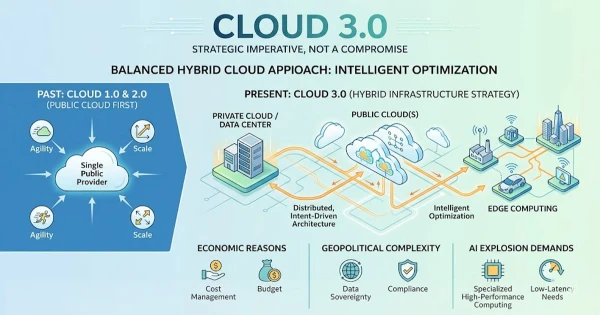
The era of unquestioned public cloud adoption is giving way to a more sophisticated, balanced approach. Enterprises are architecting a new reality: Cloud 3.0, where hybrid infrastructure is not a compromise, but a strategic imperative.
For the better part of two decades, the narrative was simple: move to the public cloud to achieve agility and scale. Yet, as we navigate an era defined by economic constraint, geopolitical complexity, and the explosive demands of artificial intelligence, this simplistic story is being rewritten. The 'cloud-first' mandate is being replaced by a more pragmatic 'cloud-right' strategy, ushering in the age of hybrid infrastructure. This evolution, often termed Cloud 3.0, represents a fundamental shift from a single-provider, centralized model to a distributed, intent-driven architecture that blends the best of public, private, and edge computing. The goal is no longer just migration, but intelligent optimization.
The End of Cloud-First: Why the Strategy is Changing
The initial promise of the public cloud was compelling. It offered a way to escape the constraints of on-premise hardware, promising rapid scalability and a shift from heavy capital expenditure to a more palatable operational expense model. This 'Cloud 1.0' and 'Cloud 2.0' era, which focused on infrastructure migration and platform development, delivered undeniable benefits. However, as organisations have scaled their cloud estates, a more complex and costly picture has emerged.

-
Soaring Costs: The pay-as-you-go model has often proven to be a double-edged sword. For many, it has evolved into a sprawling, difficult-to-predict expenditure, with hidden costs from data egress fees, underutilised instances, and complex licensing models. This has led to widespread "cloud fatigue," driven as much by finance as by a lack of innovation.
-
Regulatory Pressure and Data Sovereignty: A tightening regulatory landscape across the globe, particularly in Europe with GDPR and its equivalents, has made data residency a board-level issue. For many organisations, retaining sensitive data on infrastructure they own and control is not just a preference, but a strict compliance necessity that the public cloud alone cannot satisfy.
-
Vendor Lock-in and Concentration Risk: Over-reliance on a single hyperscaler introduces significant risk. Recent high-profile service outages have highlighted the fragility of centralised cloud dependencies, turning single-vendor dependence into an operational liability. This "vendor lock-in" also reduces negotiation leverage and makes it difficult to move workloads when services change or become less competitively priced.
These challenges have forced a strategic reset, prompting CIOs to ask more pointed questions about which workloads truly belong in the public cloud and which are better suited for private environments or the edge.
Cloud 3.0 Defined: The Rise of the Hybrid Imperative
This strategic reset is the driving force behind what industry experts are calling Cloud 3.0. Building on the infrastructure of Cloud 1.0 and the platform focus of Cloud 2.0, this third wave is defined by intelligent, distributed, and policy-aware architecture. At its heart, Cloud 3.0 is the end of a binary choice between public and private clouds.
Hybrid infrastructure is the foundational model for this new era. It seamlessly integrates public cloud resources with on-premise private cloud infrastructure, allowing data and workloads to be shared between them as needed. Gartner’s 2025 Magic Quadrant for Distributed Hybrid Infrastructure highlights this decisive pivot, noting that enterprises are moving away from cloud-first and toward more flexible models that deliver cloud services wherever they are needed—on-premises, at the edge, or in the public cloud.
This is not a step backward, but a calculated move toward greater control and resilience. By combining the elasticity and innovation of cloud services with the cost predictability and security of on-premise hardware, organisations can reduce exposure to single-vendor risk while retaining the flexibility to scale where it matters most.
The Key Drivers of Hybrid Adoption
-
Cost Optimisation: A hybrid approach allows businesses to place workloads in the most cost-effective environment. If you already own hardware, it may be more economical to keep specific, predictable workloads on-premise rather than paying for them in the cloud. This allows IT leaders to optimise spending rather than simply outsource it.
-
Enhanced Resilience and Disaster Recovery: Hybrid architectures build in redundancy and workload mobility. If a public cloud region experiences an outage or security breach, critical workloads can be failed over to the private cloud, ensuring business continuity. This ability to reroute workloads and protect uptime is a critical competitive advantage in a volatile world.
-
Meeting the Demands of AI: The rise of AI has introduced a new "compute gravity." AI workloads are massive and location-sensitive, and many enterprises are moving to build out private GPU clusters to control the costs and manage the sensitive data associated with training and running models. A hybrid model allows organisations to download pre-trained language models and fine-tune them with their proprietary enterprise data in a secure, private environment, while still leveraging the public cloud's immense compute power for other tasks.
-
Sovereignty and Compliance: For regulated industries like finance and healthcare, or for organisations operating in multiple jurisdictions, the ability to keep data within specific geographic borders is non-negotiable. Hybrid infrastructure allows organisations to keep sensitive data inside sovereign or jurisdiction-specific boundaries while still benefiting from broader cloud scale where appropriate.
Navigating a Multi-Cloud World
A key component of Cloud 3.0 is the embrace of multi-cloud strategies. Currently, over 79% of cloud buyers have embraced hybrid multicloud architectures, using multiple public cloud providers in conjunction with their private infrastructure. The goal is to take a "best-of-breed" approach, using the specific services—be it storage, AI, or analytics—where they are strongest, avoiding dependency on a single vendor's ecosystem.
This is not without its challenges. Managing a private cloud plus multiple public clouds using different dashboards and portals requires a high level of skill and creates significant operational complexity. To overcome this, Cloud 3.0 emphasises the need for a unified management control plane, often described as a "single pane of glass," to simplify operations and enforce consistent security policies across all environments.
The Path Forward: Building a Resilient and Intelligent Infrastructure
The modern enterprise is moving away from managing infrastructure for its own sake and toward delivering capabilities on demand. This is where the concept of "composable infrastructure" comes into play, allowing organisations to dynamically allocate compute, storage, and networking resources based on actual business need rather than static, siloed assets.
This shift is as cultural as it is technological. To fully benefit from Cloud 3.0, organisations need to evolve their operations, embracing greater automation, FinOps disciplines to manage cost and performance, and a platform-as-a-product approach to accelerate innovation. The next phase of enterprise IT will not be defined by who moved fastest to the cloud, but by who built the most balanced, economically rational, and operationally robust infrastructure strategy.
Conclusion
Cloud 3.0 is not about a single technology; it is a strategic evolution. It represents a decisive shift from the ideological pursuit of a cloud-only strategy to a pragmatic, balanced approach driven by business outcomes. Hybrid infrastructure is now the destination for organisations that understand that control, flexibility, and resilience, not ideology, are the true foundations of modern IT. By intelligently placing workloads across public, private, and edge environments, enterprises can navigate the complexities of cost, regulation, and AI to build a more resilient, profitable, and future-proof digital future. The choice is no longer "which cloud?" but "which cloud is right for this task?"