



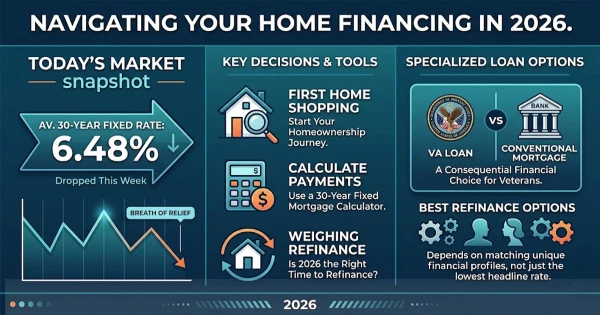
The average 30-year fixed mortgage rate dropped to 6.48% this week, offering a rare breath of relief for millions of Americans watching mortgage rates today. Whether you're shopping for your first home, calculating payments with a 30-year fixed mortgage calculator, or weighing whether to refinance, understanding the current landscape is critical. For veterans and active-duty service members, the choice between a VA loan and conventional mortgage remains one of the most consequential financial decisions of their lives. The best home loan refinance options in 2026 depend less on chasing the lowest headline rate and more on matching your unique financial profile to the right lender and loan structure.
Where Mortgage Rates Stand Right Now
Current mortgage rates in the USA have been volatile but trending slightly downward in mid-2026. The national average for a 30-year fixed-rate conforming mortgage is 6.476%, down about 6 basis points from the previous day according to Optimal Blue data. Bankrate's weekly survey of lenders confirms the 30-year home loan average fell to 6.48% this week.
Different loan types carry distinct rate profiles:

-
30-Year Fixed Rate: 6.53% average, 6.59% APR
-
15-Year Fixed Rate: 5.91% average, 6.01% APR
-
30-Year Fixed Rate FHA: 6.55% average, 6.60% APR
-
30-Year Fixed Rate VA: 6.61% average, 6.66% APR
-
30-Year Fixed Rate Jumbo: 6.67% average, 6.71% APR
Refinance rates trail purchase rates slightly. The national average 30-year fixed refinance APR is 6.72%, while the 15-year fixed refinance APR sits at 6.14%. These figures reflect rates as of Wednesday, June 17, 2026, at 6:30 AM.
Mortgage rates today fluctuate based on Federal Reserve policy, inflation data, Treasury yield movements, and lender competition. While short-term volatility is normal, the structural factors driving rates higher or lower remain consistent over time.
How to Use a 30-Year Fixed Mortgage Calculator Effectively
A 30-year fixed mortgage calculator is essential for estimating monthly payments and total loan costs. The standard mortgage payment formula calculates a fixed monthly payment that pays off the loan completely over the term:
M=P×r(1+r)n(1+r)n−1M=P×(1+r)n−1r(1+r)n
Where:
-
M = monthly payment
-
P = loan principal (amount borrowed)
-
r = monthly interest rate (annual rate ÷ 12)
-
n = total number of payments (years × 12)
To use a mortgage calculator effectively:
-
Enter your home price or current home value if refinancing
-
Input your down payment amount or percentage
-
Select your loan term (typically 30, 20, 15, or 10 years)
-
Enter your expected interest rate, ideally your preapproved rate
-
Click "Update" to see your monthly principal, interest, taxes, insurance, and PMI
Most calculators also generate an amortization schedule showing how each payment splits between principal and interest over time. This tool helps you compare different loan scenarios, evaluate the impact of extra payments, and plan for long-term financial goals.
The Best Home Loan Refinance Options in 2026
Refinancing can lower monthly payments, shorten your loan term, or tap into home equity. The best home loan refinance 2026 options depend on your credit score, down payment, home value, and financial objectives.
Top mortgage lenders for June 2026 include:
-
Bank of America: Best overall lender
-
Rocket Mortgage: Best for first-time home buyers
-
Chase: Best for customer discounts
-
Bank of America also offers strong refinance-specific tools and calculators
Refinancing strategies that work long-term:
-
Rate-and-term refinance: Swap to a lower rate or different term while keeping the same home
-
Cash-out refinance: Borrow against equity for renovations, debt consolidation, or other needs
-
FHA Streamline refinance: Simplified process for existing FHA borrowers to lower rates
-
VA Interest Rate Reduction Refinance Loan (IRRRL): Exclusive VA option to reduce rates with minimal documentation
Before refinancing, calculate whether closing costs justify the savings. A break-even analysis compares your monthly savings against total closing fees to determine how many months you need to stay in the home to benefit.
VA Loan vs Conventional Mortgage: The Ultimate Comparison
The VA loan vs conventional mortgage debate hinges on eligibility, down payment, credit requirements, and property type. VA loans are government-backed loans helping veterans, active-duty service members, and surviving spouses buy or build a home.
Key Differences at a Glance
| Factor | VA Loan | Conventional Loan |
|---|---|---|
| Eligibility | Military service required | No military requirement |
| Down payment | Typically none | Minimum 3-5% |
| Credit score minimum | No formal VA minimum; many lenders require 620+ | Usually at least 620 |
| Mortgage insurance | None | Required if down payment < 20% |
| VA funding fee | Up to 3.3% of loan amount | None |
| Property type | Primary residence only | Primary, vacation, or investment property |
| DTI ratio | Many lenders prefer ≤41% | Most require ≤36%, some accept up to 50% |
VA loans typically don't require a down payment and tend to have lower interest rates and looser credit standards than conventional loans. However, VA borrowers pay a funding fee up to 3.3% of the loan amount, though disabled veterans receiving disability payments are exempt.
Conventional loans aren't backed by the government and are available through banks, credit unions, and online lenders. They have stricter financial requirements but allow vacation homes and investment properties that VA loans cannot finance.
When to Choose Each Option
Choose a VA loan if:
-
You can get a better rate on a VA loan after factoring fees and closing costs
-
You have full entitlement and live in a high-cost area where saving a down payment would take years
Choose a conventional loan if:
-
You can make at least a 20% down payment to avoid PMI and the VA funding fee
-
You want to buy a vacation home or investment property
Closing timelines are similar: conventional purchase loans average 43 days, while VA loans close in 40-50 days.
Long-Term Strategies for Sustainable Mortgage Success
Evergreen mortgage advice focuses on principles that remain relevant regardless of short-term rate fluctuations. These strategies work for homebuyers and refinancers years into the future.
Build a Strong Financial Foundation
-
Maintain a credit score of 720+ for the best rates
-
Keep your debt-to-income ratio below 36%
-
Save for a down payment of at least 20% to avoid PMI on conventional loans
-
Document income, assets, and employment history thoroughly
Compare Multiple Lenders
Shopping at least three lenders ensures you receive competitive rates and terms. Bankrate's national marketplace of lenders allows personalized rate comparisons. WSJ's June 2026 best mortgage lenders list provides vetted options.
Understand the Full Cost Picture
Beyond interest rates, evaluate:
-
Closing costs (appraisal, title insurance, origination fees)
-
Monthly principal and interest payments
-
Property taxes and homeowners insurance
-
PMI or VA funding fees
-
Total loan cost over the full term
Consider Loan Term Strategically
A 15-year fixed rate (5.91% average) offers lower interest but higher monthly payments than a 30-year fixed (6.53% average). Shorter terms build equity faster and reduce total interest paid, while longer terms improve monthly cash flow.
Monitor Rates Without Chasing Perfection
Mortgage rates today fluctuate daily, but waiting for the absolute lowest rate often costs more in missed opportunities than the incremental rate difference. Focus on rates that fit your budget and long-term goals rather than headline-minimizing.
Conclusion: Making the Right Mortgage Decision in 2026
Current mortgage rates USA hover around 6.48% for 30-year fixed loans, with refinance rates slightly higher at 6.72% APR. The best home loan refinance 2026 strategy depends on your credit profile, home value, financial goals, and whether you qualify for VA benefits. Using a 30-year fixed mortgage calculator helps you visualize payments and compare scenarios before committing.
The VA loan vs conventional mortgage choice isn't about which is universally better—it's about matching your situation to the right product. VA loans offer no down payment and relaxed credit standards for eligible military members, while conventional loans provide broader property options and work for those without military service.
Sustainable mortgage success comes from building strong finances, comparing multiple lenders, understanding total costs, and choosing a loan term aligned with your goals. These principles remain evergreen regardless of whether rates rise or fall in the coming years. By focusing on fundamentals rather than short-term trends, you secure a mortgage that serves your financial well-being for decades.