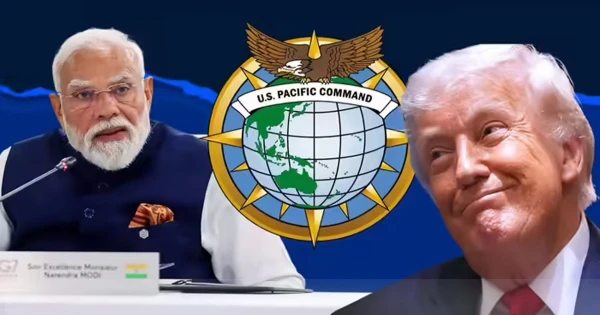
The United States has renamed its largest military command, dropping the word "Indo" from the U.S. Indo-Pacific Command and reverting to its previous designation, the U.S. Pacific Command (USPACOM) . The Pentagon announced this decision on Tuesday, just hours before Prime Minister Narendra Modi was scheduled to meet President Donald Trump at the G7 Summit in France .
The change reverses an eight-year-old decision from President Trump's first term, when the command was renamed to reflect the growing strategic importance of the Indian Ocean and India in U.S. policy . The Pentagon stated that the "restoring the legacy USPACOM designation honors the command's deep historical roots, fostering a sense of pride and collective spirit among all who serve in the Pacific" .
Officials have emphasized that the name change will not alter the command's area of responsibility or its fundamental mission. The U.S. Pacific Command's area spans from the waters off the U.S. West Coast to the western border of India . The Pentagon also confirmed that the command's commitment to maintaining a "free and open theater" alongside regional allies and partners remains unchanged .
B-52 Crash at Edwards AFB: What the 2026 Stratofortress Accident Reveals About an Aging Bomber Fleet

Geopolitical Implications and Reactions
Despite official reassurances, the decision has triggered significant concern among strategic analysts and former diplomats who view it as a symbolic downgrade of India's standing in Washington's defense framework . The 2018 renaming had been widely interpreted as formal recognition that the Indian and Pacific Oceans constituted a single strategic theater and that India would be a central partner in efforts to balance China's growing influence .
Former Indian Foreign Secretary Nirupama Menon Rao described the move as "potentially the downgrading of Indo-Pacific symbolism" . Another former foreign secretary, Kanwal Sibal, called it "another blow to the bilateral relationship delivered by Trump and his team," noting the timing just before the Modi-Trump meeting . Congress leader Shashi Tharoor questioned whether this development represents "another nail in the coffin of the Quad" .
Strategic Realignment or Historical Correction?
Analysts suggest the name change reflects a broader reassessment of U.S. strategy toward China. Some experts believe the decision signals that Washington is shifting its focus away from the Indian Ocean and prioritizing the Pacific theater . The move aligns with recent statements by U.S. Defense Secretary Pete Hegseth at the Shangri-La Dialogue, where he emphasized a "return to realism" in the Pacific and charting a "new course" for alliances .
Christopher Clary, a South Asian security analyst, noted that "once you made that decision you've really got to stick with it unless there is a very good policy reason, which there isn't" . This perspective suggests the reversal may be driven more by a shift in strategic priorities than by operational considerations.
Impact on India-U.S. Relations
The renaming comes amid tensions in the bilateral relationship, including tariff disputes, friction over India's purchases of Russian energy, and recent U.S. military actions in the Gulf that resulted in the deaths of Indian sailors . Some analysts view these incidents as collectively suggesting that the "exuberant phase of India-US relations may be ending" .
Geopolitical expert Iftikhar Firdous observed, "Names do not change geopolitics overnight. But in geopolitics, names often reveal where strategy is heading" . The change has also raised questions about the future of the Quad grouping, which was built around the Indo-Pacific framework .
Historical Context
The U.S. Pacific Command was originally established on January 1, 1947, by President Harry S. Truman after World War II . It operated under this name for over 70 years before being renamed in 2018 . At that time, then-Defense Secretary James Mattis explained that "in recognition of the increasing connectivity between the Indian and Pacific oceans, we rename the US Pacific Command to the US Indo-Pacific Command" . He also famously noted that "the command stretches from Bollywood to Hollywood" .
The Pentagon's current statement cited the command's role in establishing the post-WWII security architecture in the Pacific, coordinating joint operations during the Korean and Vietnam Wars, and leading humanitarian operations as reasons for restoring the legacy name .
Despite the official explanation focusing on historical heritage, the symbolic significance of the change has sparked debates about America's strategic priorities in the region and India's position within them .