



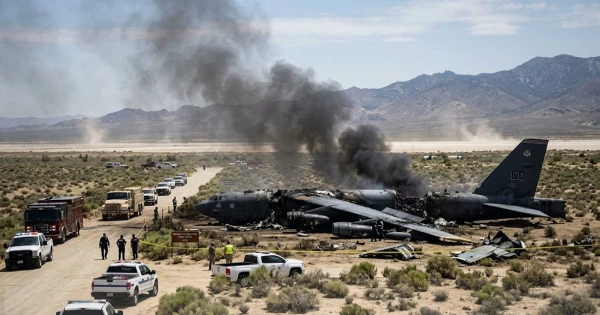
On June 15, 2026, a Boeing B-52H Stratofortress assigned to the 412th Test Wing climbed away from Edwards Air Force Base, California, on what the Air Force described as a routine test mission. Moments later, the iconic bomber crashed during initial climb, erupted in flames on the Mojave Desert floor, and killed all eight people on board. The disaster became the deadliest B-52 accident in more than four decades and the first B-52 crash since 2016, reigniting debate over how the United States keeps its longest-serving bomber relevant, airworthy, and safe.
What Happened: The Morning of June 15, 2026
At approximately 11:20 a.m. local time, the B-52H Stratofortress—tail number 60-0061—departed Edwards AFB on a test flight tied to a radar modernization program. Within minutes, it went down near the base’s airfield, leaving a column of black smoke visible across the high desert. Base officials closed the airfield, diverted inbound aircraft, and suspended non-commercial visitor passes to focus emergency responders on the scene.
Col. James Hayes, deputy commander of the 412th Test Wing, told reporters the crash was deemed “unsurvivable.” The eight people on board were a mix of military personnel, government civilians, and contractors. The Air Force withheld names until next-of-kin notification, a standard protocol in aviation mishap response.
The Race to Rule the Sky: What Sixth-Generation Fighter Jets Will Change About Air Power Forever

The incident was the first B-52 crash since a 2016 mishap at Andersen Air Force Base in Guam, and the deadliest since a 1982 accident at Mather Air Force Base in California killed nine crew members. Those parallels made the Edwards AFB crash an immediate focal point for analysts, defense journalists, and anyone tracking the B-52 modernization program.
Why the Edwards AFB Crash Matters Beyond the Headlines
The loss of one bomber is significant, but the broader story is the platform itself. The B-52 Stratofortress entered service in the 1950s and is expected to remain in the Air Force inventory into the 2060s. That near-century of service is unprecedented, and every mishap raises questions about aging airframes, upgraded avionics, and the engineering limits of perpetual modernization.
The aircraft involved, 60-0061, had recently arrived at Edwards from Port San Antonio after receiving an upgraded radar system. That detail matters because the B-52 is in the middle of one of the most extensive modernization efforts in its history.
Key reasons this accident carries lasting significance:
- The B-52 anchors the Air Force’s nuclear and conventional bomber triad, alongside the B-1B Lancer and B-2 Spirit.
- The accident occurred during a test flight, highlighting the inherent risks of experimental flight testing.
- Investigators will scrutinize whether the recent radar upgrade, aging structures, or a combination of factors contributed.
- The crash reminds us that routine test missions can turn catastrophic when complex, aging systems are involved.
- The findings will shape future safety procedures, maintenance schedules, and acquisition decisions for the fleet.
The B-52 Modernization Program: Context for the Crash
No discussion of the 2026 Edwards AFB accident is complete without understanding the B-52 modernization program. The Air Force has spent years upgrading engines, avionics, radar, communications, and weapons so the bomber can operate alongside newer platforms like the B-21 Raider. The goal is to keep the B-52 flying for roughly another 40 years, making it the first military aircraft to serve across a full century.
Major modernization priorities include:
- New engines — Replacing the Pratt & Whitney TF33 engines with more efficient, reliable powerplants to reduce maintenance and extend range.
- Radar upgrades — Installing modern active electronically scanned array (AESA) radar to improve targeting, weather detection, and situational awareness.
- Avionics overhaul — Updating flight controls, displays, navigation, and communications to meet modern airspace and combat network requirements.
- Weapons integration — Expanding the B-52’s ability to carry advanced cruise missiles, precision-guided munitions, and future hypersonic weapons.
- Structural life extension — Inspecting and reinforcing wings, fuselage sections, and critical components to keep the airframes viable for decades.
The bomber at Edwards had recently received a radar upgrade, placing it in a sensitive test phase. Test aircraft fly with new equipment that has not yet completed full operational validation, so investigators will examine whether the new systems, their installation, or their interaction with older systems played any role.
How the U.S. Air Force Investigates a Bomber Crash
A military aircraft accident investigation is a methodical, months-long process designed to discover facts, assign responsibility, and prevent recurrence. The Air Force handles its mishap investigations through specialized boards and safety channels, and the Edwards AFB crash will follow the same path.
Investigators typically:
- Secure the crash site and preserve wreckage while protecting responders and nearby communities.
- Gather crew qualifications, rest records, medical data, and in-flight communications.
- Examine maintenance logs, recent repairs, modifications, inspections, and component replacements.
- Pull telemetry, engine parameters, radar returns, and any surviving flight recorder data.
- Interview witnesses, ground personnel, controllers, and other aircrew.
- Issue a final report identifying root causes and recommending corrective actions across the fleet.
Air Force officials estimate the Edwards AFB investigation could take about six months. The timeline depends on wreckage complexity, data availability, and whether the cause is mechanical, human, or a combination of both.
The B-52’s Safety Record: Lessons From Past Losses
The B-52 Stratofortress has accumulated millions of flight hours across more than seven decades, yet serious accidents remain rare. When they do occur, they produce lessons that improve the entire fleet. The 2026 Edwards AFB crash will likely join that pattern.
Notable previous B-52 mishaps include:
- 2016 Andersen AFB crash — A B-52H went down on Guam shortly after takeoff; all seven crew members survived, though the aircraft was destroyed.
- 1994 Fairchild AFB crash — A B-52H stalled during an airshow practice maneuver, killing four crew members and leading to major changes in flight demonstration safety.
- 1982 Mather AFB crash — A B-52 crashed during a low-level training mission, killing nine crew members and influencing future low-level flight protocols.
Each event prompted changes that made subsequent B-52 operations safer. The Edwards AFB tragedy will likely produce findings that refine test procedures, maintenance standards, and crew training for the remaining fleet.
What the Accident Means for the Future of the B-52 Fleet
The B-52 is not a new platform, so every mishap becomes a referendum on the sustainability of the modernization program. The Air Force has bet heavily on the B-52H remaining relevant through the 2060s, meaning the investigation findings could influence budgets, upgrade timelines, and the pace of B-21 Raider introduction.
Long-term questions the accident raises:
- Are structural and fatigue-life limits accurately modeled as airframes approach 80 years of service?
- How well do new digital systems integrate with the bomber’s original analog-era architecture?
- Should test missions involving major avionics upgrades carry additional risk mitigation procedures?
- Can the Air Force sustain enough trained maintainers and aircrew for a fleet that has outlived most of its original support systems?
- Will Congress demand additional oversight or reassess fleet size in light of the accident?
None of these questions will be answered overnight, but the investigation will provide data points that inform them for years.
Conclusion
The B-52 crash at Edwards Air Force Base on June 15, 2026, was a tragedy first and foremost for the eight individuals lost and the families they left behind. It was also a stark reminder that the B-52 Stratofortress—an icon of American airpower—must be renewed, respected, and rigorously tested. As the Air Force crash investigation unfolds, its conclusions will do more than explain one accident. They will shape the safety culture, modernization priorities, and operational future of a bomber fleet the United States intends to keep flying for generations. The B-52’s story is far from over, and the lessons drawn from this loss will make the next chapter safer.