



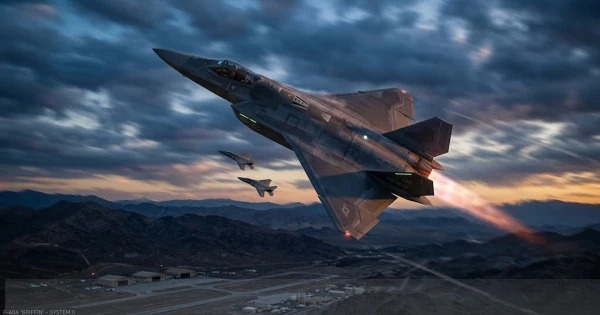
The next great leap in aerial warfare isn't coming — it's already being built. Across secretive hangars in the United States, Europe, and Asia, engineers and defense contractors are racing to define what a fighter jet will look like in the mid-21st century. Sixth-generation fighter jets represent not just an incremental upgrade from their predecessors, but a wholesale reimagining of what it means to dominate the skies — blending artificial intelligence, directed-energy weapons, and optionally manned cockpits into a single, terrifyingly capable platform.
What Exactly Is a Sixth-Generation Fighter Jet?
To understand the leap that sixth-generation aircraft represent, it helps to appreciate what came before. The fifth-generation fighters — the F-22 Raptor, F-35 Lightning II, and China's J-20 — were defined by stealth technology, sensor fusion, and supercruise capability. They remain among the most advanced warplanes ever built. Yet they were designed for a threat environment that is already shifting.
Sixth-generation fighter jets are broadly defined by a collection of advanced technologies that no existing operational aircraft possesses simultaneously:

- Optionally manned or unmanned operation: The cockpit may be present but not required. These aircraft are designed to fly with or without a human pilot onboard, allowing commanders to choose based on mission risk.
- Advanced stealth beyond current fifth-generation standards: Next-generation low-observable technology will extend stealth across a broader range of radar frequencies, making detection far more difficult even for cutting-edge adversary systems.
- Artificial intelligence and autonomous systems: On-board AI will manage sensor data, electronic warfare responses, and even combat decision-making at speeds no human pilot can match.
- Directed-energy weapons: High-energy lasers and possibly high-powered microwave systems are expected to replace or supplement traditional air-to-air missiles in certain engagement scenarios.
- Loyal wingman drone integration: Sixth-generation platforms are expected to command a network of unmanned combat aerial vehicles (UCAVs), operating as a "quarterback" in a collaborative combat aircraft (CCA) architecture.
- Next-generation propulsion: Advanced adaptive cycle engines will give these jets greater range, speed, and fuel efficiency than anything currently flying.
The Major Programs: Who Is Building the Future?
The United States: NGAD and F/A-XX
The U.S. Air Force's Next Generation Air Dominance (NGAD) program is perhaps the most closely watched sixth-generation effort in the world. Though shrouded in significant classification, the program has been confirmed at the highest levels of the Pentagon. Former Air Force acquisition officials have indicated that a full-scale demonstrator has already flown — a remarkable disclosure that signals the program is well beyond the drawing board.
Simultaneously, the U.S. Navy is developing the F/A-XX, its own carrier-based sixth-generation aircraft intended to replace the F/A-18E/F Super Hornet. Naval aviation imposes unique constraints — the aircraft must survive the brutal cycle of carrier launches and arrested landings — making the F/A-XX an engineering challenge unto itself.
Europe: GCAP and FCAS
Two major European consortiums are independently pursuing sixth-generation capability. The Global Combat Air Programme (GCAP) unites the United Kingdom, Japan, and Italy in one of the most strategically significant defense collaborations of the modern era. The program aims to field a new crewed combat aircraft by 2035, supported by a swarm of loyal wingman drones.
The Future Combat Air System (FCAS), led by France, Germany, and Spain under the Airbus and Dassault Aviation partnership, pursues a similar vision. FCAS envisions a "system of systems" — a networked combat cloud connecting the manned fighter with drones, satellites, and cyber assets into a unified battle network.
China and Russia: The Eastern Challengers
China's defense industry has moved at a pace that has genuinely surprised Western analysts. The J-35 fifth-generation carrier jet only recently entered service, yet programs understood to represent sixth-generation ambitions are reportedly underway. In early 2025, China unveiled what appeared to be two new sixth-generation prototype aircraft — large, tailless, flying-wing designs that immediately drew global attention.
Russia, constrained by the economic fallout from the war in Ukraine and sweeping Western sanctions, faces a considerably steeper path. Its PAK DA stealth bomber program has faced repeated delays, and a credible sixth-generation fighter remains a distant prospect for the foreseeable future.
The Technologies That Will Define the Sixth Generation
Artificial Intelligence as a Combat Tool
Perhaps no technology will shape sixth-generation fighters more profoundly than artificial intelligence. AI will serve as a co-pilot, threat analyst, and electronic warfare manager simultaneously. When an adversary radar illuminates the aircraft, AI will identify the signal, evaluate countermeasures, and execute a response — all within milliseconds. In a beyond-visual-range engagement against multiple threats, that speed advantage could be decisive.
AI also enables the loyal wingman concept. A single manned sixth-generation aircraft could direct a formation of four or more UCAVs, assigning them to suppress air defenses, jam communications, or engage targets — keeping the human pilot out of the highest-risk portions of the mission.
Directed-Energy Weapons: The End of the Missile Monopoly?
The air-to-air missile has dominated aerial combat since the late 1950s. Directed-energy weapons — most practically, high-energy lasers — could disrupt that monopoly. Lasers travel at the speed of light, have an effectively unlimited magazine (limited only by power generation), and cost almost nothing per shot compared to missiles that can cost over a million dollars each.
The engineering challenges remain formidable. Generating sufficient power for a combat-effective laser while managing the resulting heat — all within the constraints of an airborne platform — is an unsolved problem. But the convergence of advanced power systems and thermal management technology makes directed energy a realistic sixth-generation capability rather than a science-fiction fantasy.
Network-Centric Warfare at the Core
Sixth-generation aircraft are not being designed as standalone platforms. They are the centerpiece of a broader network — connected to satellites, ground-based sensors, cyber assets, and other aircraft through data links of unprecedented bandwidth and resilience. This means a sixth-generation fighter's value is multiplied by the quality of the network it operates within. A well-integrated fleet of sixth-generation aircraft plus loyal wingman drones could overwhelm adversary integrated air defense systems (IADS) in ways that no previous generation of air power could.
The Strategic Implications
The development of sixth-generation fighter jets is reshaping alliance structures and defense industrial policy worldwide. Japan's participation in GCAP marks a historic shift in the country's defense posture. The program requires Japan to develop sovereign capabilities in radar, propulsion, and electronic warfare that it has historically relied on the United States to provide.
For NATO, the parallel existence of GCAP and FCAS raises questions of interoperability. European air forces will eventually need platforms that can fight together seamlessly. The political and industrial harmonization required is as complex as the engineering.
For the United States, the cost of sixth-generation air power is a legitimate strategic concern. The NGAD program is projected to produce aircraft at a per-unit cost that may dwarf even the F-35. At a time of constrained defense budgets and competing modernization priorities, the Air Force will face hard choices about how many aircraft it can realistically procure — and whether a smaller fleet of extraordinarily capable jets is preferable to a larger fleet of slightly less advanced ones.
Key Takeaways: What Sets Sixth-Generation Jets Apart
- They are designed from the outset to operate with or without a human pilot.
- AI integration goes far beyond autopilot — it encompasses combat decision support and autonomous threat response.
- Loyal wingman drone control is a core mission, not an add-on capability.
- Stealth performance is expected to exceed fifth-generation platforms across a wider range of radar bands.
- Directed-energy weapons represent a potential paradigm shift in how air-to-air and air-to-ground engagements are conducted.
- The platforms are nodes in a networked battle system, not isolated weapons.
- Multiple nations — USA, UK, Japan, Italy, France, Germany, Spain, and China — are in active development.
Conclusion: The Sky of the Future Is Being Built Today
Sixth-generation fighter jets are among the most consequential weapons programs in modern history. They will determine who controls the air over future battlefields — and, by extension, who shapes the geopolitical order of the mid-21st century. The race is genuinely competitive, the technologies are genuinely revolutionary, and the stakes are genuinely enormous.
What makes this moment particularly significant is the convergence of so many transformative technologies at once: artificial intelligence mature enough for combat application, directed-energy weapons approaching practical viability, and drone autonomy sophisticated enough to be entrusted with lethal missions. No previous generation of fighter aircraft arrived with this density of simultaneous innovation.
For defense analysts, policymakers, and anyone who follows the intersection of technology and global security, the development of sixth-generation combat aircraft is not a distant abstraction — it is an active, accelerating story whose outcomes will ripple through international relations for decades. The sky, as it has always been, remains the ultimate strategic high ground. And the nations that define the next generation of air power will define much of what follows.