



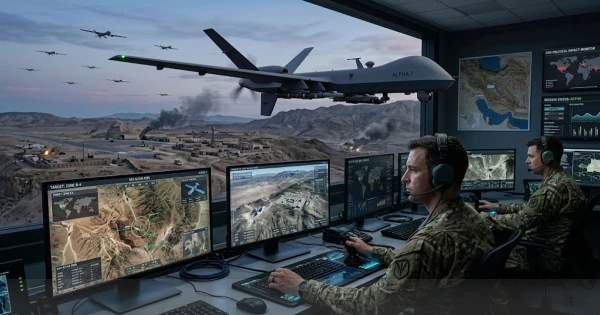
Unmanned aircraft once relegated to surveillance and hobbyist skies now determine the fate of battles, influence geopolitics, and force militaries to rethink doctrine. Military drone warfare — the integrated use of remotely piloted aircraft, autonomous systems, and swarms — combines speed, persistence, and precision in ways that make it one of the most consequential developments in armed conflict this century. This article explains how drone warfare works, why it’s durable as a strategic tool, the ethical and legal dilemmas it raises, and what militaries, policymakers, and civilians should expect in the decades ahead.
What we mean by military drone warfare
-
Military drone warfare refers to combat and support operations using unmanned aerial vehicles (UAVs), remotely piloted aircraft (RPAs), and increasingly autonomous systems.
-
Roles include intelligence, surveillance, reconnaissance (ISR), target acquisition, precision strike, electronic warfare, logistics resupply, and force protection.
-
Systems range from small hand-launched quadcopters used for tactical scouting to high-altitude, long-endurance platforms and weaponized drones.

Why drones became central to modern militaries
-
Cost-effectiveness: UAVs often cost a fraction of crewed aircraft and require fewer personnel training hours per flight hour.
-
Risk reduction: Drones remove aircrew from direct danger in contested environments.
-
Persistence and reach: Many drones can loiter for hours or days, providing sustained surveillance and rapid strike options.
-
Technological convergence: Advances in sensors, communications, miniaturized guidance, and artificial intelligence accelerated operational capabilities.
-
Proliferation: Easier manufacturing and open-source know-how lowered barriers for state and non-state actors to obtain capable systems.
Key types of military drones and their roles
-
Tactical micro and small drones: Short-range ISR, target spotting, bomb damage assessment, and local force protection.
-
MALE (Medium Altitude Long Endurance) drones: Persistent ISR and precision strike capability for theatre-level operations.
-
HALE (High Altitude Long Endurance) drones: Strategic surveillance and communications relay.
-
Loitering munitions (kamikaze drones): Combine reconnaissance with one-way strike capability, useful against high-value or time-sensitive targets.
-
Autonomous swarms: Groups of low-cost drones operating under coordinated algorithms to overwhelm defenses, perform distributed ISR, or execute combined missions.
-
Loitering electronic warfare/drone-jamming platforms: Interfere with enemy communications and sensors using stand-off electronic attack.
How drone warfare changed tactics and doctrine
-
Distributed operations: Ground forces now rely on organic drone teams for immediate ISR and fires, reducing dependence on centralized air assets.
-
Rapid kill chains: Faster sensor-to-shooter timelines compress decision cycles and enable quicker target engagement.
-
Defensive shifts: Air defenses must adapt to detect, classify, and engage small, low-signature targets across congested electromagnetic environments.
-
Multi-domain integration: Drones are integrated with satellites, cyber operations, and manned platforms to create layered effects across domains.
-
Rules of engagement and escalation management: Precision and plausible deniability from remote strikes complicate escalation dynamics and attribution.
Ethical, legal, and accountability challenges
-
Targeting and civilian harm: Mistakes in targeting, poor identification, and failures in minimizing collateral damage create moral and legal liabilities.
-
Autonomy and responsibility: When AI-driven systems select or engage targets, assigning accountability becomes complex for commanders, operators, and manufacturers.
-
Transparency and oversight: Remote operations can obscure decision-making processes, reducing public scrutiny and democratic oversight of lethal force.
-
Proliferation to non-state actors: Terrorist groups or militias using weaponized drones raise risks of asymmetric attacks on civilians and critical infrastructure.
-
International law: Existing frameworks (e.g., international humanitarian law) apply, but gaps remain around autonomous weapon decision-making, cross-border strikes, and dual-use technologies.
Technologies that ensure drones remain relevant long-term
-
Improved sensors: Hyperspectral, multispectral, and compact synthetic aperture radar (SAR) deliver all-weather, day-night ISR capabilities.
-
Secure, resilient communications: Low-probability-of-intercept links, mesh networking, and satellite backhauls reduce jamming and spoofing vulnerabilities.
-
Autonomy and AI: Sensor fusion, target recognition, navigation, and collaborative swarm behavior increase operational efficiency while lowering operator burden.
-
Miniaturization and modularity: Swappable payloads (optical, EW, strike) make platforms adaptable and cost-effective across missions.
-
Counter-drone systems: Kinetic interceptors, directed-energy weapons, signal jammers, and cyber defenses form a persistent arms race that will shape drone design and doctrine.
Persistent strategic effects and why the topic is evergreen
-
Lower barrier to entry: Continued declines in cost and rising industrial capacity mean more actors will field drones; the fundamental trend of widening access is enduring.
-
Force multiplication: Drones change force ratios—smaller militaries can achieve outsized ISR and strike effects while larger powers must counter distributed threats.
-
Doctrinal transformation: Militaries will steadily embed unmanned systems into force structure, training, and procurement processes—this is not a short-term adaptation.
-
Civil-military overlap: The same technologies powering commercial drones (battery, sensors, AI) will feed military capabilities, creating long-term regulatory and infrastructure implications.
-
Strategic stability: Drones alter deterrence, surveillance, and escalation management in ways that will persist as long as aerial autonomy and guided effects exist.
Operational vulnerabilities and how forces mitigate them
-
Vulnerability: Electronic warfare and GPS spoofing can blind or misdirect drones.
Mitigation: Hardened navigation using inertial measurement units, multi-sensor navigation (vision, LIDAR), and encrypted comms. -
Vulnerability: Small drones are hard to detect in cluttered environments.
Mitigation: Layered sensors (acoustic, radar tuned to small UAVs, EO/IR), networked detection, and machine-learning classifiers. -
Vulnerability: Supply-chain and software attacks can compromise fleets.
Mitigation: Zero-trust architectures, vetted components, redundant manufacturing sources, and continuous cybersecurity updates. -
Vulnerability: Swarms overwhelm defenses.
Mitigation: Scalable countermeasures, layered hard and soft-kill systems, and doctrines prioritizing mobility and dispersal.
Civilian and humanitarian implications
-
Disaster response: Drones provide rapid assessment after natural disasters, aid delivery to isolated areas, and infrastructure inspection—enduring civilian uses.
-
Border security and law enforcement: Persistent ISR assists policing and search-and-rescue but raises privacy and civil liberties concerns.
-
Humanitarian law compliance: Improving transparency, record-keeping, and independent review of strikes can reduce civilian harm and build accountability over time.
Policy levers and international responses
-
Export controls and norms: Countries can limit proliferation through export regulation, end-use monitoring, and coordinated multilateral controls aimed at dual-use tech.
-
Arms-control dialogues: Confidence-building measures, data sharing, and no-first-use or non-deployment zones for certain autonomous weapon classes could reduce risk.
-
Standards and certification: International standards for safety, identification (remote ID), and testing would increase accountability and interoperability.
-
Investment in defenses: Funding layered counter-UAV systems and resilient communications becomes part of national defense budgets.
-
Public oversight: Parliamentary or congressional review of strike policies, after-action investigations, and transparent casualty reporting strengthen democratic accountability.
Practical guidance for policymakers and defense planners
-
Treat drones as systems, not just platforms: Plan procurement, training, logistics, and cybersecurity together.
-
Prioritize resilience: Design networks and platforms that can operate with degraded comms and survive cyber-electronic attacks.
-
Invest in detection first: Effective defensive posture begins with proven sensors and data fusion rather than single “silver-bullet” technologies.
-
Build legal and ethical frameworks now: Define permissible levels of autonomy, transparent targeting processes, and accountability chains before wide deployment.
-
Foster industry standards: Work with commercial suppliers to certify components and create traceability across global supply chains.
What civilians and businesses should watch
-
Regulatory changes: Remote ID, geofencing, and airspace-management rules will affect commercial drone operators and adjacent industries.
-
Dual-use risks: Commercial innovation in AI, batteries, and sensors will continue to enable more capable military systems—policy and corporate governance must anticipate misuse.
-
Workforce needs: Demand will rise for drone operators, AI engineers, cybersecurity specialists, and compliance officers across civilian and defense sectors.
-
Insurance and liability: As drone use grows, expect evolving insurance requirements covering damage, privacy breaches, and operational failure.
Case study snapshot (illustrative)
-
In recent conflicts, loitering munitions and small tactical quadcopters have frequently decided tactical outcomes by destroying vehicles, breaching air defenses, and enabling precision strikes with minimal logistical footprints. Their effect has been less about a single technology and more about rapid innovation cycles, decentralized employment, and low-cost attrition models that make them sustainable for diverse actors.
Conclusion
Military drone warfare is not a passing phase; it represents a durable shift in how armed forces gather information, apply force, and manage risk. The technologies that underpin this change—miniaturized sensors, resilient communications, autonomy, and modular design—will continue to mature and diffuse. That creates both opportunities (improved disaster response, lower-risk operations) and persistent challenges (proliferation, ethical ambiguity, arms races). Long-term strategies should therefore emphasize resilience, legal clarity, robust detection and defense, and international cooperation to harness benefits while constraining the harms of increasingly capable unmanned systems.