



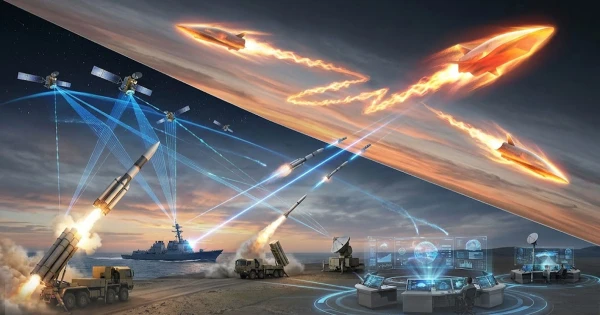
Hypersonic missiles—weapons that fly faster than five times the speed of sound while performing unpredictable maneuvers—have jolted defense planners and raised urgent questions about whether existing missile defense architectures can keep pace. As nations invest billions to field hypersonic-capable delivery systems, the race is on to develop resilient ballistic missile interceptor systems and global defense infrastructure capable of detecting, tracking and defeating these fast, low-altitude threats. This article explains what makes hypersonic weapons uniquely challenging, how interceptor technologies and networks are evolving in response, and which practical, long-term solutions offer the best prospects for sustained defense and deterrence.
Why hypersonic weapons change the calculus
-
Speed and maneuverability: Hypersonic cruise missiles and glide vehicles travel at speeds above Mach 5 and can alter course mid-flight, reducing the warning time and complicating predicted intercept windows.
-
Flight profile: Unlike traditional ballistic missiles that follow predictable arcs through space, hypersonic weapons often fly at lower altitudes within the atmosphere for longer periods, evading some satellite-based early warning systems and stressing midcourse intercept solutions.
-
Sensor and targeting challenges: Their combination of heat, plasma sheath generation at extreme speeds, and rapid course adjustments complicates radar and infrared tracking and makes discrimination from decoys or debris more difficult.

How ballistic missile interceptor systems are adapting
Modern interceptor strategies are converging on three complementary approaches: improve sensing and tracking, diversify interceptor types, and integrate layered defenses.
-
Enhanced sensing and tracking
-
Space-based sensors: Persistent infrared (IR) satellites and space-based radar constellations aim to provide earlier detection and continuous tracking even when hypersonic objects fly low. Small-satellite constellations offer scalable coverage that complements legacy sensor networks.
-
Over-the-horizon and ground-based radars: Advances in long-range, low-frequency radar and passive detection systems help detect low-altitude hypersonic flight profiles that sometimes evade higher-frequency radars.
-
Multi-sensor fusion: Combining data from space, airborne, maritime and ground sensors into fused tracks provides resilient, higher-confidence targeting information, enabling interceptors to respond faster.
-
Interceptor diversification and capability upgrades
-
Boost-phase and ascent intercept concepts: Targeting a missile during or immediately after boost can neutralize threats before they maneuver widely. This requires forward-positioned sensors and fast-response interceptors—technically challenging but valuable against some classes of hypersonic threats.
-
Endo-atmospheric interceptors: Upgraded variants of surface-to-air and anti-ballistic missiles that can operate in the atmosphere at high speed are being developed to engage glide vehicles that do not reach exo-atmospheric midcourse profiles.
-
Hit-to-kill kinetic interceptors and directed energy: Kinetic interceptors remain central—hitting the incoming object with a non-explosive direct impact—while research into directed-energy weapons (lasers) offers promise for high-volume, rapid engagement of certain targets at shorter ranges.
-
Layered defense architecture
-
Multi-tiered deployment: Deploying sensors and interceptors across space, air, sea, and ground creates overlapping fields of detection and engagement, increasing the probability of success against fast, maneuvering threats.
-
Networked command-and-control: Low-latency communications and automated engagement decision aids shorten the sensor-to-shooter timeline, crucial when engagement windows are measured in seconds or minutes.
Global defense infrastructure trends and investments
-
NATO and allied coordination: Collective investment in shared sensors, data links and interceptor interoperability strengthens deterrence by distributing burden and reducing single points of failure.
-
Regional deployments: Nations are positioning sea-based interceptor platforms and mobile ground launchers to create flexible, quickly re-deployable shields near potential threat axes.
-
Industry and dual-use innovation: Commercial space and aerospace advances—small satellites, improved propulsion materials, and AI-enabled data processing—are accelerating capabilities available to defense planners at lower cost and faster timelines.
Evergreen technical and policy measures that remain relevant
-
Invest in resilient sensor diversity: No single sensor solves hypersonic detection. Combining space-based IR, radar, and airborne assets ensures redundancy against countermeasures and hostile targeting.
-
Prioritize layered, interoperable defenses: Layering defenses across engagement phases (boost, midcourse, terminal) and ensuring allied interoperability provides durable protection even as individual technologies evolve.
-
Emphasize rapid command-and-control upgrades: Automated, secure decision systems and robust communications reduce human decision latency without removing human oversight—critical for ethical and strategic control.
-
Harden supply chains and industrial base: Long-term production capacity for interceptors, sensors, and specialized materials prevents capability gaps during crises.
-
Focus on doctrine and training: Regular joint exercises, rehearsed escalation ladders and clear rules of engagement maintain readiness and improve real-world response to novel threats.
Operational challenges and realistic limits
-
Cost and quantity: Building and maintaining interceptions-capable fleets and space-based sensor constellations is expensive. Quantity matters: multiple interceptors and sensors increase the chance of defeating salvo attacks.
-
False alarms and discrimination: High-speed engagements increase the risk of false positive engagements. Improving discrimination algorithms and layered verification is crucial to avoid costly errors.
-
Arms-race dynamics: Defensive improvements can spur offensive innovations (stealthier hypersonics, decoys, swarm launches), requiring continuous adaptation rather than a one-time technological fix.
-
Legal and strategic constraints: Deploying certain intercept capabilities (e.g., forward-based boost-phase systems) can create political tension and escalation concerns among states sharing contested regions.
Case studies: current responses that illustrate durable strategies
-
Space sensor constellations: Several nations are accelerating small-satellite IR constellations to provide persistent tracking. These systems are modular and upgradeable, giving them long-term value as sensor technology improves.
-
Sea-based layered defenses: Deploying interceptors on naval platforms offers mobility and strategic flexibility, enabling defense postures to shift with evolving threats without permanent base politics.
-
Integrated regional networks: Alliances that share sensor data and link interceptors—rather than acting in isolation—dramatically shorten reaction times and make deception harder for attackers.
What governments and defense planners should prioritize now
-
Fund multi-domain sensor networks, emphasizing rapid refresh cycles for satellite and radar assets.
-
Scale production of versatile interceptors and test a mix of kinetic and directed-energy solutions to determine operational roles.
-
Build legal and diplomatic frameworks for allied data-sharing, forward deployments, and crisis management to reduce miscalculation risks.
-
Invest in resilient software: AI/ML for tracking, sensor fusion, and discriminator algorithms matter more each year and require secure development pipelines and explainability.
-
Maintain transparency where possible: Publicly stated intent, doctrine, and rules of engagement for defensive systems reduce misunderstanding and can lower escalation risks.
Practical takeaways for long-term security planners
-
Expect continuous adaptation: Hypersonic capabilities will spur new defense tech but will not make defense obsolete if planners adopt layered, networked approaches.
-
Diversify investments: Balance spending across sensors, interceptors, infrastructure, and doctrine—neglecting any one area creates exploitable gaps.
-
Collaborate internationally: Shared early warning and interoperability are force multipliers; alliances can achieve resilient defense postures more cheaply than unilateral programs.
-
Prepare for scale: Procurement and logistics plans should assume the need for many interceptors and replacement sensors to handle complex attack profiles.
Conclusion
Hypersonic weapons pose a real and enduring challenge because they compress time, complicate sensing and maneuver unpredictably. But they are not invincible. A sustained, layered approach—built on diverse, redundant sensors; agile interceptor mixes; robust command-and-control; allied cooperation; and resilient industrial bases—offers the most realistic path to long-term defense and deterrence. Nations that prioritize interoperability, continuous sensor refresh, and doctrine-ready operational planning will retain the strategic advantage even as offensive technologies evolve. The defense landscape will continue to change, but these core principles will remain relevant for decades.