



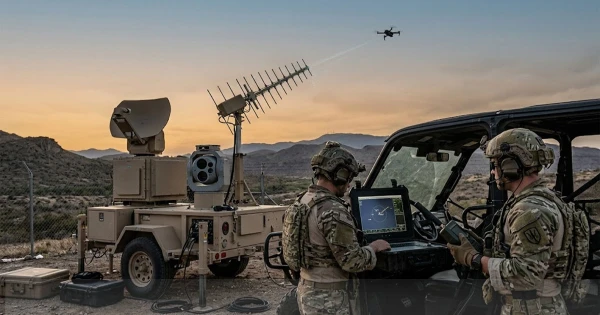
The skies are no longer safe territory. As commercially available drones flood the global market and state-sponsored unmanned aerial vehicles grow increasingly sophisticated, military planners, security agencies, and critical infrastructure operators face a challenge that was virtually unimaginable two decades ago — the need to detect, track, and neutralize threats that weigh less than a smartphone yet can carry lethal payloads over fortified borders. Counter-UAV technology has moved from experimental laboratories to front-line deployment at breathtaking speed, transforming the very concept of airspace security in the process.
The Drone Threat Is No Longer Theoretical
For years, unmanned aerial vehicles were treated primarily as surveillance tools or precision strike assets operated by state militaries. That calculus changed decisively when non-state actors began weaponizing off-the-shelf consumer drones, and when small quadcopters started appearing above airports, nuclear facilities, and conflict zones where they had no business being.
Today, the threat landscape is extraordinarily diverse:

- Commercial drones repurposed for payload delivery, carrying everything from improvised explosive devices to contraband across prison walls or national borders.
- Swarm attacks, where dozens or even hundreds of low-cost UAVs are launched simultaneously to overwhelm conventional point-defense systems.
- Intelligence, Surveillance, and Reconnaissance (ISR) drones that gather sensitive information over restricted installations before any alarm is raised.
- Kamikaze or loitering munitions, designed to orbit a target zone and dive-strike on command.
The proliferation of these threats has made Counter-Unmanned Aerial Systems (C-UAS) one of the fastest-growing segments in the global defense industry. Analysts project the C-UAS market will reach tens of billions of dollars within this decade, driven by urgent demand from both military and civilian sectors.
What Is Counter-UAV Technology?
Counter-UAV technology — often referred to in defense circles as C-UAS hardware — is the broad category of systems, sensors, and techniques designed to detect, identify, track, and defeat unauthorized or hostile drones. Unlike traditional air defense, which was engineered around fast-moving, high-altitude aircraft and ballistic missiles, C-UAS solutions must address threats that are small, slow, low-flying, and often radar-invisible.
The discipline draws from multiple engineering domains: radio frequency (RF) analysis, radar, electro-optical and infrared sensors, acoustic detection, and — increasingly — artificial intelligence-driven threat classification. No single sensor modality is sufficient on its own, which is why layered, multi-sensor architectures have become the standard design philosophy for serious C-UAS deployments.
The Four Pillars of Counter-UAV Operations
Practitioners generally organize C-UAS activities around four sequential functions:
- Detect — Identify that a drone is present in a protected airspace using radar, RF scanners, acoustic arrays, or optical systems.
- Track — Maintain a continuous picture of the drone's position, altitude, velocity, and heading.
- Identify — Classify the UAV as hostile, friendly, or unknown, and ideally trace the signal back to the operator's location.
- Defeat — Neutralize the threat using kinetic or non-kinetic means.
Each of these functions is technically demanding, and executing all four reliably in a high-clutter environment — a busy urban skyline, a crowded event venue — remains one of the defining engineering challenges of the field.
Non-Kinetic Defeat: Jamming, Spoofing, and Electronic Warfare
Before reaching for a weapon, most C-UAS operators prefer soft-kill options that disable a drone without creating debris or collateral risk. Electronic warfare tools dominate this category.
RF jamming floods the frequency bands a drone uses to communicate with its operator or receive GPS positioning data. When the link is severed, most commercial drones either hover in place, return automatically to their takeoff point, or land — all outcomes that neutralize the threat without destroying the aircraft. Handheld RF jamming "guns" have become a familiar sight at high-security events, while fixed-site installations use directional antenna arrays to cover wider sectors.
GPS spoofing takes a subtler approach. Rather than jamming the navigation signal, a spoofing system transmits a counterfeit GPS signal that feeds the drone false position information. The aircraft can be guided gradually off course, redirected to a safe landing zone, or confused to the point of failure — all without the operator on the ground realizing anything is amiss.
Cyber takeover represents an even more sophisticated technique, exploiting vulnerabilities in drone communication protocols to seize control of the aircraft outright. While this approach requires significant technical investment, it offers the compelling advantage of landing the drone intact — preserving evidence and potentially revealing intelligence about the operator and mission.
Anti-Drone Laser Systems: Precision at the Speed of Light
Of all the emerging technologies reshaping military drone interception tactics, directed-energy weapons — particularly anti-drone laser systems — have generated the most strategic excitement, and for good reason. High-energy lasers (HEL) offer a combination of attributes that no conventional interceptor can match:
- Near-zero cost per engagement — once the capital equipment is in place, firing a laser beam costs only the electricity consumed, compared to thousands or millions of dollars per missile.
- Effectively unlimited magazine depth — a laser system can engage successive targets as quickly as its power supply can recharge, with no reload cycle.
- Speed-of-light delivery — there is no flight time to calculate, no wind correction needed; the beam reaches the target instantaneously.
- Precision and scalability — operators can dial power up or down, burning out a sensor without destroying the airframe, or increasing dwell time to defeat hardened targets.
Laser systems work by concentrating photonic energy on a specific point of the target — typically a motor, battery pack, or flight control surface — until the material heats, distorts, and fails. Against small composite-frame drones, this process can take anywhere from a fraction of a second to several seconds depending on beam power and atmospheric conditions.
Several nations have already fielded operational laser systems specifically designed for drone defeat. The United States, United Kingdom, Israel, China, and Germany are among those that have demonstrated or deployed high-energy laser platforms at varying power levels. Challenges that remain include beam attenuation in adverse weather, the enormous electrical power requirements of high-power systems, and the difficulty of tracking fast-moving or evasive targets with sufficient precision.
Kinetic Intercept: When Hard Kills Are Necessary
Not every scenario permits a soft approach. In active combat environments, or when electronic countermeasures fail against a drone with hardened communications, kinetic defeat — physically destroying the UAV — remains essential. Military drone interception tactics in this category have diversified significantly.
Interceptor drones represent one of the most innovative kinetic concepts. Autonomous or semi-autonomous pursuit drones are launched in response to a detected threat, chasing down the intruder and either ramming it or deploying a capture net. Net-based intercept is particularly valued in contexts where debris from an explosion is unacceptable — such as over civilian crowds or sensitive facilities.
Micro-missile systems have been developed specifically for the C-UAS role. Unlike traditional surface-to-air missiles, these are designed to be inexpensive, highly maneuverable, and effective against slow small targets that defeat conventional guidance systems. Some designs are gun-launched rather than rocket-propelled, reducing cost and complexity further.
Modified cannon systems, including radar-guided autocannons and high-rate-of-fire rotary guns, can fill the sky with projectiles dense enough to guarantee a kill — though ammunition expenditure rates and collateral risk require careful management.
The Role of AI and Sensor Fusion
Modern C-UAS hardware increasingly depends on artificial intelligence not as a luxury but as a core operational requirement. The volume of sensor data generated by a layered detection grid — radar returns, RF intercepts, video feeds, acoustic signatures — far exceeds what human operators can process in real time. AI-driven sensor fusion platforms ingest all of these streams simultaneously, filter out false positives (birds, balloons, authorized aircraft), classify genuine threats, and cue defeat systems with minimal human latency.
Machine learning models trained on large libraries of drone signatures can now distinguish between hundreds of commercial UAV models based on their motor acoustic fingerprint or RF emission pattern alone. This capability is critical in environments where visual identification is impossible — night operations, fog, dense urban canyons — and where the penalty for misidentification is high in either direction.
Protecting Critical Infrastructure: The Civilian C-UAS Challenge
Military applications attract the most headlines, but the civilian counter-drone challenge is arguably more complex. Airports, prisons, power plants, sporting stadiums, and government buildings all face drone threats under legal constraints that do not apply on the battlefield. Jamming systems, for example, can interfere with commercial aviation frequencies; cyber takeover tools may violate computer fraud statutes; and even radar systems require spectrum licensing and coordination.
Regulatory frameworks are evolving to address these constraints. In the United States, the FAA Reauthorization Act and subsequent legislation have gradually expanded the legal authority of designated agencies to use C-UAS tools in defined environments. Similar frameworks are taking shape in the European Union, the United Kingdom, and other jurisdictions.
For security planners, this means that effective civilian C-UAS deployment requires not only technical competence but close coordination with regulatory bodies, airspace authorities, and legal counsel.
The Road Ahead
Counter-UAV technology is not a problem that will be solved once and shelved. As drone capabilities advance — longer range, greater autonomy, AI-guided navigation that does not depend on GPS or radio links — C-UAS systems must evolve in parallel. The integration of quantum sensing, advanced radar waveforms, and hyperspectral imaging represents the next generation of detection capability. On the defeat side, higher-power lasers, kinetic micromissiles, and coordinated multi-domain engagement are where investment is concentrated.
What is already clear is that airspace security — whether over a battlefield, an airport, or a national capital — can no longer be assumed. It must be actively enforced, using a layered, adaptive, technology-driven architecture that anticipates tomorrow's threats while meeting today's.
The invisible shield is being built. Understanding how it works is not merely an academic exercise; for policymakers, security professionals, engineers, and informed citizens alike, it is an essential piece of strategic literacy for the decades ahead.
Conclusion
Counter-UAV technology has emerged as one of the defining military and security disciplines of the 21st century. From anti-drone laser systems that intercept targets at the speed of light to AI-powered sensor fusion platforms that process thousands of data points per second, the C-UAS ecosystem is complex, rapidly evolving, and profoundly consequential. Military drone interception tactics are no longer confined to conventional armed forces; they are being adapted for airports, border posts, energy infrastructure, and public events worldwide. Whether through electronic warfare, directed-energy weapons, kinetic interceptors, or the regulatory frameworks that govern their use, the central imperative remains constant: control of the airspace is control of the security environment. As drone technology continues to democratize and proliferate, the organizations and nations that master counter-UAV capability will hold a decisive advantage — not just on the battlefield, but in every domain where security matters.