



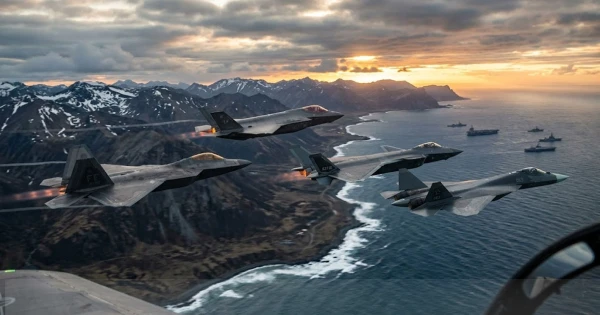
In the silent contest for control of the skies, victory is increasingly decided before a missile is fired or a pilot sees the enemy. Across the world, 5th generation fighter jets have become symbols of modern military power because they combine stealth aircraft technology, advanced military avionics, high-performance engines, and networked warfare into a single combat platform. From the F-22 Raptor and F-35 Lightning II to the Chengdu J-20 and Su-57, these aircraft represent more than speed and firepower. They mark a shift in air combat from traditional dogfighting to information dominance, where the fighter that detects first, shares data fastest, and remains hardest to track holds the decisive advantage.
The Evolution From Fighter Jets to Flying Combat Networks
For much of aviation history, fighter aircraft were judged by speed, altitude, maneuverability, and weapons load. Those factors still matter, but modern air warfare has changed dramatically. The rise of sophisticated surface-to-air missile systems, long-range radars, electronic warfare tools, and satellite-enabled command networks has made the battlefield far more complex.
5th generation fighter jets emerged as a response to that environment. They are not simply upgraded versions of older aircraft. They are designed from the beginning to operate in contested airspace, penetrate advanced defenses, and act as airborne intelligence hubs.

A true 5th generation fighter usually includes:
- Low-observable stealth design to reduce radar detection
- Internal weapons bays to preserve stealth profiles
- Advanced sensor fusion for real-time battlefield awareness
- Active electronically scanned array radar, commonly known as AESA radar
- Secure data links for network-centric operations
- High-performance engines and, in some cases, supercruise capability
- Integrated electronic warfare and defensive systems
Together, these features allow pilots to see more, decide faster, and engage threats from positions of advantage.
Stealth Aircraft Technology: More Than an Invisible Shape
Stealth aircraft technology is often misunderstood. These aircraft are not truly invisible. Instead, they are engineered to reduce the chances of detection, tracking, and targeting by enemy radar, infrared sensors, and other surveillance systems.
The most visible part of stealth is the aircraft’s shape. Angled surfaces, carefully aligned edges, and smooth contours help deflect radar energy away from the source. But stealth also depends on less obvious details, including materials, coatings, heat management, antenna placement, and even how weapons are carried.
Internal weapons bays are especially important. Missiles and bombs mounted externally can dramatically increase radar signature. By carrying weapons inside the aircraft, 5th generation fighters maintain a cleaner and more difficult-to-detect profile until the moment of engagement.
Why Stealth Still Matters
Even as radar systems improve, stealth remains valuable because air combat is not a simple contest between one aircraft and one radar. It is a layered struggle involving sensors, command centers, missiles, electronic warfare, and pilot decision-making.
Stealth provides several enduring advantages:
- It delays detection, giving pilots more time to act.
- It complicates enemy targeting and missile guidance.
- It allows aircraft to operate closer to defended areas.
- It increases survivability during strike and air superiority missions.
- It forces adversaries to spend more resources on detection networks.
For that reason, stealth will remain a core feature of next-gen air superiority fighters, even as new detection methods continue to evolve.
Advanced Military Avionics: The Brain of the Modern Fighter
If stealth is the skin of a 5th generation fighter, advanced military avionics are its brain. Modern fighter jets carry powerful radar, infrared search and track systems, electronic warfare suites, communication systems, navigation tools, and mission computers. The real breakthrough is not simply having more sensors; it is combining their data into a clear, usable picture.
This process is called sensor fusion. Instead of forcing the pilot to interpret multiple screens and raw data feeds, the aircraft’s systems process information and present a unified view of the battlespace.
That matters because air combat unfolds at extreme speed. A pilot may need to identify threats, avoid enemy radar, coordinate with friendly forces, and prepare weapons within seconds. Advanced avionics reduce workload and improve decision-making.
Key avionics features include:
- AESA radar for rapid scanning, tracking, and electronic attack roles
- Helmet-mounted displays that project critical data into the pilot’s line of sight
- Infrared sensors for passive detection of aircraft and missiles
- Electronic support measures to identify hostile radar emissions
- Secure communications for sharing targeting and surveillance data
In modern air operations, the most dangerous fighter may not be the one flying fastest. It may be the one that understands the battlefield first.
Air Superiority in the Age of Data
Air superiority has always meant controlling the airspace enough to protect friendly forces and deny freedom of movement to the enemy. What has changed is how that control is achieved.
Older fighters often relied on radar intercepts, visual identification, and close-range engagements. Modern 5th generation fighter jets are built for beyond-visual-range combat, where aircraft may engage opponents from great distances using long-range missiles and shared targeting data.
The fighter is no longer an isolated machine. It is part of a network that can include:
- Airborne early warning aircraft
- Ground and naval radar systems
- Satellites and surveillance aircraft
- Unmanned aerial vehicles
- Command-and-control centers
- Other fighter jets and strike platforms
This networked approach allows one aircraft to detect a target, another to track it, and a third to engage it. In such a system, advanced military avionics and secure data links are as important as engines and missiles.
The Leading 5th Generation Fighter Jets
Several aircraft are commonly associated with the 5th generation category, each reflecting different national priorities.
The F-22 Raptor was designed primarily for air dominance, with exceptional maneuverability, stealth, speed, and sensor capability. The F-35 Lightning II emphasizes multirole operations, sensor fusion, and interoperability among allied forces. China’s J-20 reflects a focus on long-range operations and regional airpower projection. Russia’s Su-57 combines stealth features with maneuverability and a broad weapons concept.
These aircraft differ in design philosophy, but they share a common reality: modern fighters are judged by how effectively they combine stealth, sensors, weapons, and connectivity.
Next-Gen Air Superiority Fighters: What Comes After 5th Generation?
The phrase “next-gen air superiority fighters” often points toward future combat aircraft sometimes described as 6th generation. While exact designs vary by country, the direction is becoming clearer. Future fighters are expected to build on 5th generation foundations rather than replace them entirely.
Likely features include:
- Deeper integration with unmanned combat aircraft
- More powerful engines with greater range and efficiency
- Artificial intelligence to support decision-making
- Expanded electronic warfare capabilities
- Advanced sensors across wider frequency ranges
- Directed-energy or next-generation missile systems
- Greater emphasis on software upgrades over physical redesign
One of the most important ideas is manned-unmanned teaming. A future fighter may command loyal wingman drones that scout ahead, carry extra weapons, jam enemy systems, or absorb risk in high-threat areas. This could allow pilots to make tactical decisions while unmanned systems extend reach and survivability.
Why These Aircraft Matter Beyond the Military
The importance of 5th generation fighter jets extends beyond air forces and defense ministries. They influence diplomacy, alliances, defense budgets, industrial policy, and national technological development.
Countries that operate advanced fighter aircraft gain strategic options. They can deter aggression, reassure allies, protect airspace, and support expeditionary operations. At the same time, these aircraft are expensive to buy, maintain, and upgrade. Their value depends not only on the jet itself but also on pilot training, maintenance systems, weapons stocks, secure communications, and supporting infrastructure.
A 5th generation fighter is never just an aircraft purchase. It is a long-term defense ecosystem.
The Enduring Lessons of 5th Generation Airpower
The rise of 5th generation fighter jets offers several lasting lessons about modern warfare:
- Information advantage is now central to combat success.
- Stealth is most effective when combined with electronic warfare and smart tactics.
- Software and avionics upgrades can be as important as airframe improvements.
- Air superiority depends on networks, not individual aircraft alone.
- Training, maintenance, and logistics determine whether advanced technology performs in real conflict.
- Future fighters will increasingly operate with unmanned systems and autonomous support platforms.
These lessons will remain relevant because they reflect structural changes in air warfare, not temporary trends.
Conclusion: The Future of Air Combat Is Already Taking Shape
5th generation fighter jets have transformed the meaning of air superiority. They are not merely faster or more agile aircraft; they are stealthy, networked, sensor-rich combat systems designed for an era of contested airspace and rapid decision-making. Stealth aircraft technology helps them survive. Advanced military avionics help them understand the battlespace. Secure networks allow them to share that understanding with other forces.
As next-gen air superiority fighters continue to evolve, the core principle will remain the same: the side that can detect, decide, communicate, and strike first is more likely to control the skies. For readers seeking to understand the future of military aviation, 5th generation fighters are the essential starting point. They are the bridge between traditional fighter combat and the emerging age of intelligent, connected, and highly adaptive air warfare.