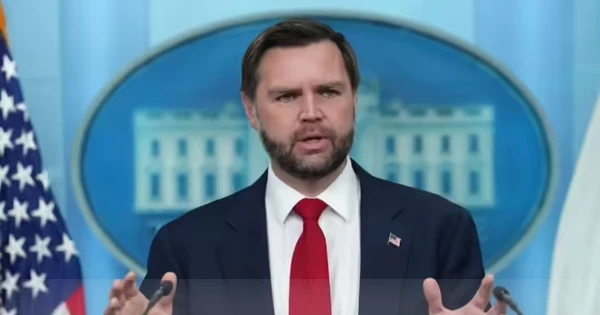
Vice President JD Vance delivered a blistering public reprimand to Israeli government officials on Thursday, warning them against attacking the United States' landmark agreement with Iran. He asserted that President Donald Trump remains the Jewish state's sole powerful ally on the global stage. The comments signal a dramatic escalation in tensions between the two long-standing allies .
Speaking from the White House, Vance directly addressed critics within Israeli Prime Minister Benjamin Netanyahu's cabinet, urging them to "wake up and smell the reality of the situation" and threatening to damage the relationship with their most critical military backer . The rebuke comes just days after the U.S. signed a controversial memorandum of understanding with Iran to end months of conflict .
A Stern Warning to the Cabinet
Vance reserved his sharpest criticism for unnamed members of Netanyahu's cabinet who have publicly condemned the U.S.-Iran deal. He questioned the logic of alienating Washington while the nation relies heavily on American support. He stated that Israel is deeply isolated on the world stage and needs to recognize the value of its partnership with the United States .

"If I was in the cabinet of the Israeli government, I might not be attacking the only powerful ally that I have anywhere left in the entire world," Vance told reporters . He underscored America's commitment by noting that two-thirds of the defensive weapons protecting Israel have been built and paid for by U.S. taxpayers .
Vance emphasized that the challenges facing Israel do not stem from the White House. "The problem for Israel is not Donald J. Trump," he stated. "Anybody in Israel who thinks their biggest problem is the president of the United States needs to wake up and smell the reality of the situation that country is in" .
The vice president also dismissed reports that Netanyahu himself was "fuming" over the agreement, stating that such sentiments have not been reflected in his direct conversations with the Israeli leader. He directed his frustration at other cabinet members who he claimed have engaged in personal attacks against the president .
The Core of the Disagreement
The rift centers on the recent U.S. deal with Iran, which aims to halt the war that was jointly launched by Washington and Jerusalem on February 28 . While the U.S. views the agreement as a necessary step to stabilize the region and reopen the Strait of Hormuz, Israeli officials have voiced strong opposition .
Israel has argued that the agreement fails to sufficiently curb Iran's ballistic missile program and does not provide a clear path to dismantling its nuclear facilities. Furthermore, Jerusalem is concerned that the deal restricts its ability to operate freely against Hezbollah militants in Lebanon .
National Security Minister Itamar Ben-Gvir, a key member of Netanyahu's coalition, has been one of the most vocal critics, declaring that Israel is not bound by Trump's agreement and will not cave to international pressure . Vance responded to such defiance by questioning the military strategy of a nation of roughly 9 million people, pointing out the limits of relying solely on military force .
A Defense of the Agreement
Vance vigorously defended the memorandum, countering claims that it grants Iran premature concessions. He maintained that Tehran will only receive benefits if it demonstrably changes its behavior. "What is the benefit that the Iranians get that they didn't have before? The answer is nothing. If they don't change their behavior, they don't get the benefit of the bargain," he explained .
He also pointed to the economic pressure the U.S. still holds over Iran and noted that the country will likely be unable to rebuild its nuclear infrastructure for years due to the extensive damage inflicted during the conflict . The vice president expressed confidence that negotiations could proceed successfully, though he admitted Iran would be a difficult partner to engage with .
As the public spat intensifies, the Trump administration has indicated it will soon brief Congress on the details of the deal. The long-term stability of the U.S.-Israel relationship appears increasingly uncertain as both nations head toward elections where the war and its economic impacts will be defining issues .