



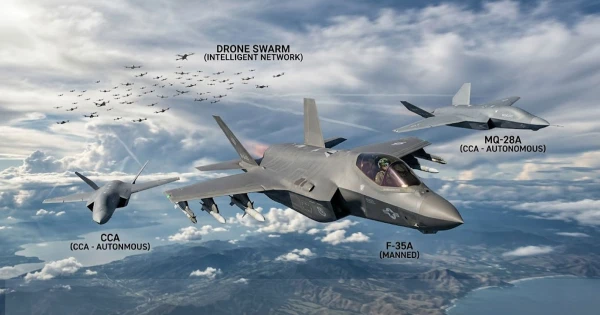
A new generation of air warfare is arriving not as a single breakthrough fighter but as a distributed system of manned jets, autonomous "loyal wingman" drones, and intelligent drone swarms working together under human direction. Known broadly as Collaborative Combat Aircraft (CCA), these AI-enabled partners extend pilot reach, reduce risk, and change operational tactics—ushering in an era where the force is as much software and sensors as it is metal and jet fuel. This article explains what CCAs and loyal wingman drones are, why militaries are racing to field them by 2026 and beyond, and what stable, long-term implications they hold for strategy, procurement, and ethics.
Why collaborative combat aircraft matter
-
Force multiplication: CCAs multiply the effectiveness of a single manned fighter by performing reconnaissance, electronic warfare, decoying, or kinetic strike tasks in concert.
-
Risk reduction: Loyal wingman drones can accept higher risk (suppression of enemy air defenses, deep penetration) that commanders may not want to expose human pilots to.
-
Cost and scalability: Unmanned platforms typically cost less to produce and operate, allowing larger numbers and mission-tailored mixes (sensors, loitering munitions, jammer pods).
-
Decision advantage: Integrated AI and sensor fusion provide faster, richer battlefield awareness to pilots and commanders, improving decision-making tempo.

What is a Collaborative Combat Aircraft (CCA)?
Collaborative Combat Aircraft is an operational concept and class of platforms where manned aircraft and unmanned systems operate together as a cohesive team. Key features include:
-
Shared situational awareness through secure datalinks.
-
Role specialization: some CCAs act as sensor nodes, others as decoys or strike platforms.
-
Human-in-the-loop (HITL) or human-on-the-loop control models that maintain legal and ethical oversight of lethal actions.
-
Modularity so payloads and software can be updated without replacing the entire platform.
Loyal wingman drones: the new wingmen
"Loyal wingman" is the most mature practical expression of CCA. These are autonomous or semi-autonomous drones designed to fly alongside manned fighters, carrying out complementary roles. Characteristics:
-
Designed for teamwork rather than independent operations.
-
Built for survivability and expendability relative to crewed jets.
-
Often low-observable and optimized to share sensor data with manned assets.
-
Configured to accept pre-authorized actions under human supervision.
AI fighter jet wingman 2026: where we are now
By 2026, several programs worldwide reached advanced prototyping and limited operational testing:
-
Development and flight demonstrations: Multiple air forces and defense firms have flown loyal wingman demonstrators to validate formation flying, sensor sharing, and basic mission autonomy.
-
Early operational concepts: Trials focused on ISR (intelligence, surveillance, reconnaissance), suppression of enemy air defenses, and convoy escort-type roles.
-
Integration challenges persist: secure, low-latency datalinks; robust autonomy in contested electromagnetic environments; and clear command-and-control models remain active technical and doctrinal workstreams.
Next‑gen drone swarms: capabilities and constraints
Drone swarms promise scale and complexity beyond individual CCAs. They present distinct capabilities and limitations:
Capabilities
-
Distributed sensing: many small drones can cover large areas and fuse data into a coherent picture.
-
Saturation effect: swarms can overwhelm defenses through sheer numbers and diverse payload mixes.
-
Resilience: redundancy means the swarm continues even with losses.
Constraints -
Command and control: coordinating many units while preserving human supervision is technically and legally complex.
-
Communications vulnerability: swarms can be disrupted by jamming, spoofing, or cyberattacks.
-
Logistics and sustainment: mass numbers create maintenance, transport, and supply-chain challenges.
Design principles that give CCAs evergreen value
To remain relevant and resilient over years or decades, CCA programs should follow durable design principles:
-
Modular open systems architecture: hardware and software plug-ins allow upgrades without full redesign.
-
Interoperability standards: common datalinks and mission data formats enable joint and coalition operations.
-
Cyber-resilience: hardened communications, authenticated updates, and redundancy mitigate cyber threats.
-
Human-centric control: maintain clear human responsibility for lethal decisions to satisfy legal and ethical norms.
-
Cost-scalability: design for production economics so numbers can be increased if doctrine demands.
Real-world uses that will endure
The practical roles for CCAs that are unlikely to fade include:
-
Persistent ISR: long-dwell sensors replacing costly manned patrols.
-
Electronic warfare and deception: jamming and spoofing to deny or confuse adversaries.
-
Escort and force protection: screening high-value manned assets with low-cost drones.
-
Distributed strike: combining long-range sensors with precision munitions across a mixed manned-unmanned package.
These roles are rooted in fundamental military problems—information, protection, and precision—that will persist beyond any single technology cycle.
Operational and ethical considerations
-
Rules of engagement and culpability: legal frameworks must define how much autonomy is permitted for lethal acts and where human authorization is required.
-
Collateral risk management: sensor fusion and positive target identification must be robust to reduce mistaken engagements.
-
Escalation dynamics: more autonomous, faster weapons can shorten decision cycles and complicate crisis stability between states.
-
Export controls and proliferation: as hardware costs fall, responsible export policies and verification regimes become more important.
Procurement and industrial implications
-
Shift to software-first acquisition: much of CCA capability resides in AI and mission software rather than airframe performance alone.
-
Supply-chain attention: semiconductors, sensors, and specialist materials become strategic bottlenecks.
-
Smaller suppliers rise: modular architectures and commercial AI open doors for nontraditional defense firms.
-
Lifecycle budgeting: planners must fund continuous software updates and cyber defenses as part of fielded systems.
Security and countermeasures that will persist
-
Electronic protection (EP) and anti-jam design: robust waveform design and adaptive networking are long-term necessities.
-
Deception and signature management: both CCAs and adversary defenses will evolve adaptive techniques to hide and detect.
-
Counter-swarm systems: directed energy, electronic warfare, and AI-based interceptors will be a continuing focus for defense planners.
Actionable takeaways for policymakers and planners
-
Prioritize open standards and interoperability to avoid stovepipes that lock forces into obsolete systems.
-
Invest continuously in software, data link security, and AI validation to keep capabilities mission-relevant.
-
Build legal and ethical frameworks before wide deployment; clarify human responsibility and escalation controls.
-
Plan for logistics: training, spare parts, and routine cyber updates are as important as the initial purchase.
What to watch next (indicators of durable change)
-
Standardized datalinks and common mission data formats being adopted by multiple militaries.
-
Widespread use of modular payload racks and plug-and-play software ecosystems.
-
Large-scale exercises integrating manned fighters, loyal wingmen, and swarm tactics in contested-communications scenarios.
-
Continued decline in unit cost for unmanned platforms paired with rising investment in AI assurance and cybersecurity.
Illustration: a plausible mission scenario
Imagine a four-aircraft team: two manned fighters and two loyal wingman drones. The drones fly slightly ahead to map air-defense nodes using passive sensors and emitters. One drone performs electronic attack to degrade enemy radars while the other serves as a decoy and carries a small precision munition. The manned fighters retain final weapons release authority, guided by fused sensor feeds. This layered approach reduces pilot risk, expands sensor coverage, and enables the team to prosecute targets that were formerly too risky or costly to engage.
Conclusion
Collaborative Combat Aircraft, loyal wingman drones, and next‑generation drone swarms represent a durable transformation in military aviation. They reframe air power as a networked, software-driven force that multiplies human pilots rather than replaces them. Nations that adopt open, modular designs; prioritize secure communications and AI assurance; and develop responsible legal frameworks will capture the long-term benefits while managing risks. As platforms evolve, the enduring lesson is strategic: the side that best integrates people, sensors, software, and logistics—not merely the one with the fastest jet—will hold the decisive advantage.