



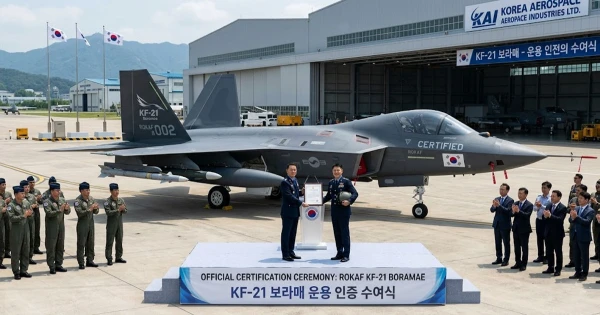
In a move that signals a monumental shift in the global defense landscape, South Korea has officially certified its domestically developed KF-21 Boramae fighter jet for operational deployment. This isn't just another new aircraft entering the market; it is the culmination of a 25-year journey to achieve self-reliant airpower . By receiving its initial type certification in June 2026, the KF-21 has proven it is not merely a concept or a prototype, but a tangible, safe, and capable 4.5-generation fighter ready for mass production and international competition, offering a compelling alternative in a market long dominated by a few established players .
Achieving Certification: A Testament to Rigor and Ambition
The path to certification for the KF-21 Boramae was paved with exhaustive testing and stringent evaluations. The Defense Acquisition Program Administration (DAPA) confirmed in June 2026 that the aircraft met all 745 airworthiness requirements across 14 categories, including crucial areas like aircraft structure, weapons integration, and electronic systems . This airworthiness certification, approved by the Airworthiness Certification Review Committee, formally recognizes the safety of the aircraft's approved design . This milestone was preceded by a final combat suitability evaluation in May 2026, which cleared the Block I variant—focused on air-to-air capabilities—for active combat .
To put the scale of this achievement into perspective, the program logged more than 1,600 test sorties across six prototypes without a recorded accident . This rigorous testing regimen, spanning from ground evaluations to weapons release, has validated the aircraft's performance envelope, which includes a top speed of Mach 1.81 and advanced avionics like a domestically developed Active Electronically Scanned Array (AESA) radar . The successful certification is a clear signal that South Korea has "fully secured its own fighter jet development capability" .
B-52 Crash at Edwards AFB: What the 2026 Stratofortress Accident Reveals About an Aging Bomber Fleet

The Boramae vs. The Lightning: A Tale of Two Fighters
The KF-21 Boramae is frequently compared to the F-35 Lightning II, and it's easy to see why. With its sleek, angled twin tails and stealthy design, the KF-21 bears a striking resemblance to its American counterpart, leading many to dub it the F-35's "little brother" . However, the similarities are largely superficial, as the two aircraft serve different roles and are built on distinct philosophies.
The key differences are fundamental to understanding the Boramae's place in the market:
-
Cost and Economics: This is arguably the KF-21's greatest advantage. KAI aims for a long-term export price of roughly $60 million, significantly undercutting the $80-110 million price tag of an F-35 . While initial Block I units are estimated around $83 million, the program's goal is to offer a high-performance fighter at a more accessible price point .
-
Generation and Capability: The F-35 is a true fifth-generation fighter, defined by its advanced sensor fusion, stealth, and internal weapons bays. The KF-21, in its current Block I form, is classified as a 4.5-generation aircraft. It features stealthy shaping to reduce its radar cross-section but lacks internal weapons bays, instead carrying its armament on semi-recessed external hardpoints .
-
Design and Propulsion: The KF-21 is a twin-engine aircraft powered by two General Electric F414 engines, similar to those on the F/A-18 Super Hornet . The F-35 is a single-engine aircraft with a more powerful and complex powerplant. The KF-21’s dual-engine design may be seen as a safety advantage in some markets, while its maintainability is designed to be a key selling point .
Future-Proofing: The Path to True Stealth
While the current KF-21 is not a fifth-generation fighter, it was designed with a clear upgrade path to achieve that status. The future Block III (KF-21EX) variant is slated to introduce full internal weapons bays, a move that would drastically reduce its radar signature and propel it into the realm of true stealth fighters . This variant is also expected to feature advanced capabilities like artificial intelligence (AI) for mission computers and manned-unmanned teaming (MUM-T) systems, allowing it to coordinate with "loyal wingman" drones . This "block" approach allows the Republic of Korea Air Force (ROKAF) and potential export customers to adopt the platform now with confidence, knowing it can evolve to meet future threats .
Operational Deployment and Market Impact
With certification secured, the KF-21 is moving rapidly toward operational deployment. The ROKAF plans to acquire 120 KF-21s by 2032, with the first 40 Block I aircraft scheduled for delivery by 2028 . The first mass-produced units are expected to be delivered to the Air Force in the second half of 2026 .
This timeline is aggressive and signals KAI’s readiness to meet both domestic and export demand. Production capacity is being scaled up, with a goal of delivering 27 aircraft in 2026 alone . The successful rollout of the first mass-produced jet in March 2026 marked the transition from a development program to a full-scale production venture .
The global interest in the KF-21 is substantial. As a co-development partner, Indonesia is a leading candidate for the first export sale, with reports suggesting a 16-aircraft purchase agreement is being advanced . Other nations that have expressed interest include Poland, the United Arab Emirates, and the Philippines, where a deal could be signed as early as late 2026 . The Boramae is positioned as an ideal solution for nations looking to replace aging fleets of F-4s, F-5s, and F-16s with a modern, cost-effective, and capable multirole fighter .
Conclusion
The KF-21 Boramae has officially arrived, and it is a game-changer. South Korea’s successful certification of its homegrown fighter jet is a historic achievement that reshapes the global hierarchy of aerospace manufacturing. By prioritizing rigorous testing and a phased capability development plan, the nation has delivered a 4.5-generation fighter that is safe, affordable, and ready for the modern battlespace. While it may not yet match the full stealth and sensor fusion of the fifth-generation F-35, its value proposition is clear. With a significantly lower price point, a design focused on maintainability, and a clear roadmap to true fifth-generation capabilities via the KF-21EX, the Boramae offers a practical, cost-effective, and strategically valuable alternative for air forces worldwide . The KF-21 Boramae is not just South Korea’s future; it is increasingly looking like the future for many air arms around the globe.