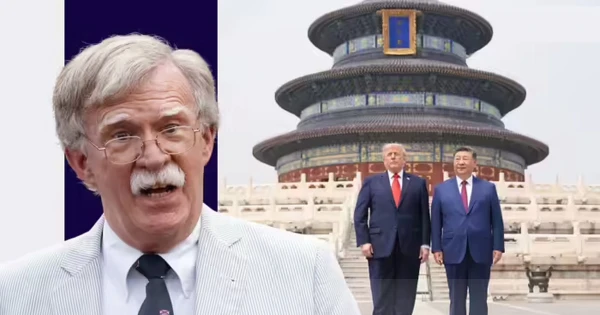
Former United States National Security Advisor John Bolton has issued a sharp rebuke of President Donald Trump's evolving foreign policy approach, warning that a proposed US-China partnership framework risks sidelining India at a critical moment for global security. Bolton described the shift as a dangerous miscalculation that could weaken American influence across the Indo-Pacific region.
In a recent interview, Bolton took direct aim at what has been referred to as the "G2" concept — a bilateral partnership between Washington and Beijing that would place the world's two largest economies at the center of the global order. The former national security advisor argued that such an approach effectively marginalizes India, a nation the United States has spent two decades cultivating as a strategic partner.
"China's aspirations for hegemony along the Indo-Pacific periphery are really one of the major issues, if not the major issue of the 21st century," Bolton said. He stressed that closer relations between India and the United States are critical to addressing the challenges posed by Beijing's growing military and economic ambitions.
B-52 Crash at Edwards AFB: What the 2026 Stratofortress Accident Reveals About an Aging Bomber Fleet

Bolton's comments come amid a series of moves by the Trump administration that have raised concerns in New Delhi about the direction of the bilateral relationship. Among the most notable developments was the Pentagon's recent decision to rename the US Indo-Pacific Command back to the US Pacific Command, reversing a symbolic 2018 change that had been widely viewed as a nod to India's strategic importance.
The renaming, announced on June 16, 2026, restored the command's historic USPACOM designation, which it had carried since its establishment in 1947. Then-Defense Secretary Jim Mattis had introduced the "Indo-Pacific" label eight years earlier to reflect the growing connectivity between the Indian and Pacific Oceans and India's rising role in regional security architecture.
Defense Secretary Pete Hegseth highlighted the reversion on social media, posting that the "U.S. Pacific Command…is back." While US officials insisted the change was purely a matter of honoring institutional heritage, the timing — coming just one day before a planned meeting between President Trump and Indian Prime Minister Narendra Modi at the G7 Summit in France — drew widespread attention.
Bolton did not hold back in his criticism of what he sees as a broader pattern of neglecting the India relationship in favor of engagement with Beijing. He argued that Trump's heavy focus on trade deals has repeatedly overshadowed more pressing strategic conversations between the two leaders.
"The problem is that Donald Trump's attention is very much focused on trade," Bolton said. "Every time he talks to foreign leaders, it becomes difficult for him to discuss any other issue."
The former national security advisor called for a dedicated strategic dialogue between Trump and Modi centered specifically on the China challenge. He noted that during both Trump's first term and his current term, discussions between Washington and New Delhi have consistently been derailed by tariff disputes and trade negotiations.
Bolton also criticized the Trump administration's tariff policy toward India as disproportionately harsh. The administration initially imposed 50 percent tariffs on Indian goods before later reaching an interim trade agreement that lowered the reciprocal tariff rate to 18 percent. Bolton described the original tariff levels as "particularly unfairly applied to India, much more so than to China."
The broader geopolitical context has added weight to Bolton's warnings. President Trump traveled to China last month, and Chinese President Xi Jinping is expected to visit the United States later this year. These developments have fueled speculation that Washington is prioritizing its relationship with Beijing over its partnerships in other parts of Asia.
Meanwhile, tensions along the Line of Actual Control between India and China remain unresolved despite multiple rounds of diplomatic and military talks. Bolton pointed to these ongoing border disputes, along with China's assertiveness in the Taiwan Strait and the South China Sea, as evidence that a coordinated response between Washington and New Delhi is more important than ever.
"We either address it together, or we're going to have to address it separately, which is not ideal," Bolton said, emphasizing the need for joint action against Beijing's expansionist behavior.
The former national security advisor also advocated for strengthening the Quadrilateral Security Dialogue, known as the Quad, which brings together India, the United States, Japan, and Australia. Bolton suggested that the grouping should move beyond diplomatic meetings and include deeper cooperation on intelligence-sharing, military coordination, and broader security consultations.
However, the Quad's future has itself come into question. A leaders' summit that was expected to be hosted by India has yet to take place, and some analysts have questioned whether the grouping retains the political momentum it enjoyed during the later years of Trump's first term and the Biden administration.
Indian strategic observers have expressed concern about the cumulative impact of recent developments. Former Indian Foreign Secretary Nirupama Rao wrote publicly that a series of signals — including the command renaming, trade disputes, and shifting diplomatic optics — suggest that "the exuberant phase of India-US relations may be ending." She characterized the relationship as becoming "more normal, more transactional, and perhaps more difficult."
Bolton's critique reflects a broader debate within the American foreign policy establishment about the right balance between engaging China and maintaining alliances with partners like India. Supporters of Trump's approach argue that direct engagement with Beijing is necessary to manage the most consequential bilateral relationship in the world. Critics like Bolton contend that doing so at the expense of partnerships built over decades is a strategic error.
The G2 concept itself carries significant implications for the global order. If the United States and China were to effectively divide spheres of influence between them, it would represent a fundamental departure from the multilateral framework that has guided international relations for decades. For India, which has positioned itself as a leading voice for a multipolar world, such a bilateral arrangement could significantly constrain its strategic options.
Bolton's warnings arrive at a moment when India is navigating an increasingly complex geopolitical landscape. New Delhi must balance its longstanding relationship with Russia, its growing partnership with the United States, and its deep strategic rivalry with China — all while pursuing its own ambitions as a rising global power.
The coming months will be critical in determining whether the Trump administration's outreach to Beijing represents a temporary tactical adjustment or a lasting reorientation of American foreign policy. For India, the stakes could not be higher. The strength of the US-India partnership has long been viewed as a cornerstone of stability in the Indo-Pacific, and any erosion of that relationship would have consequences far beyond the bilateral sphere.
As Bolton put it, sidelining India is not just a diplomatic misstep — it is a strategic mistake that could embolden China and weaken the broader coalition of democracies working to maintain a free and open Indo-Pacific.