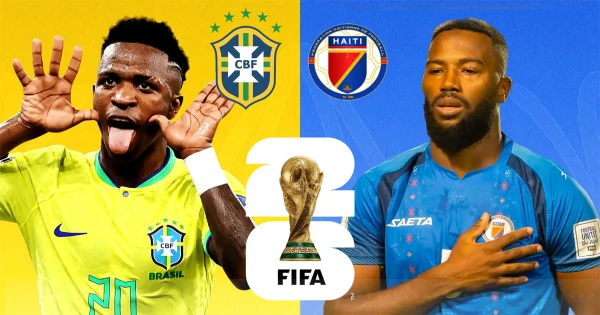
The upcoming World Cup group stage match between Haiti and Brazil in Philadelphia represents far more than a routine fixture on soccer’s grandest stage. It is a convergence of history, deep-seated cultural admiration, and a profound psychological test for a team that has long worshipped its opponent. For generations, Haitians have harbored an unwavering passion for Brazilian soccer, a love affair that has shaped the nation’s sporting identity and now creates a uniquely complex challenge as their own team prepares to face the five-time world champions.
This affection for the Seleção is rooted in multiple factors, blending athletic admiration with deeper cultural connections. Many point to the fluid, artistic style of play that Brazil has perfected, a rhythmic approach that Haitian footballers have spent decades trying to replicate on their own pitches. Others trace the origin of this bond to the visits of Pelé, the sport’s greatest icon, who traveled to Haiti twice. His 1971 arrival, however, was orchestrated by the brutal Duvalier regime for propaganda purposes, a dark historical footnote that nevertheless cemented his legendary status among the Haitian people.
Beyond the spectacle of Pelé’s genius, Haitians found a powerful source of identification with Brazil. The South American giant represented a global soccer powerhouse with undeniable African roots, featuring players who often shared the same complexion and heritage as the people of the Caribbean nation. This representation fostered a sense of kinship, making Brazil the default team for generations of Haitians who saw their own potential reflected in the yellow jerseys. The devotion has been so profound that it has frequently transcended the boundaries of sport, weaving itself into the fabric of daily life and even national politics.

The intensity of this passion has at times reached humorous and unusual heights. Lawmakers in Haiti have been known to pause parliamentary debates to watch Brazil’s matches, a testament to the game’s hold on the nation’s consciousness. In one notable instance, a Haitian administration reportedly counted on a Brazilian victory to help temper public reaction to an unpopular fuel-price increase. The plan backfired when Brazil lost, and instead of public appeasement, the government faced anger-fueled protests. For many Haitians, Brazil’s success and failure were deeply intertwined with their own national mood.
Now, however, the relationship has been flipped on its head. As Haiti prepares to go head-to-head with its beloved Brazil in a crucial World Cup group stage encounter, fans and players alike are confronting a deeply unfamiliar emotional landscape. The supporters, who never had the chance to cheer for Haiti on the world’s biggest stage until now, are torn between their lifelong devotion and their national pride. For the players, many of whom grew up idolizing the Brazilian greats, the challenge is even more profound: they must convince themselves that their heroes can be beaten.
Patrick Tardieu, a former captain of the Haitian national team, understands this psychological hurdle better than most. He was a key figure in one of the nation’s most remarkable victories, a 4-3 triumph over Brazil during the Caribbean Cup in Trinidad and Tobago in 1999. Though Brazil sent its under-23 Olympic squad rather than its senior team for the regional CONCACAF tournament, the victory was a monumental moment for Haiti. Tardieu, who scored in that match, admitted that he initially struggled to process the magnitude of what he had achieved, but was ultimately overwhelmed with a sense of pride.
Looking back, Tardieu believes his admiration for Brazil fueled his determination on that fateful day. He described the experience as playing against a big brother, a sibling he desperately wanted to prove himself against. Nearly three decades later, Haiti’s current squad must summon that same strength. However, the stakes are exponentially higher. This is a World Cup match against the actual Brazilian national team, and the pressure is immense, especially after a narrow 1-0 loss to Scotland in their tournament opener.
The logistical and security challenges facing the Haitian team have been immense. They arrived at the World Cup without having played a single home qualifier due to the pervasive gang violence that has destabilized Port-au-Prince. As a heavy underdog in a 48-team field, many did not expect them to reach this point. Yet, the squad is filled with professional players, many of whom were born in the diaspora, and they are determined to prove their worth on the global stage. Their fans, flooding Philadelphia in the nation’s blue and red colors, are eager to witness the historic event live from the stands.
For veterans like Ernst "ZeNono" Jean-Baptiste, a legendary former Haitian midfielder, the team’s return to the World Cup is a dream realized. He recalled preaching about the possibility to the players, sometimes to their annoyance, but he always believed in the talent within the nation. He believes that the fortunes of Haitian soccer have begun to change with new management and a more professional environment, moving away from years of political instability, poor administration, and unpaid players. Once the players are at ease, he argues, they can accomplish anything.
The psychological dimension of the game on Friday will likely overshadow the physical aspects of the match. As one observer noted, the battle will be 95 percent mental, defined by willpower, combativeness, and resilience. With Brazil drawing their opener against Morocco and Scotland leading the group, the pressure on Haiti is immense. The team has nothing to lose and everything to gain, yet they must overcome the deep reverence they hold for their opponents. The love for Brazil remains, but for 90 minutes, it must be set aside in favor of national pride and the pursuit of a historic upset.
Ultimately, the match is a testament to the power of soccer to evoke complex emotions and forge unexpected connections. The love for Brazil among Haitians is a story of cultural affinity, historical ties, and idol worship. But now, that devotion will be tested in the most direct way possible. The crowd will likely be a mosaic of yellow and blue, a symbol of the shared history that will be temporarily cast aside in the name of competition. For Haiti, this is not just a game; it is an opportunity to define their own legacy on the world stage, to show that the student has learned the lessons well enough to challenge the master.
As the team takes the field, they will carry the hopes of a nation that has endured immense hardship. They will also carry the weight of a complex history with their opponents. But as Tardieu proved in 1999, respect does not preclude victory. In a world of upsets and underdog stories, Haiti is ready to write its own chapter, proving that in the beautiful game, passion and belief can be just as powerful as tradition and legend.