


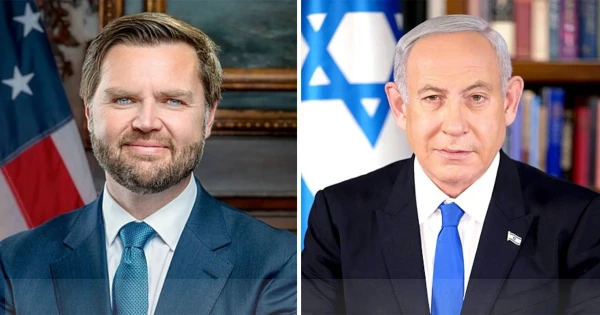
Vice President JD Vance issued a blunt and unprecedented public rebuke to the Israeli government on Thursday, warning senior officials against undermining the new U.S.-Iran peace agreement and reminding them that the United States remains their "only powerful ally" on the global stage .
The sharp comments, delivered during a White House press briefing, signal a dramatic escalation in the growing tension between the Trump administration and Israeli Prime Minister Benjamin Netanyahu's government. The rift has widened significantly following the signing of a landmark memorandum of understanding between Washington and Tehran, which explicitly calls for an end to hostilities in Lebanon .
Vance’s remarks were a direct response to vocal opposition from Israeli ministers and pro-Netanyahu media outlets, which have labeled the deal a "strategic and political disaster" and leveled personal attacks against the U.S. president and his envoys . The vice president made it clear that such criticism was not only unwelcome but strategically misguided.

"Donald J. Trump is the only head of state in the entire world who is sympathetic to the nation of Israel at this moment in time," Vance stated firmly. He added, "If I was in the cabinet of the Israeli government, I might not be attacking the only powerful ally that I have anywhere left in the entire world" .
Vance underscored the depth of U.S. military support for Israel, noting that a substantial portion of the country's defensive capabilities are American-made and funded by U.S. taxpayers. He pointedly stated that Israel's primary challenge is not the Trump administration but its own security realities . "The problem for Israel is not Donald J. Trump," he declared. "Anybody in Israel who thinks their biggest problem is the president of the United States needs to wake up and smell the reality of the situation" .
The underlying friction stems from the U.S.-Iran memorandum, which includes a provision for the "immediate and permanent termination of military operations on all fronts, including in Lebanon," while reaffirming Lebanon's sovereignty . This agreement was reached without direct Israeli participation, and Israeli officials have signaled they do not feel bound by its terms regarding Lebanon .
Netanyahu has insisted that Israeli troops will remain in southern Lebanon for as long as necessary to ensure security, directly contradicting the spirit of the U.S.-Iran understanding . Israeli leaders have publicly stated their commitment to maintaining buffer zones and continuing operations against Hezbollah infrastructure .
Vance pushed back against this stance, questioning the efficacy of a purely military approach. He directly criticized far-right ministers Itamar Ben-Gvir and Bezalel Smotrich for their opposition to the deal, challenging their strategy for a nation of nine million people . "You can’t just kill your way out of solving every single national security problem that you have," he argued .
The public confrontation marks a significant low point in the historically close U.S.-Israel relationship. Reports indicate that Trump has privately expressed frustration with Netanyahu’s actions in Lebanon, warning that the Israeli leader is jeopardizing the broader diplomatic achievement with Iran .
While the vice president acknowledged that Netanyahu himself has not publicly criticized the deal, he expressed frustration with the actions of his cabinet members and allies who have attacked the agreement and the president personally . The pro-Netanyahu media in Israel has been particularly aggressive, with one prominent host directing a vulgar epithet at Vance .
The agreement with Iran, which includes a 60-day negotiation period for a final accord, offers Tehran significant sanctions relief and aims to reopen the Strait of Hormuz. The waterway has been a critical flashpoint for global energy markets, and Vance confirmed that oil had begun flowing through the strait following the deal's signing . This economic relief for Iran stands in stark contrast to Israel's security objectives, which have focused on degrading Iranian and Hezbollah capabilities in the region .
Analysts suggest that Israel is seeking to undermine the deal by provoking a crisis in Lebanon, hoping to derail the process before Iran can secure the full benefits of the agreement . However, Vance made it clear that the administration expects Israel to respect the peace process and work with its allies to see the deal to completion . President Trump reinforced this message on social media, calling for a "complete Ceasefire on all fronts, including Lebanon, Hezbollah, and Israel" .
As the 60-day negotiation window between the U.S. and Iran begins, the world watches to see whether the Israeli government will adjust its military posture in Lebanon to align with the new diplomatic reality or continue its campaign in defiance of its primary ally. Vance's message was unequivocal: Israel must accept that the United States, under President Trump, is its strongest and most essential partner, and that the path to security runs through diplomacy as well as defense .