



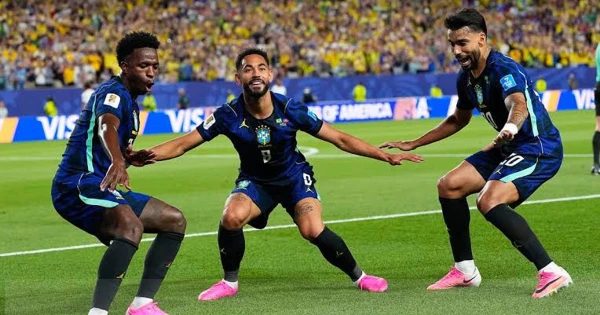
Brazil forward Antony Matheus Cunha has turned an unusual goal celebration into a global signature: a surfing-style dance along the corner flag that he and teammates now perform after scoring. What started as a hometown nod to waves and surf culture has followed Cunha from the beaches of northeastern Brazil to top European clubs and now onto soccer’s biggest stage, becoming one of the tournament’s most recognizable moments.
Cunha was born and raised in João Pessoa, a coastal city in Brazil’s northeast where beaches and surfing are part of local life. He grew up spending free time on the sand and in the water, and in recent years surfing became a serious hobby alongside football. The beach influence is visible when he celebrates — he runs to the corner flag, moves his hips and arms in a sweeping motion and mimics riding a board, a visual callback to surfing’s rhythm and balance.
The celebration resurfaced widely in the international spotlight during Brazil’s recent match against Haiti, where Cunha opened the scoring and led his teammates in the surf-inspired routine. After his second goal he added a theatrical touch: a brief dive that recalled a surfer falling from the board before quickly getting back up. Teammates joined in, turning an individual gesture into a group moment that blended sport, identity and playfulness.
Portugal's Dias Defends Ronaldo, Says Criticism Falls on Entire Squad After World Cup Draw

Cunha’s route to global prominence passed through multiple countries and clubs. He developed in Brazil before moving to Europe and taking his skills to leagues in Germany and Spain. Last season he joined Manchester United from Wolverhampton Wanderers, and goal celebrations in United’s red shirt helped cement the dance as part of his public persona. Fans and media began to associate him not only with his on-field contributions but also with a distinct ritual that links his football achievements to his beach roots.
The celebration merges personal history and cultural signaling. João Pessoa and the broader northeastern coastline of Brazil are known for vibrant coastal life; for Cunha, surfing is more than a pastime — it is a meaningful connection to home. Several teammates and friends encouraged him to translate that connection into a post-goal routine. In interviews after Premier League matches, he described how friends in Brazil teased him to improve his surfing and challenged him to “paddle up” and stand on the board. He embraced that process and brought the motif into matches.
Adapting a leisure pursuit into a celebratory act is not unique in modern football, but Cunha’s ritual stands out for its specificity and performance. It combines physical mimicry — body sways and arm movements that evoke waves — with theatrical timing that makes it memorable for broadcast and social media clips. The communal aspect, with teammates joining in, amplifies its appeal and reinforces team unity around a lighthearted moment that nevertheless underscores personal background.
The routine also highlights how footballers use celebrations for self-expression and cultural storytelling. Goal celebrations historically reflect personality, political statements, or cultural markers. Cunha’s surf dance places him in a lineage of players who use gestures to mark identity, from hometown specifics to broader national or lifestyle references. In Cunha’s case, the blend of sport and seaside preserves a narrative of origin: a professional athlete who continues to honor his formative environment.
Practical factors shape the ritual’s spread. Television replays, short-form social videos and viral sharing accelerate recognition; broadcasters’ multiple-angle coverage and social platforms’ appetite for distinctive visual hooks ensure that such celebrations travel quickly across fan bases. For clubs and sponsors, a repeatable celebratory move creates brandable moments — a consistent image that merchandise, highlight packages and promotional content can amplify.
Cunha’s move to England tested the surfing link. The country’s colder waters and less predictable sunshine make regular surfing difficult, so he returns to Brazil when possible to surf with friends and recharge. That contrast between climates reinforces the celebratory function: every goal in Europe becomes an opportunity to recreate the warmth and leisure of home. Teammates and fans have embraced the charm of the gesture, and teammates joining the dance suggest club-level support for him expressing his background.
On the field, Cunha remains primarily a forward focused on performance. The celebration follows meaningful contributions — goals that change games or open scoring — and the ritual’s recurring presence has not interfered with his play. Instead, it has become part of his public brand and how supporters and broadcasters recognize him in match highlights.
Cultural resonance also plays a role. Brazil’s national team carries global expectations for flair and distinctive style, and small theatrical touches like Cunha’s surf dance feed into broader narratives about Brazilian football’s creativity and joy. At the same time, the celebration’s light tone steers clear of controversy; it is inclusive rather than provocative, celebratory rather than political.
As the World Cup progresses, Cunha’s celebration may continue to draw attention whenever Brazil scores. Whether it remains a personal trademark or evolves into a team staple will depend on future match moments and how teammates choose to participate. For now, the surf dance offers a vivid, humanizing glimpse into the life of a modern footballer — someone whose career has spanned continents but who still carries the rhythm of his hometown beaches into international arenas.