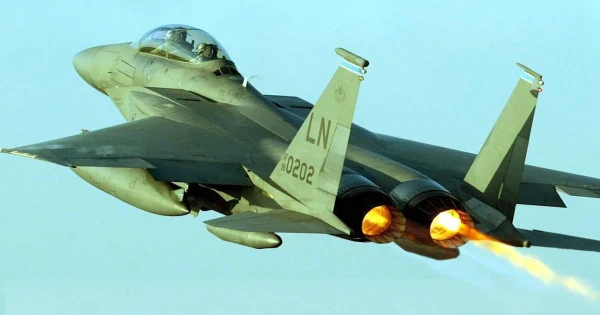
An account attributed to the pilot of a U.S. Air Force F-15E Strike Eagle that went down over Iran in April described a “jellyfish-like” formation of drones in the sky moments before the jet was lost. The image — drones moving as one, with smaller units dangling like tentacles — has prompted debate among intelligence analysts and defense experts about what the pilot may have actually seen, what such formations could mean tactically, and how to evaluate eyewitness reports made under extreme stress. The reported sighting remains unverified, but exploring what a “jellyfish” swarm might be — and what it could imply for modern air combat — offers practical context for policymakers, military planners, and the public.
Why the report matters
-
If accurate, a coordinated drone formation capable of acting like a screen or sensor layer would signal a notable operational tool in contemporary warfare.
-
If misperceived, the account still underscores the limits of human observation under duress and the need to corroborate eyewitness testimony with sensor data.
-
Regardless, the claim raises broader questions about drone tactics, countermeasures, and how to integrate lessons from asymmetric threats into air operations.

What the pilot reportedly described
-
Visual: Multiple drones “hovering” and “moving as one,” a central mass with smaller units beneath, likened to a jellyfish.
-
Function (as reported by sources): A “minefield of drones” — suggesting a defensive or area-denial purpose rather than a simple reconnaissance group.
-
Reporting caveats: The description comes from unnamed sources familiar with the debrief; the pilot suffered a concussion, and intelligence analysts reportedly disagreed on interpretation.
Could a “jellyfish” formation be real?
Yes — but not necessarily in the cinematic way the phrase implies. Several plausible explanations exist:
-
Cooperative drone formation (true swarm)
-
Definition: Drones linked by datalinks and algorithms that coordinate movement and roles in real time.
-
Capabilities: Collective sensing, distributed targeting, mutual collision avoidance, adaptive formation changes.
-
Plausibility: Nations like China and Russia have invested heavily in swarming research; the U.S. and allies have operational and developmental programs. A sophisticated swarm could present as a cohesive shape on visual observation.
-
Static or semi-static “drone screen” (barrage-balloon analogue)
-
Concept: Small drones deployed to create a physical or electromagnetic obstacle along a likely flight path — think tethered nets, explosive decoys, or a distributed sensor field.
-
How it fits the description: A large, slow-moving cluster with dangling smaller craft could look like a jellyfish and act as a “minefield” that an aircraft could fly into or trigger.
-
Practicality: Easier to field with limited autonomy; dangerous to aircraft at low altitude if drones are explosive or connected by lines.
-
Mixed systems or launched loitering munitions
-
Composition: Larger “mothership” drones controlling or carrying multiple smaller loitering munitions.
-
Appearance: A central platform with smaller units beneath could look like tentacles.
-
Use case: Launch a hunt-and-kill package to localize and attack high-value aircraft or air defenses.
-
Friendly or allied systems
-
Possibility: U.S. or allied drones conducting suppression, scouting, or decoy operations could have been present and misidentified.
-
Reason: Coalition forces deployed various aerial systems during rescue and suppression operations; unfamiliar configurations may be confusing in crisis.
-
Non-drone explanations
-
Birds, weather balloons, kites, or debris may appear drone-like, especially under stress or after injury.
-
Sensor limitations: Visual impressions should be checked against radar, infrared, and electronic-intelligence records.
How analysts weigh pilot testimony
-
Strengths: Pilots are trained observers, know aircraft signatures, and can provide immediate contextual detail.
-
Limitations: Stress, injury, and cognitive load degrade perception and recall. Ejection, concussion, and survival mode all reduce accuracy.
-
Best practice: Cross-check with multi-source data — radar tracks, signals-intelligence, imagery, satellite and ground reports — before drawing operational conclusions.
Tactical roles a drone formation could play
-
Area denial: Create a hazardous zone to deter or disable aircraft flying at specific low altitudes.
-
Sensor mesh: Use cooperative sensing to extend radar or electro-optical coverage and cue missiles or air defenses.
-
Decoy and deception: Simulate larger formations to draw fire or confuse targeting systems.
-
Kinetic attack: Use swarming loitering munitions to overwhelm point defenses or strike an aircraft that enters the formation.
Defensive and operational implications for manned aircraft
-
Flight routing: Avoid predictable low-altitude corridors where small, cheap systems can be emplaced.
-
Sensor fusion: Integrate airborne, shipborne, and space-based sensors to spot small, low-RCS (radar cross-section) objects early.
-
Electronic warfare: Harden communications, disrupt drone datalinks, and employ counter-drone jamming and spoofing.
-
Tactics: Use stand-off munitions, standoff suppression of air defenses, and increased reliance on unmanned assets for risky transits.
-
Training: Simulate degraded-sensor environments and unusual aerial clutter during pilot drills to reduce misidentification risk.
Technical hurdles and advantages for swarms
-
Hurdles: Reliable long-range datalinks, secure C2 (command-and-control), distributed autonomy, and robust anti-jamming are difficult to field at scale.
-
Advantages: Cost asymmetry (cheap drones vs. expensive aircraft), saturation of defenses, distributed sensing, and flexibility in deployment.
What we don’t know and why that matters
-
Sensor corroboration: No publicly released radar or imagery data (to date) confirms a swarming formation at the time and place of the strike.
-
Intent and origin: If drones were present, it’s unclear whether they were Iranian, allied, or opportunistic commercial platforms repurposed for conflict.
-
Effect on the strike: There is no public proof that drones directly caused the jet’s loss; missile strikes and air-defence systems remain primary suspects.
-
Attribution caution: Drawing firm technical or political conclusions from a single, unverified eyewitness account risks misreading capabilities or intentions.
How to interpret reports like this responsibly
-
Prioritize multi-source verification before using such claims to justify policy or operational shifts.
-
Treat vivid descriptions as leads, not conclusions; they guide investigation rather than settle it.
-
Remember human perception limits under duress; combine human testimony with technical records.
-
Consider plausible alternatives and avoid sensationalized narratives that outpace evidence.
Practical next steps for policymakers and military planners
-
Strengthen rapid sensor fusion capabilities to capture small-object traces in contested theaters.
-
Invest in low-cost counter-drone measures tailored to swarms and distributed screens.
-
Develop doctrine for integrating unmanned and manned assets during high-risk recoveries and transits.
-
Increase transparency in after-action reviews where possible, to build public trust without compromising classified sources.
The “jellyfish-like” drone formation reportedly seen by the downed F-15E pilot is an intriguing detail but remains unverified. Whether the image reflects an advanced cooperative swarm, an improvised drone screen, allied activity, or a misperception under stress, the episode highlights enduring lessons: the growing tactical influence of small unmanned systems, the need for robust sensor corroboration, and the importance of adaptive countermeasures for manned aviation. For military planners and public audiences alike, the sensible takeaway is to treat such accounts as prompts for investigation and preparedness rather than as definitive proof of a new battlefield paradigm.