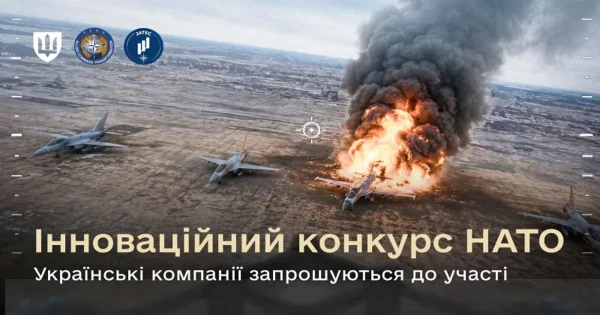
NATO and Ukraine have opened the Airfield Denial Challenge to the private sector, seeking practical systems to deny Russia use of its airfields. The Airfield Denial Challenge offers a €250,000 prize to companies or teams that can demonstrate credible, rapidly fieldable solutions to disrupt runways, fuel depots, and ground support infrastructure. NATO’s move reflects a growing belief that only a blend of military financing and private-sector innovation can shift the balance against Russia’s ability to launch lethal tactical airstrikes from rear-area bases.
Why the Airfield Denial Challenge matters
Russia’s advantage in sustained tactical aviation operations stems from airfields largely out of reach of Ukraine’s conventional strike assets. These bases enable cruise missiles, guided bombs, and stand-off munitions that threaten Ukrainian forces and civilian infrastructure. NATO’s Headquarters Supreme Allied Commander Transformation (SACT) framed the problem: point strikes and single loitering munitions lack the persistence, mass effect, and electronic-warfare resilience needed to suppress defended airfields.
The Airfield Denial Challenge is a strategic pivot: rather than rely solely on state-run procurement, NATO and Ukraine are inviting miltech startups, engineering teams, and private inventors to produce disruptive capabilities fast.

Technical requirements and constraints
SACT set a strict technical brief so submissions can work in contested theaters:
-
Operate reliably in GPS-denied and EW-contested environments.
-
Function across all-weather conditions and seasons.
-
Demonstrate a credible path to rapid fielding—solutions requiring more than one year to deploy will be excluded.
-
Provide sustained strike capability deep into contested airspace.
-
Operate with reduced continuous human control; autonomy or semi-autonomy is preferred.
-
Deliver mass and precision sufficient to suppress multiple aim points (runways, fuel, munitions, ground support).
-
Require minimal operator training and use AI-assisted target acquisition to reduce reliance on expert judgment.
-
Be in mid-to-upper military TRL, from high-fidelity lab integration to prototype-near-operational systems.
Acceptable solution classes (non-exhaustive)
SACT explicitly named several technology classes it wants to see, but the challenge remains technically agnostic:
-
Uncrewed aerial systems (UAS) of any configuration or range.
-
Autonomous or semi-autonomous munitions and loitering systems.
-
Swarming and mass-effect approaches that saturate defenses.
-
Alternative delivery mechanisms beyond conventional aerial platforms.
-
Hybrid solutions that combine kinetic, cyber, EW, and physical infrastructure denial.
Operational logic: persistent denial over reactive strikes
SACT emphasizes that the battlefield logic requires persistent denial at the source rather than intermittent, reactive interceptions. The goal is not merely to knock out a single sortie but to impose sustained degradation—rendering runways unusable, destroying fuel and ammo reserves, and neutralizing ground support systems so that airfields cannot rapidly regenerate capability.
This persistence requirement drives interest in swarm architectures, autonomous loitering weapons with resupply or rearming capability, and multi-domain hybrid tactics that fuse kinetic strikes with cyber or EW effects to prolong disruption.
Commercial incentives and high-impact ad verticals
From an AdSense and high-CPC perspective, the challenge intersects high-value commercial sectors: defense contracting, aerospace engineering, AI and autonomy, counter-drone technologies, and advanced manufacturing. Keywords tied to procurement, TRL, defense grants, and miltech commercialization typically attract high-paying ads for consulting, contracts, simulation software, and specialized components.
Practical hurdles and realistic timelines
Despite Ukraine’s prolific wartime innovation—pioneering drones and improvised loitering munitions—several practical challenges undermine rapid, large-scale impact:
-
Funding and industrial scale: Ukraine’s constrained budget and limited mass-production capacity slow deployment even for promising prototypes.
-
Countermeasures: Russia will adapt with improved airfield defenses, dispersal, and hardened infrastructure, raising the bar for persistence and precision.
-
Logistics and sustainment: Systems that degrade airfields must also be maintainable, re-suppliable, and resilient in contested supply-chains.
-
Legal and escalation risks: Persistently targeting rear-area airfields raises escalation and attribution concerns, complicating multinational sponsorship.
Timeline and selection process
The solicitation sets tight deadlines: submissions due July 20, ten finalists chosen by August 11, and a Sept. 3 pitch day (tentatively in Poland). Any submission must show a plausible path to fielding within a year—eliminating many concept-stage ideas but encouraging near-term prototypes and ready-to-integrate components.
What winning solutions might look like
Winning entries will likely blend mature technologies into novel architectures. Possible high-probability candidates include:
-
Autonomous swarm packages that overwhelm point defenses through sheer numbers and distributed attack vectors.
-
Loitering munitions integrated with onboard AI to autonomously target multiple aim points and re-task mid-mission.
-
Hybrid kinetic-EW systems that simultaneously deny runways (kinetic damage) and degrade navigation or communications (EW) to prevent repair and reconstitution.
-
Rapid-deploy modular “runway denial” kits using engineered cratering charges or chemical/physical surface treatments that impede landing operations.
Key takeaways (bullet summary)
-
NATO and Ukraine launched the Airfield Denial Challenge offering €250,000 to private-sector solutions.
-
Focus: persistent denial of Russian airfield operations via autonomy, swarms, and hybrid approaches.
-
Required: operation in GPS/EW-denied environments, multi-point mass effect, rapid fielding (<1 year).
-
Barriers: limited Ukrainian production capacity, Russian counter-adaptation, legal and escalation considerations.
-
High commercial interest: defense contracting, AI autonomy, counter-UAS, and aerospace supply chains.
Verdict and implications
The Airfield Denial Challenge recognizes a clear operational gap: without persistent, scalable ways to deny airfields, Russia will retain a decisive strike capability. Inviting private-sector ingenuity could accelerate practical solutions, but turning prototypes into theater-altering systems requires funding, production, and supply-chain scale that Ukraine alone struggles to provide.
If NATO channels procurement and industrial support toward successful finalists, the challenge could produce effective stopgaps that blunt Russian tactical aviation. Even so, measurable impact will depend on rapid scaling and the ability to adapt as adversaries counter new technologies.
The Airfield Denial Challenge represents a strategic bet on private innovation to solve a stubborn operational problem: how to permanently limit the enemy’s use of aviation infrastructure. Whether €250,000 and NATO’s convening power are enough to deliver game-changing systems remains uncertain, but the call to industry could catalyze hybrid, autonomous solutions with real battlefield utility. Share your thoughts below: do you think private sector innovation can sustainably deny airfields in modern warfare?