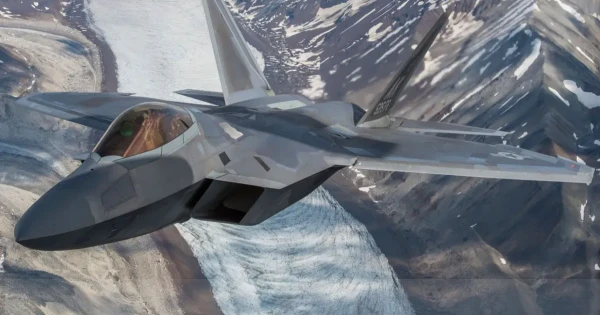
The Air Force is planning a sweeping recapitalization of Joint Base Elmendorf–Richardson (JBER) — long nicknamed “Fightertown” — that would reshape runways, hangars, munitions handling, housing and training infrastructure to support next-generation fighters, sustained operations in the Arctic and faster deployments across the Pacific. Framed as a comprehensive “campus” build rather than a set of piecemeal projects, the effort signals a durable shift in U.S. force posture: Alaska is becoming a logistics, training and deterrence hub designed to withstand modern missile and drone threats while enabling sustained power projection into the high north and Indo-Pacific regions.
Why this matters
JBER’s location makes it a link between North America, the Arctic and the Indo-Pacific — regions whose strategic relevance has grown because of great-power competition, new polar sea routes, and rising activity by Russia and China. Modernizing JBER is about more than new hangars; it’s about ensuring mission continuity under attack, moving and sustaining forces across vast distances, and training at scale in the world’s largest instrumented range. The implications touch readiness, deterrence and the U.S. military’s ability to defend the homeland and operate in contested environments.
What the Fightertown recapitalization proposes

A complete campus, not a collection of projects
-
Coordinated master plan covering airfield, operations, logistics, personnel and training infrastructure.
-
Synchronization with aircraft procurement, deployments and sustainment cycles.
-
Design flexibility, including modifications or demolition of existing facilities.
Core infrastructure elements
-
Aircraft hangars and squadron operations facilities sized for current and future platforms.
-
Corrosion control and maintenance shops tailored to harsh Arctic conditions.
-
Extensive airfield upgrades: new taxiways, aprons, shoulders and specialized aircraft operating surfaces.
-
Hardened and semi-hardened aircraft shelters to reduce vulnerability to missiles, rockets and drones.
-
Munitions complex and secure petroleum, oil and lubricants (POL) operations.
-
Warehousing, supply distribution, dining facilities, visitor control and firefighting capability.
-
Training centers and full-motion simulators for integrated crewed and uncrewed operations.
-
Housing for unaccompanied airmen and improved quality-of-life infrastructure.
Strategic drivers behind the program
Arctic and Pacific geography
-
Proximity to the Arctic: warming sea lanes, contested outposts and increased strategic activity require persistent surveillance and response capabilities.
-
Gateway to the North Pacific: JBER enables reach of ISR, long-range strike and air-refueling assets into the Indo-Pacific theater.
Operational resilience and survivability
-
The program emphasizes measures to reduce single-point failures and preserve sortie generation under attack.
-
Reintroduction of hardened aircraft shelters and dispersed basing concepts reflects renewed concern about cruise and ballistic missiles, and loitering munitions.
-
Investments in fuel, munitions and repair capacity improve the base’s ability to operate through sustained conflict.
Training and force integration
-
JBER supports major exercises such as Red Flag-Alaska and Northern Edge, which replicate complex, multi-domain fights at scale.
-
Access to the Joint Pacific Alaska Range Complex (JPARC), with more than 67,000 square miles and 77,000 square miles of airspace, offers unique training that increasingly cannot be replicated elsewhere.
-
Plans envision infrastructure to host and integrate crewed sixth-generation fighters, unmanned systems and ISR platforms into large-force training and operations.
How the Air Force plans to execute construction
Alternative contracting and industry innovation
-
The Army Corps of Engineers’ market-research notice indicates a preference for flexible authorities from the Fiscal Year 2026 National Defense Authorization Act.
-
Potential vehicles include Other Transaction Authority (OTA) and Progressive Design-Build (PDB), aimed at accelerating schedules and encouraging innovative technical solutions.
-
The government signals intent to reduce traditional federal contracting overhead and invite industry proposals that blend technical innovation with cost and time efficiencies.
Practical infrastructure and program considerations
Environmental and logistical realities
-
Alaska’s climate, permafrost and seasonal constraints drive specialized design choices: corrosion control, heated hangars, and pavement engineering appropriate for freeze-thaw cycles.
-
Transportation of construction materials and heavy equipment faces limited windows of accessibility; building sequencing must account for weather, barge schedules and airlift availability.
Base modernization vs. community impact
-
Large modernization projects can stress local infrastructure, housing markets and services; effective base-community coordination will be necessary to manage personnel movements and construction labor demands.
-
The government may need to balance on-base housing with off-base partnerships, workforce development and contractor accommodations.
Security and continuity planning
-
Hardened operations centers, redundant power and communications, and dispersed maintenance nodes reduce vulnerability.
-
Fuel and munitions storage design must meet stringent safety and security standards while supporting rapid sortie generation.
What this means for future airpower at JBER
-
F-22 sustainment and potential basing of future sixth-generation fighters (often referenced as the F-47 in service planning) would drive hangar sizing, maintenance tooling and data/integration infrastructure.
-
Increased presence of RC-135 Rivet Joint and other ISR platforms will require secure intelligence handling, mission planning facilities and runway capacity for larger aircraft.
-
A scaled-up Fightertown would anchor deeper Pacific force posture, allowing the U.S. to conduct persistent ISR, rehearsed massed sorties and joint operations from the high north down into the Indo-Pacific.
Common questions and realistic expectations
Will modernization make JBER invulnerable?
No base is invulnerable. The plan reduces vulnerabilities through hardening, redundancy and dispersal, but risks remain. Modern infrastructure raises the cost and complexity for adversaries and buys time and operational redundancy.
How soon will new facilities appear?
Design stages are underway; timelines hinge on budget appropriations and procurement authorities. Using OTA and progressive design-build can speed delivery, but large airfield and hardened construction still requires multi-year efforts.
Will the project change local life in Anchorage and nearby communities?
Large construction and increased personnel can magnify local economic activity but also strain housing, schools and services. Early engagement and coordination with municipal leaders can mitigate negative impacts and amplify benefits, such as job creation and infrastructure investment.
Actionable implications for defense planners, industry and the public
-
Defense planners: Prioritize resilience measures that integrate basing, logistics and training to maintain operations under duress.
-
Industry partners: Prepare proposals that pair rapid delivery approaches with Arctic-capable construction methods and lifecycle sustainment plans.
-
Local stakeholders: Engage early in base planning to shape workforce pipelines, housing strategies and environmental mitigation that align community and defense needs.
What to watch next
-
Industry day briefings and solicitation details will reveal technical priorities, expected timelines and procurement models.
-
Budget appropriations will determine project scope and sequencing; tracking Congressional defense funding decisions will be essential for realistic schedule expectations.
-
Technical studies about Arctic construction and energy resiliency will influence final designs, especially for runway and shelter hardening.
Conclusion
The Fightertown Alaska recapitalization reflects a strategic choice: invest in resilient, scalable infrastructure where geography gives the U.S. a distinct operational advantage. By redesigning JBER as an integrated campus capable of supporting advanced fighters, ISR platforms and large-scale training on JPARC, the Air Force is preparing for a future in which Arctic access, distributed operations and survivable basing matter as much as the aircraft themselves. For planners, industry and Alaskans alike, the project offers both opportunity and responsibility — to build infrastructure that meets modern threats, supports high-intensity training, and does so in a way that endures in a harsh environment for decades.