President Donald Trump abruptly canceled a planned signing ceremony for a sweeping bipartisan housing affordability bill on Wednesday, stunning lawmakers from both parties and throwing a rare legislative achievement into uncertainty. The president announced on Truth Social that he would not sign the 21st Century ROAD to Housing Act into law until Congress passes the SAVE America Act, an election reform bill that has stalled in the Senate.
The housing legislation, which cleared the House by a vote of 358-32 and the Senate 85-5, represents the most comprehensive effort to address housing costs in decades. Its passage through both chambers marked a rare moment of bipartisan cooperation in a deeply divided Congress.
Trump’s last-minute decision to withhold his signature blindsided Republican leaders who had planned to use the bill as a key achievement heading into the November midterm elections. The president had previously endorsed the measure, which includes provisions he supported, such as limiting institutional investors from purchasing single-family homes.

Senator Warren Expresses Frustration
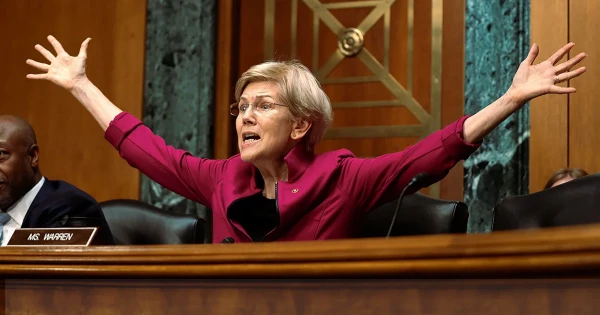
Senator Elizabeth Warren, the Massachusetts Democrat who co-authored the legislation alongside Senator Tim Scott of South Carolina, reacted with visible disbelief when asked about the president’s decision during an appearance on CNBC’s "Squawk on the Street."
"I’m sorry, if you’re asking me to get into Donald Trump’s head and figure out what’s going on there, you need somebody else," Warren said. "I just, I don’t have any idea. This just doesn’t make any sense, other than whatever it is he wants to do, it’s a complete indifference to the cost squeeze on American families and to genuine efforts to do something about it."
Warren, who played a driving role in negotiating the bill’s passage alongside her Republican counterpart, emphasized that the legislation represents the kind of bipartisan work Americans expect from their government. She accused the president of prioritizing his political agenda over the needs of working families struggling with rising costs.
"He could be over here trying to claim a victory lap and instead he’s saying no, no, he doesn’t want anything to do with it," Warren said. "It’s because he really doesn’t care about American families and doesn’t care about the fact that prices are up and the promises he made to lower costs on day one have not only come to nothing."
President Links Housing to Election Reform
In his Truth Social post, Trump framed the SAVE America Act as a national emergency requiring immediate congressional action. "Today’s Housing News Conference and Signing is hereby cancelled until such time as we pass the desperately needed SAVE AMERICA ACT, which I consider to be a National Emergency," he wrote.
The SAVE America Act would require individuals to provide proof of citizenship and photo identification to cast their ballots, imposing strict new federal requirements on voter registration and participation. The measure has passed the House multiple times but has encountered significant hurdles in the Senate, where Republican leaders have acknowledged they lack the necessary votes to advance it.
Senate Majority Leader John Thune of South Dakota appeared caught off guard by Trump’s announcement. When asked about the cancellation, Thune told reporters, "I just heard that. I guess I would say, at this point, I don’t have any observations about that."
House Speaker Mike Johnson indicated he had spoken with Trump earlier Wednesday and expects the president to eventually sign the housing bill. Johnson said he is exploring options to pass the SAVE America Act through budget reconciliation, a process that would allow the measure to bypass the Senate’s 60-vote threshold, though the Senate parliamentarian has previously ruled the legislation does not meet reconciliation requirements.
Bipartisan Achievement on Hold
The 21st Century ROAD to Housing Act includes more than 45 provisions aimed at increasing housing supply and lowering costs for American families. Among its key elements, the bill would cap the number of single-family homes large institutional investors and private equity firms can purchase, addressing growing concerns about corporate ownership driving up home prices.
The legislation also establishes a $200 million per year Innovation Fund to reward localities that increase housing supply, provides grants to help local governments convert vacant commercial properties into affordable housing, and streamlines environmental reviews to accelerate development. Additional provisions expand access to small-dollar mortgages, promote manufactured housing, and support housing opportunities for veterans.
Republican lawmakers had been eager to tout the bill’s passage as evidence they are addressing affordability concerns that rank among voters’ top priorities heading into the midterms. The president’s decision to delay the signing has frustrated GOP members who worked to pass the legislation.
Republican Senators Express Confusion
The president’s move has deepened tensions between Trump and Senate Republicans, who have already clashed over legislative strategy and policy priorities in recent weeks. Several GOP senators expressed bewilderment at the decision to hold the housing bill hostage to election reform legislation that lacks sufficient support.
Senator Thom Tillis of North Carolina told reporters the situation "makes no sense" and accused the president of handing Democrats a political victory. "This housing bill was a very clear, bipartisan effort to address some of the basics of affordability, and we are here," Tillis said. "It makes no sense."
Senator Bill Cassidy of Louisiana, who has become increasingly critical of the president, noted that affordability is what voters truly care about as he entered the Senate Republican luncheon. Trump was scheduled to meet with Senate Republicans at the Capitol on Wednesday, though it remained unclear how the cancellation would affect those discussions.
Constitutional Implications
Under the Constitution, a bill that has passed both chambers of Congress automatically becomes law if the president does not sign or veto it within 10 days, excluding Sundays, as long as lawmakers remain in session. The White House has not indicated whether Trump intends to veto the legislation or allow it to become law without his signature.
Trump’s earlier social media posts referred to the housing bill as "the Elizabeth 'Pocahontas' Warren centric housing bill," downplaying its significance compared to the SAVE America Act. He described the housing measure as "of minor importance compared to lower interest rates" and insisted that election reform must take priority.
Economic Context and Political Stakes
The housing affordability crisis has become a defining issue for American families, with home prices and rents climbing sharply in recent years. High interest rates, limited housing supply, and rising construction costs have pushed homeownership out of reach for many middle-class families and first-time buyers.
The 21st Century ROAD to Housing Act was designed to address these challenges through a combination of regulatory reform, financial incentives, and targeted investments. Its passage through Congress represented a rare instance of Democrats and Republicans finding common ground on a major policy initiative.
By canceling the signing ceremony, Trump has denied Republicans a high-profile accomplishment they had hoped to campaign on in the midterms. Some Republican strategists have expressed concern that the decision could undercut their message on affordability and give Democrats an opening to criticize the administration’s priorities.
Warren Criticizes President’s Economic Record
Warren used the cancellation as an opportunity to criticize Trump’s overall economic record, pointing to rising costs across multiple sectors. "Prices are higher on groceries, prices are higher on health care, prices are higher on virtually everything that Americans buy because of Donald Trump’s policies," she said.
The senator argued that Trump’s decision to shelve the housing bill demonstrates a lack of concern for the financial pressures facing working-class families. She noted that the legislation had been carefully crafted through bipartisan negotiations and represented a genuine effort to address the housing affordability crisis.
"This is serious for the young family that can’t buy a home, the renter who sees his rent going up and doesn’t know how he’s going to cover both health insurance and rent," Warren said. "This is serious business. It is one big effort to lower costs, and Donald Trump doesn’t want to be anywhere near it."
Looking Ahead
The fate of the housing legislation remains uncertain as lawmakers await clarification on whether Trump intends to veto the bill or allow it to become law without his signature. The bill passed with veto-proof majorities in both chambers, meaning Congress could override a presidential veto if it came to that.
Meanwhile, the SAVE America Act’s prospects in the Senate appear dim, with Republican leaders acknowledging they lack the votes to advance the measure. The standoff between the president and Senate Republicans over the election reform legislation shows no signs of resolution, leaving the housing bill in legislative limbo.
For American families struggling with housing costs, the uncertainty surrounding the legislation represents yet another obstacle in an already challenging economic environment. The bill’s supporters continue to press for its enactment, arguing that the need for affordable housing cannot wait for political negotiations to play out.