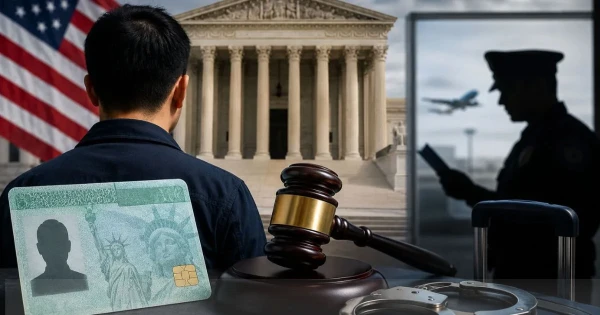
The Supreme Court issued a landmark 6-3 ruling on Tuesday that significantly expands the power of border officials to deny re-entry and initiate deportation proceedings against lawful permanent residents, commonly known as green card holders, who are suspected of certain crimes. The decision, which strengthens the hand of federal immigration authorities, determines that officers at ports of entry are not required to have "clear and convincing evidence" of a crime before treating a returning resident as an applicant for admission. Instead, the ruling establishes that a "reason to believe" such an offense occurred is sufficient to trigger the process, a shift that has profound implications for millions of permanent residents in the United States .
The case at the center of this ruling, Blanche v. Lau, originated with Muk Choi Lau, a Chinese national who has been a lawful permanent resident of the United States since 2007 . In 2012, Lau traveled to China while facing pending trademark counterfeiting charges in New Jersey . Upon his return to John F. Kennedy International Airport, customs officers did not admit him as a returning resident. Instead, citing the pending charges, they paroled him into the country—a legal distinction that carries significant consequences, including the potential loss of access to documents required for work and residency .
Lau later pleaded guilty to the counterfeiting charges and was subsequently ordered deported. He contested the removal, arguing that the border officers lacked the authority to deny him returning resident status without "clear and convincing evidence" of a crime, such as a conviction or confession, at the time of re-entry . The Supreme Court, however, rejected this argument, stating that federal immigration law does not impose that requirement on border officials . Justice Clarence Thomas wrote for the majority, clarifying that the government can establish the actual criminal conviction later during formal deportation hearings, effectively allowing the initial denial of re-entry based on a mere suspicion or pending allegation .
Trump Shelves Bipartisan Housing Bill Signing, Demands Action on Voter Integrity Legislation

Prior to this ruling, several lower courts had required immigration officers to meet a higher evidentiary standard before reclassifying a green card holder as an "applicant for admission." This new interpretation empowers border agents to treat returning permanent residents as if they are seeking admission for the first time, based solely on a pending charge or an indication of a possible crime . This classification is not a mere formality; it fundamentally shifts the legal burden of proof. Once an individual is designated as an applicant for admission, the onus falls on them to prove they are legally entitled to enter and remain in the country, rather than on the government to prove they should be excluded . This procedural shift can lead to immediate parole, detention, or the initiation of removal proceedings long before a criminal case is resolved .
A "Massive Blank Check" for Immigration Enforcement
The ruling drew a sharp and forceful dissent from the Court's liberal wing, with Justice Ketanji Brown Jackson, joined by Justices Sonia Sotomayor and Elena Kagan, warning that the decision grants the government a "massive blank check" to strip green card protections based on allegations rather than proof . Justice Jackson argued that the ruling allows the government to effectively retroactively justify a border decision with a conviction obtained after the fact, a sequence she says "undermines the plain terms and basic operation of the law" . She emphasized the fundamental American principle that all are innocent until proven guilty, noting that Lau was divested of his already-admitted status and paroled solely on the basis of an indictment .
Practical Implications for Green Card Holders
The practical takeaway for lawful permanent residents is significant, particularly for those with any criminal history, pending charges, or arrest records . The ruling does not change the substantive grounds for deportation, but it dramatically lowers the evidentiary threshold for initiating the process at the border . For the majority of green card holders with no criminal record, the ruling may have little to no effect. However, for those with prior convictions—even for old, seemingly minor offenses—or pending allegations, the stakes of international travel are now considerably higher .
Immigration attorneys are warning that the decision creates a chilling effect on travel for green card holders with any blemishes on their record . A pending charge for a "crime involving moral turpitude"—a broad category including fraud, theft, and certain other offenses—is now a powerful trigger for border agents to act . Those who are reclassified as applicants for admission may have their physical green cards confiscated, be placed in "immigration limbo," or face mandatory detention without the right to a bond hearing . For Indian Americans, who represent a significant portion of the green card-holding population, this ruling adds a new layer of risk to international travel, particularly for those navigating the U.S. legal system . Legal experts strongly advise any green card holder with a criminal background or pending legal issues to consult an immigration attorney before leaving the country, as a routine trip abroad could now expose them to unexpected and severe immigration consequences .