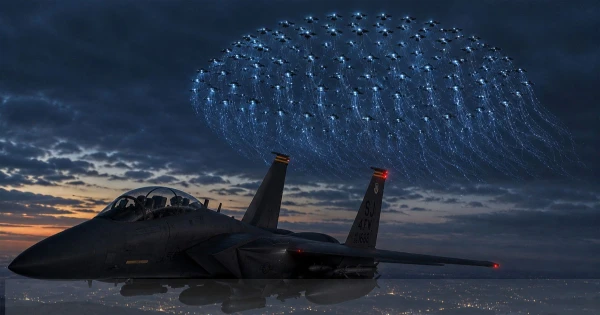
During a high-stakes mission over Iran this past April, a U.S. Air Force F-15 fighter jet was struck and shot down, forcing its pilot to eject over hostile territory. While the rescue of the aircrew ultimately succeeded, the events leading up to the crash have ignited a fierce debate among American intelligence officials. At the center of the controversy is the pilot’s account of what he saw in the sky just moments before his aircraft was lost: a swarm of Iranian drones moving in a highly unusual and coordinated formation that he described as resembling a "jellyfish."
The pilot’s experience was detailed during a classified intelligence debrief following his rescue, though the specifics of his testimony have only recently come to light. According to sources familiar with the debriefing, the formation was unlike any known drone activity previously documented by U.S. forces. The pilot described multiple unmanned aerial vehicles operating in perfect synchronization, appearing to function not as individual units, but as a single, cohesive organism.
One source who reviewed the pilot’s statement recounted the description in stark terms. The aviator noted that several larger drones appeared to move as one entity, with smaller drones trailing beneath them in a manner reminiscent of legs. The source characterized the pilot’s reaction to the spectacle as one of profound disbelief, noting that the aviator commented on the otherworldly nature of the formation. The pilot further described the surrounding airspace as a veritable "minefield of drones," suggesting that the skies were saturated with these interconnected threats.

If validated, the pilot’s observations could represent a significant leap forward in Iran’s drone warfare capabilities. The technology implied by this type of operation is known as "one-to-many meshed networking." This advanced system would allow a single operator on the ground to control a vast number of drones simultaneously, creating a swarm that can navigate, communicate, and potentially attack as a single, adaptive unit. Such a capability would mark a departure from conventional drone operations, which typically rely on one-to-one control.
The exact mechanism that brought down the F-15 remains under active investigation. However, initial assessments by military analysts suggest that the sophisticated drone formation may have played a direct role in enabling Iran to successfully target the American aircraft. The F-15 was carrying two crew members: a pilot and a weapons systems officer. In the immediate aftermath of the crash, U.S. forces initiated an urgent rescue operation to recover the downed aviators.
The pilot was successfully recovered within hours of ejecting from the stricken jet. The weapons systems officer endured a more arduous ordeal, surviving alone in the mountainous terrain for over a day before being rescued. It remains unclear whether the second crew member had a visual on the drones prior to the aircraft’s demise, as his debriefing has not been publicly detailed in conjunction with the pilot's account.
This incident holds historical weight, marking the first time a U.S. fixed-wing aircraft has been shot down over Iran during the current period of conflict. The peril of the situation was further underscored by the loss of a second U.S. aircraft, an A-10 Thunderbolt, which was operating in support of the rescue mission. Fortunately, the pilot of that aircraft was able to eject safely after the A-10 went down in international airspace.
Despite the pilot’s vivid and chilling account, the U.S. intelligence community is reportedly split on how to interpret the event. A significant point of contention lies in the physical state of the pilot at the time of his debrief. Medical evaluations confirmed that he suffered a concussion as a result of the ejection and subsequent landing. Furthermore, this incident was the pilot’s second time being shot down during the Iran war, with his previous loss involving a friendly-fire engagement with Kuwaiti forces.
These factors have led some officials to question the reliability of the pilot’s perception under extreme duress. During the debriefing, intelligence officers reportedly pressed the aviator on the certainty of his observations, asking him to confirm whether he was truly sure of what he had witnessed. This internal skepticism highlights the profound implications of accepting the pilot’s account as fact, as it would necessitate a reassessment of Iran’s technological prowess.
The debate arrives at a delicate moment in international relations, as Washington and Tehran are engaged in ongoing negotiations aimed at de-escalating the conflict. While these talks have primarily centered on Iran’s nuclear program, the emergence of advanced drone capabilities has become a pressing security concern. Prior to this incident, U.S. intelligence assessments had not indicated that Iran possessed the capability to coordinate drones in such a complex, swarm-like formation.
However, Western defense experts have long expressed concern over Iran's burgeoning drone program, which has reportedly benefited from technological assistance provided by both China and Russia. If Iran has indeed mastered the art of coordinated drone swarms, it could pose a formidable challenge to U.S. forces and regional allies. The ability to deploy a coordinated swarm carrying explosives would allow for complex attacks designed to overwhelm traditional air defense systems.
Defense analysts warn that preparing for such a threat would require massive financial investment and a strategic overhaul. The potential cost to develop countermeasures against a swarm capable of coordinating attacks and holding resources in reserve to strike again is staggering. Such a system would represent a revolutionary approach to aerial warfare, making it difficult to defend against using current tactics. The ongoing investigation into the F-15 incident underscores the high stakes involved, as U.S. officials work to determine whether they are facing a new and dangerous reality or a misinterpretation of a more conventional threat.